Tag: OER

open with care

Fine craft by Anne-Marie Scott. Image  Creative Commons CC-BY
Fine craft by Anne-Marie Scott. Image Creative Commons CC-BY

Next week is Open Education Week March 9-13th 2015.

Last week I was contributing to face to face (at Open Educational Practice Scotland OEPS steering group) and online discussions  (comments on How Sheila Sees it) about the difference between open educational practice (OEP) and open educational resource practice (OERP).  I imagine it will come up again this week when I am speaking at the Coursera Partners Conference.

The challenge for me, is that in discussions of OEP the ‘open’ seems very ill defined. It can encompass a full range of open approaches and does not necessarily involve any consideration of content licencing.

In OER, the open is more clearly defined.  e.g Open definition, OER Commons, Open Education Week,  as it relates to content, data etc. It is content made available to be shared, used and modified. This is why Creative Commons is doing so well; there is now a way for anyone to make their content explicitly open.

What I liked about the early JISC OER projects was the explicit challenge to release a significant amount of content from within your institution, and ideally for that process to become mainstreamed and sustainable. It meant the technologists and content owners ( academics) worked together with the lawyers and librarians/collections to release stuff at scale, either old stuff or really new stuff mostly.

Academic staff development people always tell me that teaching and learning isn’t about content, but I kinda think it is. That’s why we have libraries full of published content, and reading lists, and course packs, and slides, and handouts, and recordings,and datasets and we constantly produce and publish more as we research and teach.  And we get promoted because of it. Our students produce a bunch too, and sometimes we assess it.

As an ex- academic staff developer myself, I’d say academic staff development people don’t produce much discipline content and are notoriously bad at using each others’ so they are not big OER producers. They are more into OEP now which is such a wide concept that their expertise is needed to develop it as an area of practice.

I like OER practice. I like the rigour of defining and working within something that ‘is’, knowing what ‘is not’.  I think it is really interesting and challenging to help people to find , make and use resources, and to be literate in their use of open content. And I like to mainstream it in ways which lower the barrier to participation in OER production as much as possible. I like to put systems and workflows in place. The more wonderful, unique stuff gets out there on an open licence, the more there will be for me and others to use.

During Innovative Learning Week, we ran the first of our ‘Making open courses using open resources’  workshops at Edinburgh.  In theory that task should be much easier than it was 5 years ago. There are 900 million Creative Commons-licensed works, up from  400 million in 2010.

We’ll present at OER15 about how we got on.


first charity shop

Photo taken by me in the street. No rights reserved.

During our Wikipedia editathon last week I discovered archive news  reports of the first ever Scottish charity shop. Ten years before the first Oxfam shop in Oxford. I was editing a new page about the University of Edinburgh Settlement.

In 1936 Grace Drysdale made a film about the everyday activities of the Settlement community and proposed the creation of a ‘Thrift shop’ based on an American idea. The shop would receive items that people did not want, and would accept anything from ‘luggage to cooking utensils’.[11]

A Thrift Shop committee was established in 1936, and the first shop ‘Everybody’s Thrift Shop’ opened in April 1937 at 79a Nicholson Street,[12] 10 years before Oxfam established their first charity shop in 1947. In 1938 the thrift shop was reported as being ‘a more ambitious application of the jumble sale idea’.

When the shop first opened it was a great success. People queued for an hour beforehand in anticipation and policemen were on hand to ensure the stall-holders were not overwhelmed. Reports confirm that bargains: crystal, evening shawls and furniture were to be found and that one woman left delighted with ‘a handsome suit once worn it was whispered, by a professor’.[12] Women carrying bulky purchases were ushered out to make room for other shoppers.

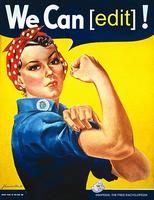
we can [edit], yes we can

IMG_2147 copy
We can edit and we can eat cake. Picture taken by me, no rights reserved, and no leftovers.

The Women, Science and Scottish History editathon‘ series of events in Innovative Learning Week at University of Edinburgh was a great success. We ran sessions on 4 days, had plenty of new students, staff and friends join us, edited more than 30 articles and trained dozens of novice wikipedia editors.

Each day, the one-hour introduction to editing Wikipedia focused on offering tips and insight into different approaches as well as practical training. Participants were welcome to  attend as many days as they would like: everyday we  added something new. Our Wikimedia trainers (principally Ally, the Wikimedian in Residence at the National Library of Scotland)  was on hand  to provide assistance, and our librarians ( Marshall, Gavin and Grant)  provided specialised materials focusing on the subjects covered.

Knowledge was shared openly. Articles  were created or improved. Networks of connections were made and  shared topics of interest explored.   Copious cake and cookies were eaten, and a fun time was had by all. We plan to do further events and some research to maintain and sustain momentum and support our fledgling crowd community. In December, at  the EduWiki conf  Ally reported that she had not seen much engagement  from University of Edinburgh in Wikipedia projects . At least that’s changed.


The hashtag was #ILWeditathon. Read Our story in a storify

Articles improved

Articles created

european community engagement

Me at ScotlandEuropa

I spoke in Brussels this week about University of Edinburgh’s leading role in developing and delivering innovation in higher education. The LERU league of European research institutions is an unashamedly closed club of 21, but occasionally they have open-ish meetings and this one was packed, so it was an interesting and interactive session. This particular meeting was at Scotland House, so I felt like I was representing up.

The meeting was focussed around the briefing paper which was written while I was working at Oxford, so it was fun to respond to it on behalf of Edinburgh now that I work here.

I spoke mostly about the unique positions held by the research institutions in engagement with their communities near and far and about the channels for translating research with social relevance.

Earlier in the meeting there had been much conservative concern and warnings (from those not doing MOOCs) that doing MOOCs was not worthwhile. The presentations from Leiden and Edinburgh about our MOOC success and mission relevance perked everyone up again.

I spoke about how involvement in the emerging area of MOOCs is inline with our three- part core mission: teaching, research and innovation. Our teaching in our MOOCs is strongly influenced by research we do about our MOOCs, is innovative, and the platforms we work with are informed by knowledge transfer in educational technology development.

We are motivated to inspire the citizens and leaders of tomorrow to be curious, driven, responsible and capable of academic thinking. I spoke about the U21 Critical Thinking in Global Challenges shared online course (SOC) which builds upon and runs parallel to, our MOOC of the same name. We are taking the opportunity to strategically extend our online learning opportunities to learners or co-enquirers outside our university. Universitas 21 also has 21 members, and some of them are the same as the LERU 21 members, but many are not. Nice to see colleagues from Amsterdam and Lund.

I talked about how we strategically work collaboratively with other institutions, and with commercial partners in the delivery of online learning. I mentioned our increasing strategic closeness with SRUC and their contributions to our growing stable (or barnyard) of horse, animal and chicken MOOCs*.  I mentioned our partnership work with national museums, the Scottish Government and the Edinburgh Festivals.

What struck me though, was that the hype is fading around MOOCs and the idea that this is going to transform the business of higher education  by opening it up to all has passed. It increasingly becomes attractive to those big brands who are getting the strategic benefit of these international platforms to  discourage other from getting into the same space.  Colleagues from Leiden agreed.

Doing MOOCs well is very difficult and very expensive. Unless you have excellent teams, which we do, it won’t be a success.

In fact, if you work at any of the other LERU institutions you should certainly heed all the advice in the LERU paper and not rush into it.


*Leiden have chosen Sharia law and international terrorism as their MOOC topics. That makes ours look actually rather tame.

learn to edit Wikipedia and change the way the stories are told

Rosie the Editor
Rosie the Editor

All welcome.

Join us at our women in science Wikipedia Editathon  each afternoon 16-19th Feb

Have you ever wondered why the information in Wikipedia is extensive for some topics and scarce for others?

Did you know that the Edinburgh Seven were the first women to matriculate to study medicine in HE in the UK? Do you know when? Do you know their names and the things they went on to do? Do you know about the Surgeons Hall riot?

Did you know that of the 300,000 people who make regular edits to Wikipedia only 13% are women?

It seems like there is work to be done to enrich the quality and quantity of articles which might inspire people to know more about the history of women in science, particularly in Edinburgh where we have such cracking stories to be told.

During  Innovative Learning Week, the University’s Information Services team  are running a series of four Wikipedia ‘editathons‘ with the support of the School of Literature, Languages and Cultures, the Moray House School of Education, EDINA, and the National Library of Scotland. We will  focus on improving the quality of articles about women in Scottish science history. Working together with archivists, academic colleagues and Wikimedia experts, we will train you how to edit and add information to Wikipedia. It really is very easy.

We will explore how writing Wikipedia articles develops digital literacy and academic writing skills. You will be supported to develop articles covering women in science, Scottish women in history, Edinburgh as the birth place of medicine, the Edinburgh Seven, University history, distinguished Edinburgh alumni etc. We will bring out content from the University archives which has never been mentioned on the Web before and you can bring your research, your knowledge, your search skills, your writing skills.

This series of events will run over a series of afternoons with focused topics. You can attend just once or on multiple days, and can select topics that interest you and which need development on Wikipedia. Training, technical support and subject area advice will be provided throughout. One day we will focus on editing biographies and people pages, another day  buildings, places and linking to maps, another day on adding images, but you can work on any of those as we go along.

Each workshop is open to all: campus-based students, distance learning students, alumni, all staff and members of the public.

Once you have learned to edit  you will want to do it again and again. Trust me.

As a starting place we have selected people, mostly women, who are significant to the University, medicine and science, past and present, and will bring interesting source materials that will support article development. You are welcome to bring your own topic and source materials. We will be working to improve and extend the articles about:

  • Mary Anderson (Edinburgh 7)
  • Charlotte Auerbach
  • James Miranda Steuart Barry (aka Margaret Ann Bulkley)
  • Emily Bovell (Edinburgh 7)
  • Matilda Chaplin (Edinburgh 7)
  • Sir Robert Christison (opponent of the university education of women)
  • Mary Crudelius (campaigner for women’s education)
  • Helen Evans (Edinburgh 7)
  • Elsie Inglis (maternity health)
  • Sophia Jex-Blake (Edinburgh 7)
  • Eve Johnstone (Psychiatry)
  • Judith MacKay (tobacco control)
  • David Masson (supporter of the university education of women)
  • Noreen Murray (molecular geneticist – as in Ken and Noreen Murray Library)
  • Edith Pechey (Edinburgh 7)
  • Elsie Stephenson (nursing)
  • Isabel Thorne (Edinburgh 7)


advent of technology

Eric Carle, Illustration of the farmer/Father Christmas in "Dream Snow" ECA Library Image Collection http://images.is.ed.ac.uk/luna/servlet/s/yd2zm7
Eric Carle, Illustration of the farmer/Father Christmas in “Dream Snow” ECA Library Image Collection http://images.is.ed.ac.uk/luna/servlet/s/yd2zm7

In previous years I have enjoyed making Christmas collections of curated open images and artifacts along various ‘Open Advent’ themes.

In 2011 OUCS had its first ‘Open Advent Calendar’, followed in 2012 by the ‘One-Horse-Open-Sleigh‘ and in 2013 by ‘Online Presents‘.

This year to save me from tears, I am touting the ‘advent of technology’ hashtag. (Not particularly successfully it has to be said).

My best festive themes  feature ‘raise a glass for our Google Glass project’, ‘choose your tools carefully with our Christmas TREE‘ and ‘be careful of your digital footprints in the snow’.  Jo gamely joined me with some sterling ‘elf sciences work.

However, today being REF day, and Edinburgh having done rather well, I can point you to genuine CHSS nuts boasting in an open flyer!


OpenSpires inspires

openspires
Screen shot of OpenSpires (C) University of Oxford CC-BY

Over the summer a couple of the interns we recruited to work at IT Services, University of Oxford have been working  with IT Services staff and academic colleagues to create a new website which draws together in one place all of the Oxford massive online open collections (MOOCs), open educational resource (OER) initiatives, open science, open source and open data projects. Oxford began publishing OER in 2009. The work over the last 5 years includes everything from podcasts to crowdsourcing schemes, educational materials to whole digital archives.

You can see them all at openspires.it.ox.ac.uk/

The site serves as an excellent showcase of projects and initatives which have taken a proactive and deliberate approach to openness in line with the University’s mission to maintain and enhance its standing as a university of international reach in teaching, research and knowledge dissemination.

I’ve been really proud to support many of these projects via the OER Service of training and advice in IT Services and of the fact that much of the guidance, training materials and content which IT Services produces is also licenced as OER. It’s important to walk the talk in all parts of the university.

an OER Vision for University of Edinburgh?

The Book of Salvation Opened, 1772 http://images.is.ed.ac.uk/luna/servlet/s/1zx3cb

The University’s mission is the creation, dissemination and curation of knowledge. As a world-leading centre of academic excellence we aim to: Enhance our position as one of the world’s leading research and teaching universities and to measure our performance against the highest international standards; Provide the highest quality learning and teaching environment for the greater well-being of our students; Make a significant, sustainable and socially responsible contribution to Scotland, the UK and the world, promoting health and economic and cultural well-being. As a great civic university, Edinburgh …will continue to look to the widest international horizons, enriching both itself and Scotland. (University Mission)

‘Educators worldwide are developing a vast pool of educational resources on the Internet, open and free for all to use. These educators are creating a world where each and every person on earth can access and contribute to the sum of all human knowledge. They are also planting the seeds of a new pedagogy where educators and learners create, shape and evolve knowledge together, deepening their skills and understanding as they go.’ (Capetown Open Education Declaration)

The sharing of open educational materials is in line not only with University of Edinburgh’s mission but also with a global movement in which research- led institutions play a significant role. I’d suggest an OER vision for University of Edinburgh might have three strands, each building on our history of the Edinburgh Settlement, excellent  education, research collections, social responsibility, enlightenment and civic mission.

1. ‘For the common good’: Teaching and learning materials exchange to enrich the University and the sector.

  • To put in place the support frameworks to enable any member of University of Edinburgh to publish and share online as OER teaching and learning materials they have created as a routine part of their work at the University. (E.g handouts, teaching materials, lesson plans, recorded lectures, research seminar content, blended-learning content, datasets, problem sheets and tools).
  • To support members of University of Edinburgh to find and use high quality teaching materials developed within and without the University.

2. Edinburgh at its best’: Showcasing openly the highest quality learning and teaching:

  • To identify collections of high quality learning materials within each school department and research institute to be published online for flexible use, to be made available to learners and teachers as open courseware.(E.g. Recorded high profile events, noteworthy lectures, MOOC and DEI course content).
  • To enable the discovery of these materials in a way which ensures that our University’s reputation is enhanced.

3. ‘Edinburgh’s treasures’: Making available online a significant collection of unique learning materials available openly to Scotland, the UK and the world, promoting health and economic and cultural well-being.

  • Identifying a number of major collections of interdisciplinary materials, archives, treasures, museum resources to be digitised, curated and shared for the greater good and significant contribution to public engagement with learning, study and research. (E.g. Archive collections drawn from across disciplines e.g History of Medicine/Edinburgh as the birthplace of medicine/ Scottish history/ social change)
  • To put in place policy and infrastructure to ensure that these OER collections are sustainable and usable in the medium to longer term.

I suspect the expertise ( although not the resources*)  to deliver each of these strands exists within the University through partnership between Schools and Information Services. This vision would build upon work, custom and practice already in place within the University but offers an opportunity to take a strategic approach to publishing open educational resources at scale.  What else should be included?


*The annual cost of running MIT OCW is about $3.5 million

diversity via OER

0070201c
Two Men in an Interior . Sean Watson (c) University of Edinburgh ECA Collection http://images.is.ed.ac.uk/luna/servlet/s/ex3a95

Last weekend I was in a conversation about the dearth of LGBT people in medical teaching cases. This may be because LGBT people never get ill and have no health, family or wellness issues.  Or it might be that our curriculum doesn’t reflect diversity in society.

Never fear, I said,  rather than start from scratch writing our own, lets go out to the OER-web to find materials which have been developed elsewhere that are available and licensed for us to use in our curriculum.

One google search later I found this ‘Preparing Future Physicians to Care for LGBT Patients: A Medical School Curriculum‘ from Case Western Reserve University School of Medicine. You have to register to use it, but it’s CC Attribution-NonCommercial-ShareAlike once you’re in.

My colleague Jo quickly pointed out that the need for an ‘upperclassman facilitator’ might be a stumbling point if one were trying to replicate this teaching plan precisely.  Luckily ,derivatives are allowed. We are free to remix, transform, and build upon the material . Phew.