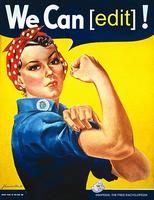
EqualBITE: Gender equality in higher education is an open access book to which I contributed a chapter. My chapter is about the positive power of wikipedia editathons, but the book contains a full range of ideas and responses to tackling the real lived experience of inequality in higher education.
The piece I wrote I wrote a long time ago, before we even had a wikimedian in residence and before the Playfair Steps had really got going. The book has taken a while to come to fruition. It began as an idea to develop a set of ‘recipies’, with each of the contributions having a witty pun-laden title styled as instructions, method and ingredients. I thought that was a cute idea, but seemingly the author team lost their resolve for this, decided that recipies were too girly and decided to adopt a more formal style.
The result is still good though.
It’s free to download, or you could buy it.
It would make a lovely Christmas present.
Trinity College Dublin, Jedi Archive. Picture taken by me. No rights reserved by me.
After swearing for years I would never sit another exam, I have finally bit the bullet and became a student again.
I am conscious that my development as a researcher will require me to think in new ways, but also that I will bring much of my own experience and previous knowledge to the task. As an experienced professional I have been successful in using those things which I ‘just know to be true’ as the basis for my professional practice without much reflection on how this knowing has been arrived at. I am well aware that particularly with regard to workplace issues of equality and diversity many of my colleagues do not think as I do, so it is not a position which can be assumed as shared. It will be challenging to go back to basics and understand why I think the way I think and make a clear justification for the approaches I choose. It will also be interesting to gain new understanding of the ‘researcher language’ of ethics, ontologies, epistemologies and the various ‘isms’. In the course of writing my first asssignment I have found myself referring to dictionaries and encyclopaedia in a way I have not done for a while. I have also had occasion to reach into my dusty book piles for Wenger’s community of practice , Schon’s reflective practitioner, Kolb’s learning cycle , Handy’s organizations and Lewin’s action researcher. It is nice to see these old friends again.
In the classroom it was interesting to become a student again. I did my masters more than 15 years ago. It was fun to see how a room full of successful professionals cope with being challenged to identify the sheer scale of stuff that they do not know when faced with the daunting writing task. As well as researcher-thinking skills I will need to develop new digital skills. I’m fairly confident in searching the internet and library catalogues, and I think/hope I am ok at evaluating sources for credibility. Taking a critical researcher view again will be different. I will also have to learn to use Endnote and wrangle a large (document) piece of writing much longer than the reports and projects plans I write day-to-day.
Actually, I didn’t dream it. I was there to present to Academic Senate. Senate means ‘old men’, in case you didn’t know. It’s from the Latin.
Our Senate at Edinburgh University is actually fairly mixed, and the room was packed for a discussion about ‘The Future of Distance Learning’, and that is my bag.
I have to say though, the AV technology brought in for the event, while lovely, and useful, kinda spoiled the point of the venue. St Cecilia’s is famous for its age and its accoustics. It is set out with amphitheatre steps to sit on around the sides like those Latin-speaking senators might have done in ancient times. I think we should have spoken from the performance area without ppt slides* and been our own projectors.
St Cecilia’s Hall, University of Edinburgh
In case you are wondering , University of Edinburgh currently has about 2,920 distance learning students studying via online programmes at Masters level. We have 65 programmes – (with about 100 permutations).
In terms of cohort size, 7 out of top 10 are CMVM programmes. Surgical Sciences peaked in 2014/15 (155) and has returned to its previous steady state level (105). Yes, we do teach surgery online. Most other programmes teach fewer than 35 students per year.
For the demographic fans amongst you we have 62% women studying online masters compared with 57% of all masters students. Our online students are also older than our on-campus ones. 88% are over 25. We have students from 134 countries studying online. 60% reside outside the UK; but that is not very different from the domicile of our on campus students. The top 6 countries are all English speaking ( Scotland, England USA, Australia, Canada, Ireland) and account for 59% of students
A significant difference in the student mix is that there are few Chinese online students, whereas they account for 21% of campus based PGT students. Our MOOC learners come from all over the world… but despite there being 2million of them, only 80 apply for online masters.
Only 1.4 % of our online learners are our alumni.
Alumnus is also Latin, it means ‘foster-son or pupil’. Alumna is for women.
*I had lovely slides designed by Yujia in a colour scheme to match the venue as you can see.
Cover of our BITS magazine designed by our ISG Graphic Design Service designers
This week is Information Security Awareness Week at University of Edinburgh. The graphic design team have made a range of lovely graphics for them based on treasure, phishing, pirates, datastewards etc. And I invented a tagline and hashtag for them.
The information, datasets and creative content we work with every day are valuable assets to the University and to other people. We should treat them like treasure. We should know where they are, how safe they are, who has access to them and how easily they might be stolen. Our feature topic for this issue of BITS is information security. This magazine is part of a University-wide awareness raising initiative for all colleagues and students to take care.
We have information and advice about what you can do to keep you and your work safe, and what the institution support services are doing to make that easy. Don’t underestimate how attractive even your most mundane information about people, processes and finances might be to someone looking in from outside.
The @UoEInfosec team have sometimes seemed reluctant to use the #treatitliketreasure hashtag in their tweets.
I wondered if perhaps they don’t like it.
I asked.
‘I don’t really understand how twitter hashtags work’ was the reply.
Students watching Replay highlights. Picture from University of Edinburgh Image collection. CC BY https://images.is.ed.ac.uk/luna/servlet/s/a93pr4
We are more than two weeks into term now at University of Edinburgh.
My poem:
Lectures are being recorded. The sky has not fallen in. The service is called Replay. Students like it. Staff like it. We are gathering data. The learning technology teams have shown themselves to be expert in the jobs they do. The learning technology teams have shown themselves to be excellent in the jobs they do. I’m not shocked. Well done all.
A cartoon in our archives showing Noreen Murray as a schoolgirl being reprimanded for making clones of herself in the laboratory (a reference to Noreen’s work cloning DNA)
University of Edinburgh Library and Collections has a huge number of image collections with a wide range of art, science, portraits, people, cartoons and photographs. We would like to open up some of these images to make them more discoverable and usable as images of role models, women in science, women in medicine, diverse groups and positive representations.
Job Purpose:
Your project will be to search our collections for striking, inspirational and engaging images and work with curators to describe, digitise, publish and share them in a way which makes them easy to find and reuse. Your work will be supervised by our collection curators and archivists who will help you to describe and interpret what you find.
This internship coincides with an exciting time for Information Services Group as we celebrate the diversity of our collections. Your work will be the starting point for future projects and give us vital information to help us plan new ways of working. This is an exciting opportunity to work with some of the UK’s most interesting collections and your work will have immediate and visible impact.
Working Hours:
Working hours are 6 hours per week. Flexible conditions (working pattern to be negotiated with the successful applicant).
Main Responsibilities:
•You will work closely with our archivists and curators to identify where in our collections there may be images (particularly of women and women scientists) which can be found, shared and re-used.
•You will take high quality scans and photographs of the images, create descriptive metadata, store files in line with agreed workflows
and regularly add the images with their stories to a library-hosted blog.
•You will work with our other interns to ensure that the images you find are quickly used.
•You will work under supervision, but on your own initiative to use your investigative, research and search skills to discover images with
stories and visual impact.
•Throughout the term of the internship you will find and share a steady stream of content that can be easily re-used in presentations and displays around the university.
•You will gain new skill in researching collections, understanding metadata, intellectual property rights and copyright, as well as using digital scanners and digital images.
•You will work as part of a large team and independently, managing your own work projects and time, reporting on progress, publishing your findings and attendingmeetings and presentations.
•You will gain a unique insight into the library andcollections and equality and diversity issues in that context.
•You will challenge us with new ideas and summarise these in an end-of-project report.
Person Specification:
Essential:
•A current PhD University of Edinburgh student (this post is designated for the purposes of student employment, therefore you must be a matriculated student for the duration of your employment).
•A background in a relevant subject area such as gender studies, art, sociology, information studies, literature, journalism, photography, science, engineering, education, humanities, library studies, archiving, curation, human resources, management or any other relevant discipline.
•You will have a keen eye for detail, be patient and accurate and understand the
importance, beauty and power of metadata.
•Experience of searching, researching and finding things.
•Initiative and judgment to resolve many day-to-day problems independently.
•An enquiring mind and an eye for detail.
•Strong written and oral presentation skills.
•Good IT skills for using social media, working with data and targeted communications.
•Ability to set, meet, manage and monitor progress against targets.
•An engaging interpersonal style and experience of successfully persuading and influencing colleagues.
•Ability to handle irreplaceable documents and objects with care.
•
Desirable:
•Understanding of relevant equality and diversity themes as they relate to equality in theworkplace and the importance of visible role models and positive representations.
•Experience of researching a topic in detail.
•An understanding of how cultural heritage collections can support learning and research at universities.
•This internship would suit someone with a background in equality or gender studies,change management or human resources or someone with a particular interest inpolicies and practicalities of gender issues in library, technology or STEM workplaces.
The conference was really interesting, and quite political. Lots of talk of combatting fake news and a keynote from the ACLU. It was also quite a diverse conference, I thought, and the topic of diversity came up again and again. A lot of people thinking very hard about the sheer scale of getting ‘everyone’ involved in open knowledge.
I mused* on 2 things:
Someone presented some research indicating that women who contribute to Wikipedia do not only edit on ‘women’s topics’ or female biographies. That was not a shock as women, notoriously, are interested in all kinds of topics. But it does mean that getting more female editors does not automatically increase the coverage of our under represented bios.
There was some interesting findings with regard to images. It seems that the images available in Wikimedia Commons to represent people in roles and professions disproportionately portray men in those roles. Even when the profession in question is traditionally female dominated.
Interesting.
The connection between these two I think, must draw upon the same theory of ‘unconscious bias’ as our recruitment training does. Men and women both tend to think that men are more appropriate in professional roles, and more notable for biographies. Unconsciously, even when we pay attention, we may fall foul of our bias.
Much inspired by it all, I return to my main hobby of creating and improving women’s bios. This week I wrote about Prunella Briance, founder of the NCT and Sheila Kitzinger. I felt brave and added a picture of actual breastfeeding to Kitzinger’s page. I think she would have wanted that. Briance, Kitzinger and the NCT fought the good fight to allow women to breastfeed without fear, even in public.
*coincidentally, while I was there I discovered another dead muse, and created a page for Blanche Blackwell.
Common Sense of a wholly new type. https://images.is.ed.ac.uk/luna/servlet/s/y2j4j2 (c) University of Edinburgh. Full Public Access.
Some people have asked if we are going to have subtiles on our lecture recordings as default. The answer is no, but I’d be keen to hear creative ideas on how we could do it. ….. Any ideas which cost less than $3m per year are welcome.
Students with disabilities are, we hope, one of the groups which will most benefit from lecture recording. That is however, quite a diverse group, with a wide range of individual needs, with a variety of existing support in place. Disability Services supported our initial business case with their own papers and contribute to discussions on our policy task group. Accessibility use cases were included in our procurement and selection so we are confident that we chose a good solution from a knowledgeable supplier with a large HE user community.
Our approach is based on being widely flexible and enabling choices of formats and pedagogy. The draft lecture recording policy states that recordings are primarily an additional resource, rather than a substitute for attendance, so the recording and slides provide the ‘alternative format’ to enhance the accessibility of a live-delivered lecture.
Some lecturers’ notes and slides provide considerable text to support the recorded audio. Replay recordings will support a wide range of accessibility and inclusivity needs – visually impaired; dyslexia and other similar; various autism spectrum disorders; students who for a number of mental health reasons may find physical attendance overwhelming; students for whom English is not their first language, those who struggle with complex technical terms or latin translations, those who experience debilitating anxiety as a result of missing classes. Where students have a schedule of adjustments that includes having a scribe in class with them, a recording will help the scribe clarify and areas of subject specific terminology.
We are running training sessions for all staff on how to make accessible PowerPoint presentations, often it is the use of .ppt which has the greatest impact on accessibility. Replay itself includes good keyboard controls for the video player, integration with JAWS screen reader software, tab-accessible page navigation and a high contrast user interface.
Recording lectures will require academic staff to use microphones – we know practice is currently patchy. So the act of making a recording can improve accessibility for those in the room even if they never replay the video. We are also introducing dozens more Catchbox microphones to catch more student contributions in the recording.
The Replay video experiments with chalk boards will considerably enhance accessibility for students at the back of the lecture theatre with the ability to ‘zoom in’.
For students using ISG services our service level is as consistent across all of our learning technologies as we can make it. Replay recordings will be made available in a closed VLE environment, alongside eReserve texts from the library, PDF and Word documents, lecture slides etc. Any of these digital artefacts can be requested in an alternative format as part of supporting reasonable adjustments. In the case of the lecture recording this could be supplying a transcript or subtitles. For other artefacts it could be supplying in a larger font, or converting written text into audio format. We don’t pre-judge what the required adjustment might be in any of these cases.
With regard to transcripts/subtitles specifically:
Our experience is that automated speech to text although improving, is not fully there yet. And costs remain prohibitive, so transcripts or subtitles are not automated in the lecture recording system.
Specialist language in lectures remain tricky and are often subtitled badly. It is also difficult for the transcription to discern whether the lecturer is quoting, reading, muttering or joking. The kind of ‘performance’ and content some of our colleagues deliver would need a highly nuanced translation. All UK HE struggles with this challenge and colleagues are anxious that their speech is not misrepresented by a poor quality subtitle which might be more confusing for learners.
Even supposed ‘100% accurate human-mediated subtitling’ is not 100% and often requires a proof-read or edit from the speaker. In some cases colleagues are willing to take on this extra work, for others it is seen as a major barrier.
That said, we have purchased, as part of our bundle, 100 hours of human-mediated subtitling and transcripts ( 99% accurate) and 900 hours of machine speech to text ( approx. 70% accurate). The current planned use cases for this would be:
• where profoundly deaf students request a transcript;
• where the recordings are not a substitute, but in fact a primary delivery mechanism (e.g distance learning);
• where colleagues are publishing and sharing recordings of their lectures publicly online as open educational resources.
• Where a student with mobility difficulties has been unable to access the venue.
As part of the policy consultation over the coming year we may be able to encourage colleagues to make audio and video recordings downloadable so that students can use their own technology to make transcripts.
For the future:
If, as a result of scaling up recording, we find there is a large additional requirement for transcripts we have a number of options:
• If the institutional commitment to spending is there, we can integrate the third party supplier of our choice. For 50,000 hours of recordings each semester that would be approx $3m per semester.
• We can retain more high quality transcription services. This may need to be recharged to Schools to recover costs – capping costs would be difficult
• We can look into involving more colleagues in using their personalised, trained ‘speech to text’ tools to create transcripts.
• We are working with colleagues in Informatics to stay aware of the most up to date speech to text technologies.
• We can spend much less than $3m per semester paying students an hourly rate to transcribe lectures in their discipline.
University archive colleagues have been incredibly kind and spent time with me looking through his photos. Apparently there is some genuine interest in the history of electron microscopy and molecular biology these days.
The estate of Dr Peter Highton will be happy to donate whatever we have in our cupboards.
I can’t claim any connection with Stella Cartwright, but I created a Wikipedia page for her. I learned about her last night at an event at The Scottish National Galleries: Beyond Artemisia: Women Artists Brought into the Light.
Last year at an event organised by Scottish National Galleries around their ‘Modern Scottish Women’ exhibition I created a page for Anne Finlay.
One of the things both these women have in common is that their biographies include a number of ‘affairs’ with the (more famous, and often married) men in their circle.
Anne has a considerable body of work. The challenge with Stella is to consider whether being a muse, but not an artist in ones own right, is a notable enough contribution to warrant a page. Stella is mentioned in a number of citable sources, but her role is as an inspiration for the work of others. She had an impact on their lives and work, but their pages perhaps do not mention her…..
I am sensitive to the arguments made by Hilary Mantel, that we should not retrospectively make the women in our stories strong and independent, but I do think some of them deserve to be named as notable*.
I have made links for Stella to University of Edinburgh Library archives, and to published articles and resources. I hope that her story will stand the scrutiny of my fellow Wikipedia editors. The page has already been reviewed, so that is good. But the category I created for ‘muse’ has been deleted.
* When I first started editing Wikipedia, when ‘AdaLovelace Day” was being invented, it is worth remembering that most of the discussion behind the scenes on Ada’s page was about the relative worth of her contribution to the work of the better known Babbage.
 EqualBITE: Gender equality in higher education is an open access book to which I contributed a chapter. My chapter is about the positive power of wikipedia editathons, but the book contains a full range of ideas and responses to tackling the real lived experience of inequality in higher education.