Category: Open Educational Resources

my week as an international open education woman

Issue 26 p. 1 front cover Illustration of hanging a sheet on a washing line Usage terms: We have been unable to locate the copyright holder for Hanging a sheet on a washing line. Please contact copyright@bl.uk with any information you have regarding this item. - See more at: http://www.bl.uk/collection-items/spare-rib-magazine-issue-026#sthash.qZnKW0Db.dpuf
Issue 26 p. 1 front cover
Illustration of hanging a sheet on a washing line
Usage terms: We have been unable to locate the copyright holder for Hanging a sheet on a washing line. Please contact copyright@bl.uk with any information you have regarding this item. – See more at: http://www.bl.uk/collection-items/spare-rib-magazine-issue-026#sthash.qZnKW0Db.dpuf

It is a source of great pleasure for me that in recent years the celebrations of International Women’s Day have co-incided nicely with Open Education Week. This makes it easy for me to find authentic and useful things to do as my contribution.

This time last year I was visiting a number of tech partners in California and the theme was #makingithappen  This year the theme is #pledgeforparity and I’ve stayed at home.

I don’t find it difficult to see connections between feminism and open education movements. Both seek to give equality of access, challenge traditional structures and ways of doing things; and involve a diverse community of people in thinking about the greater good. Both also have outspoken advocates with strong opinions and sometimes end up arguing amongst themselves. Nonethless it’s been a fun week.

Saturday: A lovely day doing pleasant writing tasks at the Modern Scottish Women wikipedia editathon #artandfeminism. Working towards parity of coverage and parity of esteem with Jo, Gill, Sara and Mary.

Monday: I ate retro sweets with Charlie and Susie near our #OpenEducationWk display stand and attended the launch of Jo and Peta’s Dangerous Women Project to which I have contributed a blog post to be published later in the year.

Tuesday: On IWD2016 I spent some enjoyable time searching the digital archive of Spare Rib at the British Library to find images to use in my OER16 keynote. I was surprised to find that Spare Rib itself is not particularly well described in Wikipedia, so I spent some time on that too. I added a section on design to continue the #artandfeminism theme.

It seems to me that the big libraries are missing a trick if they are spending time making digitised collections open to the public and not taking a moment more to get a good article on the topic in Wikipedia. They probably need a Wikimedian in Residence.

Wednesday: While my teams were launching our new University of Edinburgh Open Educational Resources policy  to #OEPS in Stirling, I was presenting online in Croatia for Sandra. Our policy is largely based on one crafted by Rebecca for Leeds.

Thursday: I worked with Dominique, our ISG gender equality intern to refine once more our ISG gender equality plan and with Sonia, Yujia, Susan and Lauren to edit the ’embracing openness’ double page spread for our upcoming BITS magazine.

Friday: Today I am working from home, fortified by jam by Anne-Marie and coffee warmed by Maggie’s bespoke knitwear.  I see that all but one of the women artists we were editing on Saturday now have their own wikipedia page, and Lorna, Viv and Catherine are giving it a bit of welly in an ALT OER-SIG webinar to promote our April conference.

A good week’s work all.
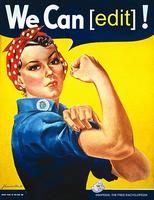
wor wikimedian

Rosie the Editor
Rosie the Editor

Our Wikimedian in Residence (WiR) partnership is a result of a long term engagement and also a credit to the quality of the UK Wikimedians and their ability to support, impress and influence senior managers, who  in turn, shape institutional strategies and investment.

I have been repeatedly impressed by the quality of the Wikimedians and the generosity of their host organisations to help at events. It seems to me only fair that University of Edinburgh which has benefitted so much from our local WiRs should now host a WiR to continue a sustained involvement with the scheme and the Wikimedia UK community. Once Edinburgh has shown the way I hope the other Scottish universities will follow suit to ensure that there is always at least one WiR for the nation.

Background

When I was Director of Academic IT at University of Oxford my teams attended the editathon organised by JISC  (June 2012) to improve articles on the Great War . Oxford holds an elegant collection of crowd-sourced  and expert-curated content in the Great War Archive   and we were keen to ensure, in advance of the centenary, that our collection of open educational resources (OER) could support public engagement and school teaching on the topic.  Martin Poulter was WiR at JISC at the time.

In 2013 we hosted an editathon at Oxford for Ada Lovelace Day. Martin provided training for the event and brought several other wikimedians to help.  Liz McCarthy and Kate Lindsay  worked with Martin to make the whole event a great success and I was entirely sold on the idea.

Oxford hosted another editathon for Ada Lovelace Day 2014, but by that time I had moved job to become Director of Learning, Teaching and Web Services at University of Edinburgh. There had not yet been any wikipedia editathons at Edinburgh  so I brought my new colleagues to  the EduWiki conference  to find out more.  Ally Crockford spoke at the event and she highlighted the WiR scheme.  I met with Gill Hamilton at National Library of Scotland (NLS) to learn about the job descriptions, support and work plans which would be successful for a WiR partnership.

Edinburgh University runs an annual Innovative Learning Week designed to enable staff and students to attend day long, or week long events outside of normal timetabling patterns. The first Edinburgh editathon ran during ILW 2015. Ally and Sara Thomas came to help. Ally was very bold and went for an event spanning the full 4 days.

We certainly couldn’t have done it without Ally and Sara but the striking thing for me was how quickly colleagues within the University took to the idea and began supporting each other in developing their skills and sharing knowledge amongst a multi-professional group.  This inspired me to commission Allison Littlejohn and her team to do some academic research  to  look at the connections and networking amongst the participants and to explore whether editathons were a good investment in developing workplace digital skills.

This is the research I presented at Martin’s Wikipedia Science Conference  which underpinned my business case for establishing a WiR at University of Edinburgh with focus on skills development as part of the University’s commitment to open knowledge.

This year University of Edinburgh is hosting an international conference on open educational resources : OER16. I am delighted to see so many papers accepted from wikimedia projects. We will also run an editathon alongside the event and hopefully convert even more OER practitioners to the joys of Wikipedia editing. Three of the keynote speakers at the event are from organisations with WiR:  John Scally for NLS,  Emma Smith for Oxford and me for Edinburgh. Each of these organisations are making big  public commitments to open knowledge, sharing and public engagement.  Partnership projects with Wikimedia UK is part of the way we do that.

WiR at University of Edinburgh

Ewan McAndrew has been appointed The University of Edinburgh’s Wikimedian-in-Residence.


His year-long residency will run from January 2016 to January 2017 and involves facilitating a sustainable relationship between the university and Wikimedia UK to the mutual benefit of both communities.

To do this, he will be an advocate of open knowledge and deliver training events and workshops which will further both the quantity and quality of open knowledge and the university’s commitment to digital literacy.

More practically, this will involve arranging and delivering skills-training sessions which will fit in with and, importantly enhance, the learning and teaching within the curriculum. He will also stage events outside the curriculum which will draw on the university’s, and Edinburgh’s, rich history and knowledge.

Wikipedia Edit-a-thons will be a large part of this; however, there are numerous ways staff and students can get involved and directly contribute their knowledge and expertise to develop Wikimedia UK’s diverse range of projects.

Ewan is based in the Learning, Teaching & Web Services Division within the Hugh Robson Link Building. You can keep up to date with the residency through Twitter, the WiR blog and through the Wikipedia Project page.

To contact Ewan McAndrew, to discuss collaborating together or just to find out more, email: Ewan.McAndrew@ed.ac.uk

body of work

23707548313_7d4a452525_o
Dermatome man, early twentieth century. (c) University of Edinburgh https://www.flickr.com/photos/crcedinburgh/23707548313/in/album-72157661120362394/ CC BY-SA 2.0

During our ‘Creating an open body of knowledge’ wikipedia editathon last week we managed to upload over 500 images, create 4 brand new articles and 56 improved articles.   Our Wikimedian in Residence, Ewan reports that:

“There are now some astonishingly interesting additions to Wikipedia which just simply weren’t there before….

Including:

  • Anne’s article on Norman Dott – the first holder of the Chair of Neurological Surgery at the University of Edinburgh.
  • Gavin’s one man ‘Citation Hunt’ crusade to plug those pesky ‘citation needed’ labels in articles.
  • Chris’s work on Robert Battey – an American physician who is known for pioneering a surgical procedure then called Battey’s Operation and now termed radical oophorectomy (or removal of a woman’s ovaries).
  • Melissa’s noteworthy work doubling (if not trebling) the article on Mary Fairfax Somerville – a Scottish science writer and polymath, at a time when women’s participation in science was discouraged. As well as editing articles on Isabel Thorne, Matilda Chaplin Ayrton and the Scottish Blood Transfusion Service.
  • Christine’s new ‘Controversy’ section on the intriguing case of James Miranda Barry.
  • Eoin’s really helpful mapping tool of the buildings to be photographed: https://mapalist.com/map/573668
  • Our historian of medicine, James’s work on The Brunonian system of medicine – a theory of medicine which regards and treats disorders as caused by defective or excessive excitation.
  • Mary’s first ever article on Leith Hospital – illustrated with pictures she took herself and uploaded to Wikicommons.
  • Eugenia’s articles on Frances Helen Simson (a Scottish suffragist) and The Edinburgh Royal Maternity and Simpson Maternity Hospital Pavilion. Ably added to by Luise Kocaurek’s work on Lady Tweedale.
  • Anne-Marie’s work on Emily Bovell’s article and a brand new article on the New Zealand Army Nursing Service page which came into being in early 1915, when the Army Council in London accepted the New Zealand government’s offer of nurses to help in the war effort during the First World War.
  • Neil’s articles on ‘Fabry disease’ – a rare genetic lysosomal storage disease – and on ‘Alport Syndrome’ – a genetic disorder] affecting around 1 in 5,000 children, characterized by glomerulonephritis, end-stage kidney disease, and hearing loss.
  • Sara’s sterling work uploading images and flitting about improving articles on Leith Hospital, Edinburgh University’s Women’s Union and many more articles.
  • Kimberley’s work on Frances Hoggan – the first British woman to receive a doctorate in medicine from a university in Europe, and the first female doctor to be registered in Wales.
  • And much much more besides…. including LiuLing’s work on The Royal Infirmary of Edinburgh on Chinese Wikipedia!”

open now

ticket
Promo picture for #OER16

Booking is now open for #OER16 . More than 100 papers accepted, some fine looking speakers, and some of the funnest people with whom you could ever care to discuss the minutae of copyright law.

Looking forward to it.

https://oer16.oerconf.org/

In this week we will also be launching our new Edinburgh University OER showcase website Open.ed, and celebrating the ratification of our OER policy by University of Edinburgh Learning and Teaching Committee.

an Edinburgh festival of digital education

Picture taken by me from Evolution House. No rights reserved.
Picture of Edinburgh castle taken by me from the balcony of Evolution House. No rights reserved.

Next year in April 2016 University of Edinburgh will host 3 major digital education conferences back to back. The city will provide a stunning back-drop for leading educators, policy makers and learning technologists to meet, share ideas and present their research. The calls for papers for each of the conferences is open now and the lists of keynote speakers and themes offer a tempting menu for anyone interested in open educational resources, learning analytics or the challenges of learning at scale.

The conferences are: the 7th Open Educational Resources: Open Culture. OER16 https://oer16.oerconf.org/, the 6th International Learning Analytics and Knowledge (LAK) Conference. LAK16 http://lak16.solaresearch.org/ and the 3rd annual meeting of the ACM Conference on Learning at Scale L@S

Where else would you want be?

all in the name of Lovelace

IMG_2334
Picture taken by me. Copyright on LEGO Ada belongs to Stewart Cromar.

Ada Lovelace Day at University of Edinburgh was a great success this year. The LTW, USD and L&UC teams outdid themselves. We had a lifesize Lego Ada in the Main Library, and the complete Ada and Baggage Lego set in Hugh Robson Building.  We taught students and colleagues how to code music, edit wikipedia, build lego rasperry-pi cases, add metadata, colour-in and celebrate women in tech, all in the name of Lovelace.

Votes for Lego Women
Stewart Cromar’s on going campaign to get his Ada lego set on to the shelves of stores worldwide was embraced by #adalovelaceday enthusiasts.  LEGO Ada has now passed the 4.5K vote mark and is currently the #1 project on the Ideas homepage.

Open educational resources
In celebration of Ada and just because it’s a good thing to do we released several open educational resources for you to enjoy. These include the instructions for our workshops, how to make your own raspberry pi case and a super on-trend grown-up colouring in sheet designed by Jackie Aim.

IMG_2348
Picture taken by me. Copyright on LEGO Ada belongs to Stewart Cromar

Social Media Reaction
Our Ada Lovelace Day website took over a 1K page views in the week, with the OER content being particularly popular. In addition to the many tweets from participants using the #ALD15eduni hashtag we had several official Tweets and RTs from both Raspberry Pi and Sonic Pi and messages of support from similar events at other universities.

On Tour

Stewart and I will both be giving papers in Oxford in December as part of the Ada Lovelace bicentennial celebrations hosted by the Bodleian and Somerville College.

the most dangerous phrase in the language is ‘we’ve always done it this way.’

Commodore Grace M. Hopper, USN (covered) By James S. Davis [Public domain], via Wikimedia Commons
Quote usually attributed to Grace Hopper.

You may or may not be aware that ISG is pumping money into innovation projects designed to improve the services and offerings we make to the University.

We issued a call out to our staff for ideas- below are the winning projects I have funded from LTW.

All these projects are due to complete by August ’16, so if you see the name of an LTW person you know, or an idea you like, please do get in touch so that we can let you know what we are working on. The outputs of all these projects will be licenced CC-BY ( as far as practicable).

A comparative study between a low-cost capture agent and mobile devices -Marc Jennings
Augmented Reality and Learning (Microsoft Holo Lens) -Myles Blaney
Beacons of Knowledge: working with students to co-create geolocated virtual campus tours-Jo Spiller
Build a 3d Printer -Anne- Marie Scott
Developing student digital skills in the community -Amy Woodgate
Diversifying the curriculum with student-led remix and reuse OER- Jo Spiller
Drones: innovative media production -Amy Woodgate
Evaluating frameworks and toolkits for leading Learning Design Practice at University of Edinburgh -Fiona Hale
Exploring accessible Photogrammetry and 3D scanning -Stuart Nicol
Feedback on Feedback -Robert Chmeileswki
Learning Dashboards for professional development- Jenni Houston
Live Interactive Point of View Video -Euan Murray
Self-directed learning resources for spatial literacy -Gavin Inglis
Twitterbot – Pilot Service – Martin Morrey
Virtual Edinburgh Maker Platform Proof of Concept- Martin Morrey

media management

http://images.is.ed.ac.uk/luna/servlet/s/186b57
Female Faces, Lips and Dots. Hughes, Jennifer M. © The University of Edinburgh http://images.is.ed.ac.uk/luna/servlet/s/186b57

We have invested in a new media asset management service for the University. Our vision is to enable the University to meet the full breadth of learning and teaching, assessment, research and engagement activities, by providing usable tools for making, editing, storing, sharing and disseminating video and audio files.

The new media asset management system will be delivered using the Kaltura video platform. Kaltura is a market leader in this space and the University has made a significant long-term investment in order to deliver our learning and teaching vision, and our strategies around distance education and research engagement. We will provide a central service to support the efficient use and management of media assets from all across the university. All staff and students will have access to the service.

Receive project updates by subscribing to: is-media-info@mlist.is.ed.ac.uk
(Info on subscribing to a mailing list: http://edin.ac/1Kw3Vsd)

Supporting new uses of media

The new service will support a wide range of activities, and we will be developing a suite of training and awareness opportunities over the next 3 months to promote these. Some of the most popular activities include:

  • Flipping the classroom – desktop recording tools can be used to pre-record media for students to watch in advance of contact time.
  • Enhancing feedback – use the service to record personalised video feedback and share with students either individually or to a group. Ask students to record and share with their peers or tutors, or use commenting tools to crowdsource feedback.
  • Using Video for assessment: Stimulate our student’ creativity and develop digital skills by tasking students to record their own media and submit it for feedback or assessment through our VLEs.
  • Showcasing our best – a web based video portal with curated channels of content will allow us to share within our University community, or with the wider world.
  • Strengthening the link between research and teaching – find high quality outputs from research projects in the video portal and use web based editing tools to clip out the best bits for use in teaching and learning.
  • Best of breed editing tools – web-based editing tools will make it simple to reuse, adapt and update learning materials.
  • At your desk recording – built in desktop recording tools allow you to create and share media quickly and easily.
  • Multi-platform broadcast strategy – publish to appropriate audiences simply and quickly through our VLEs, the University website, and other platforms such as YouTube and iTunesU.
  • Support accessibility and inclusion – use recording tools to easily provide information in an alternative format, and use transcripts, subtitles to make our content as accessible as possible.
  • Create Open Educational Resources – using built in copyright and publishing workflows you can make open learning resources widely available online.
  • Gaining insight and understanding – analytics will allow us to understand exactly what media is engaging to our audiences and what impact it is having.
  • Be present elsewhere – stream a lecture or presentation to a remote location, for example a remote conference.
  • Student revision – holding a library of recorded lectures and other content that can be used for revision and ‘listen again’ will better support our students.

Timescales

We plan to make the service available in late Semester 1 with a more limited set of features and training available, as an ‘early-adopters’ pilot phase. We will use Semester 2 to refine the service and continue training, awareness and community building activities ready for full scale launch in May 2016. This will allow us to check that our procedures, support and training are effective.

Please do sign up to our mailing list for regular updates on progress.

be our Wikimedian in Residence

IMG_2147 copyDo you have an eye for detail and a love of facts? Are you an experienced Wikimedian with experience working with the Wikimedia community? What would you do to engage our staff and students in editing, contributing and sharing open knowledge? We are recruiting a Wikimedian in Residence to work in Information Services alongside our learning technologists, archivists, librarians and information literacy teams. Following our first successful editathon events we now need your help to establish a network of Wikimedians on campus and to embed digital skills and open knowledge activities in learning and teaching across the University.

Media coverage:

The Student Newspaper

Edinburgh Evening News

The post is offered on a fixed-term (12 months), part-time basis (17.5 hours per week).

Closing date: Thursday 29 October 2015 at 5pm

Ada Lovelace Day, Edinburgh

Donate_lego
(c) Stewart Cromar 2015 Vote now to make it real https://ideas.lego.com/projects/102740

The University of Edinburgh will be hosting Ada Lovelace Day on Tuesday 13th October 2015 – an international celebration of the achievements of women in science, technology, engineering and maths (STEM). You are all welcome, please join us.

Our provisional schedule includes:

  • composing music with algorithms
  • building Raspberry Pi enclosures with LEGO
  • metadata games in University of Edinburgh’s Library and University Collections
  • Wikipedia training session and edit-a-thon
  • Ada buns
  • guest speakers
  • and much more!

Book now.

Schedule:
Morning (booking link)
11:00-11:30 Introduction to the day with speakers on Lovelace, research using LEGO, programming and games (Melissa Highton, Katya Krasnopeeva & Judy Robertson)

11:30 – 14:00 Fun with data, algorithms, and Pi:  hands-on sessions (drop-in)
•        compose your own music with algorithms – sessions running at these times: 11:30 – 12:15; 12:15 – 13:00; 13:00 – 14:00
•        build your own Raspberry Pi enclosures with LEGO  – sessions running at these times: 11:30 – 13:00; 13:00 – 14:00
•        play and compete in metadata games (University of Edinburgh’s Library and University Collections division) – sessions running at these times: 11:30 – 13:00; 13:00 – 14:00

Afternoon (booking link)
14:00 – 17:00 Wikipedia Editathon
Join us to raise profile of women in computer science & inspire a new generation!  Receive expert advice and training so that you can, edit and publish articles for Wikipedia. Then publish new articles or improve existing articles about prominent Edinburgh University women, past and present, who are under-represented within Wikipedia.
·         14:00-15:00 Wikipedia training
·         15:00 Afternoon tea (catering provided)
·         15:15-17:00 Wikipedia Editing and Publishing: Edinburgh’s women in Computer Science

*You are welcome to bring your own topics of interest to write Wikipedia articles about too.

#ALD15 #ALD15Eduni