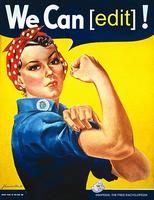
The Wikipedia Science conference was a good place to discuss the contribution of women to the telling of science stories and disseminating research. Peter Murray-Rust described Wikipedia as our greatest achievement in the 21st Century. I reminded the audience that less that 15% of the people who edit Wikipedia are women and we discussed whether or not this was a problem. One delegate suggested that women aren’t interested in facts and another that women have ‘other’ things to do. We wondered how Wikipedia would be different, and Wikipedia science would be different, if more women contributed. We wondered what might be done to find out.
The Edinburgh Seven had a tough time when they tried to break into the male world of university medicine, but they were working within historical, established structures. Surely Wikipedia is designed from the start to be more open, more democratic, more participatory? Wikipedia is only 15 years old. It seems like it is work worth doing to try to recruit more editors and a good place to start would be amongst information professionals and women in tech.
It seems to me that the kinds of initiative we may need to get more women using wikipedia for science, are very much in the same vein as those more generally for women in STEM workplaces. We need women to want to join, and want to stay.
The presentation I gave described the research I am involved in with the Open University to identify the workplace learning outcomes for university staff and students in developing digital skills, information literacy skills and understanding of copyright in an open knowledge environment. The research team have surveyed and interviewed. Interviewees describe rich learning experiences, learning a range of skills and knowledge, for example:
technical knowledge (how to create a Wikipedia page, how to edit, how to cite other sources etc),
factual knowledge around the topic (names, dates, locations of historical events),
relational knowledge (how to interact with archivists and materials, how and where to source information, how to plan work with others),
socio-cultural knowledge (how to operate within a network of people with a common purpose).
Which all seem like good skills worth investing in. I am particularly interested in how editathons, if run well, can develop not just tech knowledge but also workplace cultural capital and networks. These are the things women need in STEM workplaces.
The hashtag for the conference was #wikisci . I recommend the conference as a top value for money event. Less than 30 quid for access to the most up to date thinking in wikiscience.
Me trying to find a book on technical debt. Photo credit: LTW, University of Edinburgh CC-BY
Three weeks ago, while preparing my presentation for e-learningforum@ed conference I was musing on the similarities between ‘technical debt’ and what one might call ‘ copyright debt’.
I was thinking about institutional risks of not being open. Institutional risks are sometimes legal, sometimes reputational, sometimes financial. Mostly, at IT directors’ meetings we talk about the need to mitigate risks early on, and avoid risks in the future.
Generally, the risks of not engaging with open practice are reputational: Other institutions are doing it; we might miss out on this good thing; we should be seen to be bold in digital education and leading edge in our open research. There is a risk to our reputation if colleagues do not seem to be up to-date-on licensing and refer to online materials or data as ‘open’ when they are not. But most of those risks are easily hidden under a smear of open-washing and a vagueness about the definition of open in different contexts.
These are not risks which will ever convince a VP Finance and Resources to invest.
If you want to convince an IT director or a CIO to invest in systems which have built-in open-licensing workflows, protecting the institution against the risk of expensive copyright debt may be the way forward.
My definition of ‘copyright debt’ is based on my understanding of ‘technical debt’. Technical debt is a metaphor often used in IT to explain why it costs so much to replace IT systems. I use it to explain why rather than spending my budget on new exciting learning and teaching functionality, I am having to spend it to replace something we thought we already had.
You can ready about technical debt on Wikipedia. It’s the cost of not doing something properly in the first place. From the moment you build a system poorly, without due attention to software code rigour and process, you begin to accrue debt and then interest on that debt. From the moment you don’t fix, patch and maintain the code, the same thing happens. At some point you are going to have to go back and fix it, and the longer you leave it the more expensive it will be*.
From the moment a colleague tells you that they don’t have time, or don’t care about the copyright licensing and metadata on their teaching materials and load them up into a VLE, online course environment, departmental website, online course-pack, lecture power-point slides, whatever, you start to accrue ‘copyright debt’.
Someone will have to go back to those materials at some point to check them, figure out who made them and when and check for 3rd party content. The longer time passes (or staff change) between the original materials being uploaded in to the VLE the harder it will be to find the original source.
The cost will hit at the moment that you migrate from one VLE to another, or from one website to another, or from one media asset management system to another. At that point lecturers and departmental administrators will be asked to confirm that they have copyright permission for the materials they are migrating, and they will say ‘ I have no idea, in fact I don’t even remember/know where all the bits came from’.
They will suggest that someone in a central service (usually the library) should do the checking, and that is where the cost hits. No-one in the library is super-human enough ( unless you pay them a lot) to check all the hundreds of teaching and learning materials in your VLE, so most of it will just be binned and colleagues will be outraged that they have to make it all again.
I’d suggest the common causes of copyright debt include (a combination of):
Business pressures, where the business considers getting something released sooner before all of the necessary copyright searches are complete.
Lack of process or understanding, where the businesse is blind to the concept of copyright debt, and make decisions without considering the implications.
Lack of flexible components, where materials are not openly licensed, the re-use permissions are not flexible enough to adapt to changes in course content.
Lack of time, which encourages colleagues to do quick google searches and take materials they find without checking the license.
Lack of metadata, where content is created without necessary supporting metadata. That work to create the supporting metadata represents a debt that must be paid.
Lack of collaboration, where knowledge of open practice isn’t shared around the organization and business efficiency suffers, or junior learning technologists are not properly mentored.
Parallel development at the same time on two or more VLEs can cause the build up of copyright debt because of the work that will eventually be required to move content from one to another. The more content developed in isolation without clear licensing , the more debt that is piled up.
Delayed reformatting – the formats which were used for creating learning objects quickly becomes obsolete. Without clear permission to make adaptations it is hard for older TEL materials to be converted to new formats. The longer that reformatting is delayed, and the more content is written to use the older format, the more debt that piles up that must be paid at the time the conversion is finally done.
Lack of alignment to standards, where industry standard features, frameworks, open technologies are ignored. Eventually, integration with standards will come, doing it sooner will cost less.
Lack of knowledge, when the content creator simply doesn’t know how or why to use open materials.
The challenge in all this of course, is that the individual academics making the materials don’t care about the longer term cost to the central services of this debt. This argument won’t persuade them to take the time to change their practice, so we must build rigour for open practice into the workflows of our enterprise-wide systems and services as soon as we possibly can, making it easy for colleagues to make positive choices.
Or else we risk a whole heap of copyright debt.
*Basically it is the software equivalent of ‘ a stitch in time saves nine’.
(While I was doing this thinking, I bumped into a session at #OER15 called ‘the cost of not going open‘ by Viv Rolfe which also looked to quantify costs. Viv’s approach is to look at costs and savings around academic time spent creating materials, which complements my thinking rather nicely.)
Martha Lane Fox By The Cabinet Office [OGL (http://www.nationalarchives.gov.uk/doc/open-government-licence/version/1/)], via Wikimedia CommonsBaroness Martha Lane-Fox delivered the 39th annual Dimbleby Lecture from London’s Science Museum on March 30, 2015. I delivered a short welcome speech at Elearing@ed forum at Edinburgh University on April 23. I took the opportunity to quote her.
In her lecture she quoted Aaron Swartz “It’s not ok not to understand the Internet anymore.”*
I talked about Creative Commons.
Creative Commons has changed the way the Internet works in higher education.
Therefore, it is not ok not to understand Creative Commons anymore.
As it happens, the day before , on April 22, I saw Baroness Oona King of Bow speak. Baroness Lane Fox name-checked Ada Lovelace, who was of course, Countess King in her own day, but I think that is just co-incidence.
*She also said “get more women involved in technology.”
University of Edinburgh Digital Image Collections CC BY-NC-ND 3.0
This week I’ll be at OER15 in Cardiff. It will be lovely to see so many OER colleagues again.
The conference theme is ‘Mainstreaming Open Education’ and I’ll be talking about the development of OER policy at University of Edinburgh, which has been student-led from the start.
As 2014 opened, the EUSA vice president for academic affairs challenged University senior managers to explore how learning materials could be made open, not only for students within the University, but across Scotland and to the wider world.
These were heady days, the University was riding the wave of global interest in MOOCs, an NUS report was published to champion OER, there was an upcoming independence referendum and many in Scotland saw a strategic opportunity to contribute to a fairer society via open educational practice. A high level task group was established, including key opinion shapers, from around the University of Edinburgh.
By the close of 2014 the referendum opportunity had passed, but the impetus to push forward with OER policy remained. The University now has a strategic lead on Open Education with a vision, policy, support framework, and task groups focused on delivering more. There remains a lot of work to be done.
In this presentation for OER15 Dash, Stuart and I will draw on best practise, describe the process of linking OER to institutional mission and aims and explore the challenges of multispeed approaches; working with student leadership, University senior management, educational developers and academic innovators to deliver sustainable OER in a research institution.
‘Poulterer, Buenos Aires [Argentina]’. Photograph of a poulterer standing with his horse carrying cages of poultry on a street in Buenos Aires, Argentina in the early 20th century. Next to him is a man carrying a milk cannister, a man carrying two baskets of fruit and another man smoking a cigarette. http://images.is.ed.ac.uk/luna/servlet/s/19g4jxUniversity of Edinburgh’s new Chook MOOC will explain the general principles of chicken behaviour that can be used to assess welfare in chickens in hobby flocks or commercial farms. The focus is primarily on laying hens and meat chickens (broilers). The main course is likely to be of interest to people who own chickens as pets or keep a small hobby flock, commercial egg and chicken meat producers, veterinarians and vet nurses. You know who you are.
Last week I was contributing to face to face (at Open Educational Practice Scotland OEPS steering group) and online discussions (comments on How Sheila Sees it) about the difference between open educational practice (OEP) and open educational resource practice (OERP). I imagine it will come up again this week when I am speaking at the Coursera Partners Conference.
The challenge for me, is that in discussions of OEP the ‘open’ seems very ill defined. It can encompass a full range of open approaches and does not necessarily involve any consideration of content licencing.
What I liked about the early JISC OER projects was the explicit challenge to release a significant amount of content from within your institution, and ideally for that process to become mainstreamed and sustainable. It meant the technologists and content owners ( academics) worked together with the lawyers and librarians/collections to release stuff at scale, either old stuff or really new stuff mostly.
Academic staff development people always tell me that teaching and learning isn’t about content, but I kinda think it is. That’s why we have libraries full of published content, and reading lists, and course packs, and slides, and handouts, and recordings,and datasets and we constantly produce and publish more as we research and teach. And we get promoted because of it. Our students produce a bunch too, and sometimes we assess it.
As an ex- academic staff developer myself, I’d say academic staff development people don’t produce much discipline content and are notoriously bad at using each others’ so they are not big OER producers. They are more into OEP now which is such a wide concept that their expertise is needed to develop it as an area of practice.
I like OER practice. I like the rigour of defining and working within something that ‘is’, knowing what ‘is not’. I think it is really interesting and challenging to help people to find , make and use resources, and to be literate in their use of open content. And I like to mainstream it in ways which lower the barrier to participation in OER production as much as possible. I like to put systems and workflows in place. The more wonderful, unique stuff gets out there on an open licence, the more there will be for me and others to use.
During Innovative Learning Week, we ran the first of our ‘Making open courses using open resources’ workshops at Edinburgh. In theory that task should be much easier than it was 5 years ago. There are 900 million Creative Commons-licensed works, up from 400 million in 2010.
We can edit and we can eat cake. Picture taken by me, no rights reserved, and no leftovers.
The ‘Women, Science and Scottish History editathon‘ series of events in Innovative Learning Week at University of Edinburgh was a great success. We ran sessions on 4 days, had plenty of new students, staff and friends join us, edited more than 30 articles and trained dozens of novice wikipedia editors.
Each day, the one-hour introduction to editing Wikipedia focused on offering tips and insight into different approaches as well as practical training. Participants were welcome to attend as many days as they would like: everyday we added something new. Our Wikimedia trainers (principally Ally, the Wikimedian in Residence at the National Library of Scotland) was on hand to provide assistance, and our librarians ( Marshall, Gavin and Grant) provided specialised materials focusing on the subjects covered.
Knowledge was shared openly. Articles were created or improved. Networks of connections were made and shared topics of interest explored. Copious cake and cookies were eaten, and a fun time was had by all. We plan to do further events and some research to maintain and sustain momentum and support our fledgling crowd community. In December, at the EduWiki conf Ally reported that she had not seen much engagement from University of Edinburgh in Wikipedia projects . At least that’s changed.
Women Singing at a Table (Waulking the Cloth) by Keith Henderson http://www.bbc.co.uk/arts/yourpaintings/paintings/women-singing-at-a-table-waulking-the-cloth-94160
I have been in several meetings this week discussing crowdsourcing and citizen science models for Edinburgh. The terms are often being used interchangably even though they really shouldn’t.
Remembering my time at Oxford I was thinking of the Oxford Community Collection model. This is a model of working we developed to support any organisation in creating a shared collection of digital asssets through online crowdsourcing and personal interaction.
The beauty of the model is that it combines large-scale online crowd-sourcing with personal, individual interaction. The model allows contributors to choose the way they contribute to a collection, offering those who lack the resources, ability, or opportunity to use computers an opportunity to be part of a digital initiative, sharing their material with the world.
The model also includes a real emphasis on planning for with sustainable success. Being part of and interacting with a community is central. This is described and discussed in more detail in RunCoCo: How to Run a Community Collection Online (2011), a report which presents a simple A, B, C of advice for projects:
Aim for Two-way engagement;
Be part of your community;
Challenge your assumptions.
In finding a unique approach at Edinburgh the fact that we have our successful MOOC learner communities has been mentioned. It’s no longer about what you can get 100,000 people to watch or read, it’s about what you can get them to make , do, add and share. And it’s about being part of your community. More on this later.
I spoke in Brussels this week about University of Edinburgh’s leading role in developing and delivering innovation in higher education. The LERU league of European research institutions is an unashamedly closed club of 21, but occasionally they have open-ish meetings and this one was packed, so it was an interesting and interactive session. This particular meeting was at Scotland House, so I felt like I was representing up.
The meeting was focussed around the briefing paper which was written while I was working at Oxford, so it was fun to respond to it on behalf of Edinburgh now that I work here.
I spoke mostly about the unique positions held by the research institutions in engagement with their communities near and far and about the channels for translating research with social relevance.
Earlier in the meeting there had been much conservative concern and warnings (from those not doing MOOCs) that doing MOOCs was not worthwhile. The presentations from Leiden and Edinburgh about our MOOC success and mission relevance perked everyone up again.
I spoke about how involvement in the emerging area of MOOCs is inline with our three- part core mission: teaching, research and innovation. Our teaching in our MOOCs is strongly influenced by research we do about our MOOCs, is innovative, and the platforms we work with are informed by knowledge transfer in educational technology development.
We are motivated to inspire the citizens and leaders of tomorrow to be curious, driven, responsible and capable of academic thinking. I spoke about the U21 Critical Thinking in Global Challenges shared online course (SOC) which builds upon and runs parallel to, our MOOC of the same name. We are taking the opportunity to strategically extend our online learning opportunities to learners or co-enquirers outside our university. Universitas 21 also has 21 members, and some of them are the same as the LERU 21 members, but many are not. Nice to see colleagues from Amsterdam and Lund.
I talked about how we strategically work collaboratively with other institutions, and with commercial partners in the delivery of online learning. I mentioned our increasing strategic closeness with SRUC and their contributions to our growing stable (or barnyard) of horse, animal and chicken MOOCs*. I mentioned our partnership work with national museums, the Scottish Government and the Edinburgh Festivals.
What struck me though, was that the hype is fading around MOOCs and the idea that this is going to transform the business of higher education by opening it up to all has passed. It increasingly becomes attractive to those big brands who are getting the strategic benefit of these international platforms to discourage other from getting into the same space. Colleagues from Leiden agreed.
Doing MOOCs well is very difficult and very expensive. Unless you have excellent teams, which we do, it won’t be a success.
In fact, if you work at any of the other LERU institutions you should certainly heed all the advice in the LERU paper and not rush into it.
*Leiden have chosen Sharia law and international terrorism as their MOOC topics. That makes ours look actually rather tame.
Have you ever wondered why the information in Wikipedia is extensive for some topics and scarce for others?
Did you know that the Edinburgh Seven were the first women to matriculate to study medicine in HE in the UK? Do you know when? Do you know their names and the things they went on to do? Do you know about the Surgeons Hall riot?
It seems like there is work to be done to enrich the quality and quantity of articles which might inspire people to know more about the history of women in science, particularly in Edinburgh where we have such cracking stories to be told.
During Innovative Learning Week, the University’s Information Services team are running a series of four Wikipedia ‘editathons‘ with the support of the School of Literature, Languages and Cultures, the Moray House School of Education, EDINA, and the National Library of Scotland. We will focus on improving the quality of articles about women in Scottish science history. Working together with archivists, academic colleagues and Wikimedia experts, we will train you how to edit and add information to Wikipedia. It really is very easy.
We will explore how writing Wikipedia articles develops digital literacy and academic writing skills. You will be supported to develop articles covering women in science, Scottish women in history, Edinburgh as the birth place of medicine, the Edinburgh Seven, University history, distinguished Edinburgh alumni etc. We will bring out content from the University archives which has never been mentioned on the Web before and you can bring your research, your knowledge, your search skills, your writing skills.
This series of events will run over a series of afternoons with focused topics. You can attend just once or on multiple days, and can select topics that interest you and which need development on Wikipedia. Training, technical support and subject area advice will be provided throughout. One day we will focus on editing biographies and people pages, another day buildings, places and linking to maps, another day on adding images, but you can work on any of those as we go along.
Each workshop is open to all: campus-based students, distance learning students, alumni, all staff and members of the public.
Once you have learned to edit you will want to do it again and again. Trust me.
As a starting place we have selected people, mostly women, who are significant to the University, medicine and science, past and present, and will bring interesting source materials that will support article development. You are welcome to bring your own topic and source materials. We will be working to improve and extend the articles about:
Mary Anderson (Edinburgh 7)
Charlotte Auerbach
James Miranda Steuart Barry (aka Margaret Ann Bulkley)
Emily Bovell (Edinburgh 7)
Matilda Chaplin (Edinburgh 7)
Sir Robert Christison (opponent of the university education of women)
Mary Crudelius (campaigner for women’s education)
Helen Evans (Edinburgh 7)
Elsie Inglis (maternity health)
Sophia Jex-Blake (Edinburgh 7)
Eve Johnstone (Psychiatry)
Judith MacKay (tobacco control)
David Masson (supporter of the university education of women)
Noreen Murray (molecular geneticist – as in Ken and Noreen Murray Library)
 Two weeks ago I presented the story of our Women in Science and Scottish History editathon at the Wikipedia Science conference in London at the Wellcome Trust*.
 The Edinburgh Seven had a tough time when they tried to break into the male world of university medicine, but they were working within historical, established structures. Surely Wikipedia is designed from the start to be more open, more democratic, more participatory? Wikipedia is only 15 years old. It seems like it is work worth doing to try to recruit more editors and a good place to start would be amongst information professionals and women in tech.
 Which all seem like good skills worth investing in. I am particularly interested in how editathons, if run well, can develop not just tech knowledge but also workplace cultural capital and networks. These are the things women need in STEM workplaces.


!['Poulterer, Buenos Aires [Argentina]'. Photograph of a poulterer standing with his horse carrying cages of poultry on a street in Buenos Aires, Argentina in the early 20th century. Next to him is a man carrying a milk cannister, a man carrying two baskets of fruit and another man smoking a cigarette. http://images.is.ed.ac.uk/luna/servlet/s/19g4jx](http://thinking.is.ed.ac.uk/melissa/wp-content/uploads/sites/4/2015/03/0053040c.jpg)