Category: Open Educational Resources

‘tech-out’, the technology version of a ‘teach-out’

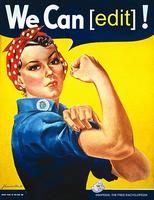
Rosie the Editor

Some of us are on strike. (I may have mentioned this before). Academic colleagues are holding ‘teach outs’. What kind of activity would be the learning technology version of a ‘teach out’?  I’m thinking  ‘making OER ‘and ‘wikimedia editathons’.

I’ve asked a guru and been told that a ‘teach-out’ takes place outside the walls, has an informal curriculum, is activist focused and free!

Open education and OER is all about ‘beyond walls’, it is about sharing, releasing openly, deliberately, resources which can be re-used by others for free. There are whole conferences about how this is informal, disruptive, beyond the curriculum and underpinned by activism for social change in HE. There are even Declarations about it.  Wikimedia is the largest online  open educational resources platform in the world.  Wikimedia is an activist organisation whose members  support and campaign for changes in copyright, access, freedoms and disruption of traditional knowledge publishing models. There is also a well known issue with gender bias in the content.

I’ve looked up some UCU guidance. They say:

“Good reasons to do teach-outs include:

  • They show students that their teachers aren’t just putting their feet up. We care about students’ education and are willing to educate unpaid — just not to do the kind of educating we’re normally paid for.
  • We only go on strike when bad things are happening, but promoting the teach-out allows us to focus conversations on a positive activity. Attending allows students (and anyone else!) to show support for the strike.
  • The teach-outs also give members a communal, productive activity to do on strike days that builds ideas, capacity, and community — and reminds us what higher education is really all about.
  • Not all members are willing or able to be involved in picketing, but are happy to participate in teach-outs, broadening the possibilities for activism on a strike day.

Organising teach-outs is very easy! Almost everyone in UCU organises conferences, open days, meetings and talks professionally. Moreover, it’s in the nature of teach-outs that they’re ad hoc, a bit improvised, even carnivalesque. So basically, it’s about doing what we’re good at, yet no-one minds if it goes wrong “

This is exactly the kind of thing we encourage through our OER activities and wikimedia editathon events.  It is #openeducationweek as well as #internationalwomensday and #ussstrikes. The best thing you can do is join a ‘tech-out’. You don’t have to cross a picketline, Wikipedia is definitely outside our walls, but conveniently adjacent, and differently owned, like a local pub or community hall.  You can learn how to do OER from our handy guides. You can join our wikimedia editathon remotely with our helpful videos.

If you want a communal, productive activity to do on strike days that builds ideas, capacity and community, and reminds us what higher education is really all about, Comrades, join me in Open Education.


take an EqualBITE

EqualBITE: Gender equality in higher education is an open access book to which I contributed a chapter.  My chapter is about the positive power of wikipedia editathons, but the book contains a full range of ideas and responses to tackling the real lived experience of inequality in higher education.

The piece I wrote I wrote a long time ago, before we even had a wikimedian in residence and before the Playfair Steps had really got going. The book has taken a while to come to fruition.  It began as an idea to develop a set of ‘recipies’, with each of the contributions having a witty pun-laden title styled as instructions, method and ingredients. I thought that was a cute idea, but seemingly the author team lost their resolve for this, decided that recipies were too girly and decided to adopt a more formal style.

The result is still good though.
It’s free to download, or you could buy it.
It would make a lovely Christmas present.

what will you watch?

Students watching Replay highlights. Picture from University of Edinburgh Image collection. CC BY https://images.is.ed.ac.uk/luna/servlet/s/a93pr4

We are more than two weeks into term now at University of Edinburgh.

My poem:

Lectures are being recorded.
The sky has not fallen in.
The service is called Replay.
Students like it.
Staff like it.
We are gathering data.
The learning technology teams have shown themselves to be expert in the jobs they do.
The learning technology teams have shown themselves to be excellent in the jobs they do.
I’m not shocked.
Well done all.


keep a breast of open knowledge

No nudes is not good news. Picture taken by me at work of one of the artworks on display from our collections. No rights reserved by me.

In an effort to stay up to date with all things wiki, I went last week to Wikimania 2017 in Montreal. It was my first Wikimania. Ewan and I did our ‘What’s the Value of a Wikimedian’ double act. You can watch us on Media Hopper.

The conference was really interesting, and quite political. Lots of talk of combatting fake news and a keynote from the ACLU. It was also quite a diverse conference, I thought, and the topic of diversity came up again and again. A lot of people thinking very hard about the sheer scale of getting ‘everyone’ involved in open knowledge.

I mused* on 2 things:

  1. Someone presented some research indicating that women who contribute to Wikipedia do not only edit on ‘women’s topics’ or female biographies. That was not a shock as women, notoriously, are interested in all kinds of topics. But it does mean that getting more female editors does not automatically increase the coverage of our under represented bios.
  2. There was some interesting findings with regard to images. It seems that the images available in Wikimedia Commons to represent people in roles and professions disproportionately portray men in those roles.  Even when the profession in question is traditionally female dominated.

Interesting.

The connection between these two I think, must draw upon the same theory of ‘unconscious bias’ as our recruitment training does. Men and women both tend to think that men are more appropriate in professional roles, and more notable for biographies. Unconsciously, even when we pay attention, we may fall foul of our bias.

(slides from these research presentations)

Much inspired by it all, I return to my main hobby of creating and improving women’s bios. This week I wrote about Prunella Briance, founder of the NCT and Sheila Kitzinger.  I felt brave and added a picture of actual breastfeeding to Kitzinger’s page. I think she would have wanted that. Briance, Kitzinger and the NCT fought the good fight to allow women to breastfeed without fear, even in public.


*coincidentally, while I was there I discovered another dead muse, and created a page for Blanche Blackwell.


the Highton digital estate

Darwin Building as it was in 1967. Picture belongs to the Highton Estate, no rights reserved by me.

Schopenhauer apparently said we mostly can’t make pain go away, but it’s always open to us ‘to turn tears into knowledge.’

We can also turn our sad memories into open knowledge. Two years on I am still discovering more about my father, and sharing more of his collections.

His pictures of ecoli which I spread into Wikipedia have multiplied page views, about 1.2 million so far.

University archive colleagues have been incredibly kind and spent time with me looking through his photos. Apparently there is some genuine interest in the history of electron microscopy and molecular biology these days.

The estate of Dr Peter Highton will be happy to donate whatever we have in our cupboards.

time for an evidence base for technology enhanced learning?

Red herring
Red Herring By misocrazy from New York, NY (Cropped from Kipper) [CC BY 2.0 (http://creativecommons.org/licenses/by/2.0)], via Wikimedia Commons
I spoke at JISC Digifest 2017. It was lovely to see so many colleagues old and new there.

Jisc had gathered a community of learning technologists and IT specialists and asked us to think about how we might find an evidence base for TEL.

But I do wonder: Should we even try?

There is a real risk to the universities in having the people who are best placed to build and develop excellent new services  spending too much of their time of fruitless tasks.   I think knowing what kinds of evidence is relevant for which decisions is a leadership skill, and leadership in learning technology is what its all about.

That’s not to say we shouldn’t make evidence-based decisions, or decisions based on data. We need to know the difference between evidence and data. But I think ‘technology enhanced learning‘ might be a red herring. Or possibly a hens tooth.  Or may be both.

Even before the Trump era of post-fact and post-truth there were already many people, with strong convictions will not be persuaded by evidence, however well it is presented.

Some times I suspect that people ask for evidence not because they want to make a decision, but because they already have.

Sometimes I suspect that the request for more evidence, and more detail is a stalling or blocking tactic. It is just one approach to resistance.  No amount of detail will ever be enough and you’ll spend a long time looking for it.

What I am sure is true is that different kinds of evidence persuades different kinds of people in different kinds of decision-making and we need to be smart with that. The  kinds of evidence that persuades users to use the tools, is very different from evidence budget-holders need to make decisions on spend and buy the tools in the first place.

The evidence-base is not the same as the business-case.

So, In summary: Should we spend more time assembling an evidence base for technology enhanced learning?

I vote No. The opportunity cost is too great.   It would have to be so broad, yet so detailed to convince university lecturers it would be quickly unstainable. It would be backward looking and the data unreproducable. It would have little useful link to the real, real-time decisions being made for investment for the future. We should not waste that time, we have more urgent things to do.


OER risks: why not being open now costs us money in the future.

It’s that time of year again. OER17 conference will see a gathering of the OER clans in the UK once more. Together we will map the political landscape for OER.  I will be arguing that it is OER which will save the HE institutions from Brexit, Trump and possibly Indyref2.

It is clear that business models associated with OER are in their infancy and whether any institution pursues models[…….] will be highly dependent on any given institutions business strategy.’(1)

“The clear identification of ownership and copyright permissions is integral to managing open educational resources. This means that institutions become much more aware of intellectual property in relation to the resources they create and use. “ (2)

The senior management briefing papers and guides produced as a result of the JISC /HEA funding programmes (2009-13) offered suggestions to colleagues within institutions on how to best engage with senior stakeholders. They also offered suggestions to those stakeholders as to reasons why they might invest in OER as part of strategic planning.  And yet, at many OER conferences, workshops and events the questions are still raised: ‘What can we do to get institutional support for our open education practice?’ ‘ How can we persuade senior managers?’

What piece of the puzzle is missing?   In this presentation I will offer a view from the perspective of one UK HEI senior management which I hope will be of interest and use to colleagues working in large institutions at a time of Brexit and Trump.  Making a business case for OER is simple if it aligns that activity to institutional strategies for investment, market differentiation, student and staff satisfaction or IT, IP and mitigation of risk. The context of OER includes a range of views relating to the economics of OER . This short presentation will focus on just one, but one which identifies persuading budget holders within the institution as key to successful sustainable services.

This session is a presentation rather than a workshop but please feel free to bring  a copy of your own University’s strategic mission.


(1)Open Educational Resources infoKit JISC[online] Available at: https://openeducationalresources.pbworks.com/w/page/24838043/Approaches%20and%20models [Accessed 11 Nov. 2016].

(2)Compelling Reasons to Adopt Open Educational Resources [online] Available at: https://openeducationalresources.pbworks.com/w/page/45742558/Compelling%20Reasons%20to%20Adopt%20Open%20Educational%20Resources# [Accessed 11 Nov. 2016].

host a wikimedian: you can’t afford not to

wikimediaconf2017-Highton[1]This week I spoke at a Wikimedia Edu conference. I spoke about the value of wikimedians in residence (WiR) for higher education (HE).  Some people have told me they can’t afford to host a wikimedian. I would argue you can’t afford not to.

There are 3 main reasons why you can’t afford not to. They are:

  1. Universities must invest in digital skills.
  2. Gender inequality in science and technology is a real thing.
  3. Wikimedians will save us from Wikimedians.

Universities must invest in the development of digital skills for staff and for students. The senior managers in your institutions will be well aware of the recent HEPI report and numerous other reports. Which urge universities to pay attention to digital skills. It is widely recognised that digital capabilities are a key component of graduate employability. To stay competitive globally, ‘the UK must ensure it has the necessary pool of (highly) digitally skilled graduates to support and drive research and innovation throughout the  economy.’

Universities do invest- some more than others. Some employ IT skills trainers, information literacy librarians, study skill tutors, they buy a site-wide license for Lynda.com. For staff they invest in staff development units, learning and development teams. They choose writing for the web training, social media training,  data management skills,  public engagement training, they choose coding for all.

If you are in a university, go look how much those digital skills trainers are paid, that is what you should be paying your wikimedian. If you have a wikimedian hiding in your library, it’s time to come out from behind the stacks and engage with the real business of teaching and learning.

We can’t afford not to develop graduates’ digital capabilities; universities need digitally-skilled staff with digitally-enabled experience.

The formal recognition of students’ digital capabilities is also important. Technology can make it easier to develop authentic learning experiences that are relevant to the labour market and help  students demonstrate their skills to employers.

If you put your wikimedian alongside your digital skill trainers and learning technologists.  Their impact can be significant.

wikimediaconf2017-Highton[1]And it’s not just about editing skills, it’s about open data, replicability, re-use, understanding sources, spotting fake news, understanding analytics, understanding copyright, being part of communities on line. Writing in different styles. Understanding how robot editors and human editors work together- all that new ‘digital labour’.

With HE students and staff wikipedia leads to discussions about privilige and geographies of knowledge, transparency, bias, and if there is ever a ‘neutral’ point of view.  If our staff and students choose to participate in developing new tools, they are developing tools as part of a world-wide  open-source software development project, which is  a significant authentic opportunity.

Gender inequality in science and technology is a real thing, and that is the second reason why you can’t afford not to have a wikimedian in residence.

Your institutions will all be participating in Athena Swan initiatives to some extent.  To achieve Athena Swan awards departments must show how their workplaces and practices tackle the structural barriers for women working in academia, specifically in the STEM disciplines. The Athena Swan assessors like to see evidence of networks and activities, highlighting achievements, and role models and  visibility.

One of our early editathons at Edinburgh – focusing on the Edinburgh 7– the first women to study medicine,  was cited as an example of good practice by the institution in preparing our submission for silver award. Edinburgh was the first of the Scottish institutions to gain that award. The challenges of overcoming structural inequalities which mitigate against  women’s contributions  is an endeavor higher education shares with Wikipedia. It is not enough to say women don’t participate because they don’t have time or technical skills. It is not enough to say that if women learned to behave more like men they would be able to fit in or join in. It is not enough to say that the world of Wikipedia- and science in general- is ‘neutral and fact driven’ and thus free from bias.

wikimediaconf2017-Highton[1]The first step maybe to target articles about women, and recruit new female editors, but  as soon as you go a step beyond that, and apply some kind of Wikipedia Bechdel test –does an article about a woman scientist draw upon a credible source written by a woman? Do those credible sources about women scientists exist, if not why not?  You quickly come up against a wider structural issue about womens participation in academia and scholarship, and promotion, and publication.*

So I suppose my point here is that if you are making a business case for a WiR and you can’t get the funding straight away from the digital skills budget holder, you might be able reference your own institution’s Athena Swan activity and show how the kind of work activities a WiR would do would deliver successful, measurable outcomes for gender equality initiatives.

Which brings me to the third reason why you need a Wikimedian in Residence- is because dealing with Wikimedia is a job in itself.

Wikimedia has developed, in quite a short time,  a particular culture amongst its community. Also it’s tools , toys and projects are growing at a rate of knots.  It’s hard to keep up unless you are immersed.

Sprawling bureaucracy and policy labyrinth is very familiar to those in HE- particularly those in ancient institutions. We also know about exclusive language and communities of practice. There is some irony in the fact that Wikipedia cannot explain itself clearly. Its policies, its processes, its rules and community.

What I have learned from hosting a WiR to develop curriculum activities for students is that is it just not that simple. I was lucky to get one who is already a teacher, because he has had to do a lot of work to ‘translate’ Wkimedia’s policies and processes into ways we can engage.

wikimediaconf2017-Highton[1]Editing as an individual is a different activity than editing as a group or class. Classroom activities – learning and teaching activities- need to be carefully designed and structured and although this can be done successfully it takes a bit of work and that’s what we need a resident to help us with. So if Wikipedia can meet educators halfway and explain its process simply & effectively (e.g. a detailed lesson plans, a robust Visual Editor, easy to follow video tutorials etc) that would really help teachers and trainers in their workplace.

We can’t expect learners and teachers to bend themselves completely out-of-shape to accommodate Wikipedia when there are things we can do quite simply to which would bridge the gap: highlighting its rubrics, assessment criteria, word count tools, plagiarism & copyright detectors and past course assignments & materials etc. Modelling good practice and sharing exemplars will lead to takeup in courses.

Students come to classes and staff come to staff development sessions to learn in groups and that group work activity requires time, effort and resources before during and after. We are working towards that at Edinburgh, creating and sharing re-usable lesson plans and models for classroom activities, but it is that ‘translation’ role between the technology and the teachers which is missing.

‘Twas ever thus in learning technology. This is not new, this is what learning technologists do. It is timely for Wikipedia now.

And in return, we  will enrich content with our collections and expand the range of knowledge covered. We will contribute not only our research to Wikipedia but do research with and about Wikipedia. We will use the data sets being shared and study how the work of knowledge sharing and gathering is conducted.

And hopefully we will all end up pulling in the same direction.


  • Please read
    Heather Ford and  Judy Wajcman
    ‘Anyone can edit’, not everyone does: Wikipedia’s infrastructure and the gender gap’
    Article in Social Studies of Science, May 2017
 

grab some scottish pussy

If you feel the urge, as Donald Trump sometimes does, to grab some pussy, this 3D model of the skull of a Scottish Wildcat (Felis Silvestris) made by Dr. Tobias Schwarz, of the Royal (Dick) School of Veterinary Studies has been shared as OER on Sketchfab where it can be viewed, grabbed, re-used and re-shared.  It’s a cat with big teeth.

You and I both know that phrases like ‘grab ’em by the pussy’ does not go down well with Scottish women, nor with our national Bard,  Robert Burns. Even in 1792  he warned that such locker-room banter was old-fashioned.   Burns’ poem on ‘The Rights of Women‘ describes three rights we can expect from men: protection , decorum and admiration.   On decorum I am confident he would have stood with most men and scolded Trump bigly.

‘There was, indeed, in far less polish’d days,
A time, when rough, rude men had naughty ways,
Would swagger, swear, get drunk, kick up a riot,
Nay even thus invade a Lady’s quiet.

Now, thank our stars! those Gothic times are fled;
Now, well-bred men-and you are all well-bred-
Most justly think (and we are much the gainers)
Such conduct neither spirit, wit, nor manners.’

On protection of our rights, one week in to the Trump presidency, I’m not filled with confidence. The pictures from the White House of Trump’s all-male advisors gleefully signing executive orders is chilling.

‘While Europe’s eye is fix’d on mighty things,
The fate of Empires and the fall of Kings;
While quacks of State must each produce his plan,
And even children lisp the Rights of Man;
Amid this mighty fuss just let me mention,
The Rights of Woman merit some attention.’

At our Burns Night supper this week I was grateful to be reminded by Sian that it was Hilary Clinton who coined the phrase “Human rights are women’s rights, and women’s rights are human rights,” . That was more than 20 years ago (1995) at  the United Nations Fourth World Congress on Women in Beijing.

“What we are learning around the world is that if women are healthy and educated, their families will flourish. If women are free from violence, their families will flourish. If women have a chance to work and earn as full and equal partners in society, their families will flourish. And when families flourish, communities and nations do as well. That is why every woman, every man, every child, every family, and every nation on this planet does have a stake in the discussion that takes place here.”

If only that had been more important than how she managed her emails. This episode of ‘This American Life‘  Act 1: ‘Server be Served’ describes how Secretary Clinton was  scupperd by her own IT support.

The interviews “depict less a sinister and carefully calculated effort to avoid transparency than a busy and uninterested executive who shows little comfort with even the basics of technology, working with a small, harried inner circle of aides”.

( Act 2: ‘Knowing what we Know’, a dramatised conversation between Hillary and Huma is excellent too)