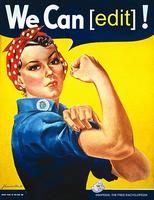
Photo taken by me in the street. No rights reserved.
During our Wikipedia editathon last week I discovered archive news reports of the first ever Scottish charity shop. Ten years before the first Oxfam shop in Oxford. I was editing a new page about the University of Edinburgh Settlement.
In 1936 Grace Drysdale made a film about the everyday activities of the Settlement community and proposed the creation of a ‘Thrift shop’ based on an American idea. The shop would receive items that people did not want, and would accept anything from ‘luggage to cooking utensils’.[11]
A Thrift Shop committee was established in 1936, and the first shop ‘Everybody’s Thrift Shop’ opened in April 1937 at 79a Nicholson Street,[12] 10 years before Oxfam established their first charity shop in 1947. In 1938 the thrift shop was reported as being ‘a more ambitious application of the jumble sale idea’.
When the shop first opened it was a great success. People queued for an hour beforehand in anticipation and policemen were on hand to ensure the stall-holders were not overwhelmed. Reports confirm that bargains: crystal, evening shawls and furniture were to be found and that one woman left delighted with ‘a handsome suit once worn it was whispered, by a professor’.[12] Women carrying bulky purchases were ushered out to make room for other shoppers.
We can edit and we can eat cake. Picture taken by me, no rights reserved, and no leftovers.
The ‘Women, Science and Scottish History editathon‘ series of events in Innovative Learning Week at University of Edinburgh was a great success. We ran sessions on 4 days, had plenty of new students, staff and friends join us, edited more than 30 articles and trained dozens of novice wikipedia editors.
Each day, the one-hour introduction to editing Wikipedia focused on offering tips and insight into different approaches as well as practical training. Participants were welcome to attend as many days as they would like: everyday we added something new. Our Wikimedia trainers (principally Ally, the Wikimedian in Residence at the National Library of Scotland) was on hand to provide assistance, and our librarians ( Marshall, Gavin and Grant) provided specialised materials focusing on the subjects covered.
Knowledge was shared openly. Articles were created or improved. Networks of connections were made and shared topics of interest explored. Copious cake and cookies were eaten, and a fun time was had by all. We plan to do further events and some research to maintain and sustain momentum and support our fledgling crowd community. In December, at the EduWiki conf Ally reported that she had not seen much engagement from University of Edinburgh in Wikipedia projects . At least that’s changed.
Women Singing at a Table (Waulking the Cloth) by Keith Henderson http://www.bbc.co.uk/arts/yourpaintings/paintings/women-singing-at-a-table-waulking-the-cloth-94160
I have been in several meetings this week discussing crowdsourcing and citizen science models for Edinburgh. The terms are often being used interchangably even though they really shouldn’t.
Remembering my time at Oxford I was thinking of the Oxford Community Collection model. This is a model of working we developed to support any organisation in creating a shared collection of digital asssets through online crowdsourcing and personal interaction.
The beauty of the model is that it combines large-scale online crowd-sourcing with personal, individual interaction. The model allows contributors to choose the way they contribute to a collection, offering those who lack the resources, ability, or opportunity to use computers an opportunity to be part of a digital initiative, sharing their material with the world.
The model also includes a real emphasis on planning for with sustainable success. Being part of and interacting with a community is central. This is described and discussed in more detail in RunCoCo: How to Run a Community Collection Online (2011), a report which presents a simple A, B, C of advice for projects:
Aim for Two-way engagement;
Be part of your community;
Challenge your assumptions.
In finding a unique approach at Edinburgh the fact that we have our successful MOOC learner communities has been mentioned. It’s no longer about what you can get 100,000 people to watch or read, it’s about what you can get them to make , do, add and share. And it’s about being part of your community. More on this later.
Have you ever wondered why the information in Wikipedia is extensive for some topics and scarce for others?
Did you know that the Edinburgh Seven were the first women to matriculate to study medicine in HE in the UK? Do you know when? Do you know their names and the things they went on to do? Do you know about the Surgeons Hall riot?
It seems like there is work to be done to enrich the quality and quantity of articles which might inspire people to know more about the history of women in science, particularly in Edinburgh where we have such cracking stories to be told.
During Innovative Learning Week, the University’s Information Services team are running a series of four Wikipedia ‘editathons‘ with the support of the School of Literature, Languages and Cultures, the Moray House School of Education, EDINA, and the National Library of Scotland. We will focus on improving the quality of articles about women in Scottish science history. Working together with archivists, academic colleagues and Wikimedia experts, we will train you how to edit and add information to Wikipedia. It really is very easy.
We will explore how writing Wikipedia articles develops digital literacy and academic writing skills. You will be supported to develop articles covering women in science, Scottish women in history, Edinburgh as the birth place of medicine, the Edinburgh Seven, University history, distinguished Edinburgh alumni etc. We will bring out content from the University archives which has never been mentioned on the Web before and you can bring your research, your knowledge, your search skills, your writing skills.
This series of events will run over a series of afternoons with focused topics. You can attend just once or on multiple days, and can select topics that interest you and which need development on Wikipedia. Training, technical support and subject area advice will be provided throughout. One day we will focus on editing biographies and people pages, another day buildings, places and linking to maps, another day on adding images, but you can work on any of those as we go along.
Each workshop is open to all: campus-based students, distance learning students, alumni, all staff and members of the public.
Once you have learned to edit you will want to do it again and again. Trust me.
As a starting place we have selected people, mostly women, who are significant to the University, medicine and science, past and present, and will bring interesting source materials that will support article development. You are welcome to bring your own topic and source materials. We will be working to improve and extend the articles about:
Mary Anderson (Edinburgh 7)
Charlotte Auerbach
James Miranda Steuart Barry (aka Margaret Ann Bulkley)
Emily Bovell (Edinburgh 7)
Matilda Chaplin (Edinburgh 7)
Sir Robert Christison (opponent of the university education of women)
Mary Crudelius (campaigner for women’s education)
Helen Evans (Edinburgh 7)
Elsie Inglis (maternity health)
Sophia Jex-Blake (Edinburgh 7)
Eve Johnstone (Psychiatry)
Judith MacKay (tobacco control)
David Masson (supporter of the university education of women)
Noreen Murray (molecular geneticist – as in Ken and Noreen Murray Library)
University of Edinburgh Innovative Learning Week (ILW) 2015 #ILW2015 will take place from 16-20 February. Event booking is now open!
ILW 2015 is our fourth annual festival of creative learning and is a chance for students, staff and alumni to develop skills, meet new people and celebrate innovation in our academic community.
This year’s programme includes a fine spread of events hosted or facilitated by LTW in conjunction with friends and partners across the university.
Le Notre, Andre 1679-83 Marly : general plan ECA Library Image http://images.is.ed.ac.uk/luna/servlet/s/c8li5i Collection
The Learning, Teaching & Web Services Division (LTW) brings together the technology enhanced learning, digital education, website, web services and classroom technology teams to ensure that we offer a service to colleagues and students which meets the needs of Schools and Colleges.
LTW will support and engage with initiatives generated by our staff, students, alumni and those outside the University. I hope that colleagues across the collegiate university will engage with our services, case studies and events, give advice to our projects and invite us into ongoing discussions about how best to make use of the technology on offer.
Engaging with users
Since establishing the Division in August 2014 I have been out and about around the University, discussing the support needed for learning, teaching and outreach, and for an enhanced student experience. I have been delighted to find so many colleagues with enthusiasm for new ways of thinking and working as part of a University-wide conversation on digital innovation. Ongoing investment in this area will enable us to maintain excellent services within the University by providing a robust foundation for the enhancement of learning, teaching and communications. The University is moving towards an increasingly open presence on many digital platforms: open educational resources, open data, open science and open practice. Effective digital communications from the University will ensure that this digital shift benefits society on a national and a global scale. The success of massive online and distance learning courses demonstrates that we have found new audiences and collaborators from across the globe. Your help will be needed to make the most of the new website to ensure that those seeking knowledge about any area of academic activity discover relevant work carried out at Edinburgh.
Technology in the classroom
My conversations with colleagues have highlighted an increasing demand for digital skills training and for support to integrate technology into the classroom. The distinction between IT and AV is becoming increasingly blurred: it’s all digital now. For many colleagues it is the technology context – the technology available in the teaching rooms – which influences their choice of media to use. As you would expect in a research institution, colleagues are using the most up-to-date technologies every day in their research. Our challenge now is to find appropriate ways to model those activities in teaching so that students learn how professional researchers make use of the tools, methods and datasets in their field. The technology on campus should provide a flexible environment that lets students and staff experiment, co-create, build, share and learn from each other.
The digital estate
Digital content and tools which make up the university’s digital footprint, or digital estate are growing. Digital content and tools such as Learn, MyEd, Turnitin, PebblePad, mobile apps and webpages have a key part to play in equality and a consistently excellent student experience. Reviewing support for the digital experience requires us to look across the University at what systems and services we provide. It is important to assess how these are perceived, navigated and experienced by students and staff; what shortcomings and gaps there are; and what will be required of these systems and services in five years’ time. Should we invest as much in our digital estate as we do in our physical one?
I am looking forward to working with groups across the institution to identify the services that will help us to deliver what we need locally, nationally and internationally.
Any discussion about wearables in higher education quickly progresses to the age-old question: Can you tell by how some-one is dressed that they are cheating?
Would your exam invigilators know if students were wearing google glasses? How long before there is no more need to write formulae on your sleeve, you’ll be able to just use your cufflink to scroll down? Can you tell how long there is to go on a cheating watch?
It may be that we have to give up entirely on the idea that closed book exams are done in sealed rooms with no extra help.
Or we could do exams in the nude. Or scrubs. Or in special orange exam survival jumpsuits. Good thing we have a costume design degree.
On the 14th January I will be in Huddersfield speaking as keynote at the School of Art, Design and Architecture, Annual Teaching and Learning Conference. Doing my research, looking at their website I see that they also host a Conference on Serious Games.
It seems to me that games may be about to become seriously important in higher education in various ways. People I know have been researching this for years, and I wonder whether the time has finally come. There are many aspects to this , obviously. There is game design, gamification, serious gaming, research about people who play games, the people who design games, the potential for games to be learning environments, for children, for adults, for problem solving, for social skills, for violence, for misogeny etc. Certainly after #gamergate it seems like it is an area of activity with some dark sides which might beneft from having a bit more light shone upon them before activists are hung out to dry.
Universities, beyond their informatics and design departments, will I think, be paying more attention to games soon, if they are not already, because a generation of people for whom computergames and e-sports are commonplace are heading towards university now.
Several universities host major gaming conferences, Nottingham has declared itself Game City.
Picture taken by me in the street. No rights reserved.
My vision and strategy skills were tested during my trip to Online Educa in Berlin after Lufthansa left my luggage in Frankfurt and I stupidly, left my glasses and contact lenses in that luggage. I found myself taking a very myopic view of MOOC strategy, and trying not to fall foul of any immediate tripping hazards.
Luckily the luggage returned before I began my next leg to London.
At the conference I presented a high level overview focusing on the role of the public intellectual; the ways in which we can use digital initiatives to develop town and gown relations; the ways in which we add value to online courses; and the importance of research universities in sense-making in a maelstrom.
I used broad strokes to paint a colourful picture, but that may be becasue everything in the distance seemed slightly blurred.
Many friends and partners from the LERU universites were there, and there continues to be a wide interest in our experience at University of Edinburgh of living with MOOCs.
At ALT I’ll explain why peer-review is good for your soul. As an Aurora role model I’ll explain why table manners are important. In Berlin I’ll explain how MOOCs are changing management in higher education.
I have a very varied job and will be packing several pairs of shoes.