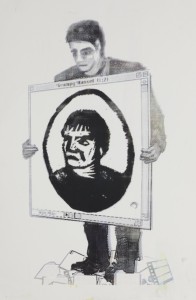
For a technology conference which has its keynotes in a main hall for several thousand people, the Educause presentations were charmingly retro and hardly technology-enhanced at all.
Clay Christiansen (62) spoke about distruptive innovation using slides featuring small type, clip art, serif fonts, copyright assertions and some oddly watermarked images. He modelled the Harvard experience in front of an audience of 4000. He asked us to pray for Harvard Business School. Which we did.
Later on, national treasure Doris Kearns Goodwin (71) lectured for an hour reading rapidly from a pre-written paper accompanied by no visual aids. The audience hung on her every word. More proof, were it needed, that learning technology is grounded in the liberal arts.
I went sessions and presentations about the recent shifts in the open source open communities: Apereo, Kauli and Unizin. There was a lot of talk about freedom and control.
I was surprised how many people wanted to discuss the recent Scottish referendum. More talk of freedom and control.
(c) University of Edinburgh Digital Image Collections CC BY-NC-ND 3.0
‘Have nothing in your library that you do not know to be useful, or believe to be beautiful’, William Morris might have said. In our library we have a copy of the Decretals of Gratian, printed in 1472, which was reputedly the favourite printed book of its owner, Morris himself.
With a movement towards open practice in higher education the topic of learning design in technology enhanced education seems to have become popular again.
“Learning design is the practice of planning, sequencing and managing learning activities, usually using ICT-based tools to support both design and delivery.”1
It acts as a means of eliciting designs from academics in a format that can be tested and reviewed by others involved in the design process, i.e. a common vocabulary and understanding of learning activities.
It provides a method by which designs can be reused, as opposed to just sharing content.
It can guide individuals through the process of creating new learning activities.
It helps create an audit trail of academic (and production) design decisions.
It can highlight policy implications for staff development, resource allocation, quality, etc.
It has the potential to aid learners and tutors in complex activities by guiding them through the activity sequence.
‘Learning design’ has suffered slightly in the UK, I think, from being used interchangeably with ‘instructional design’ which has US and ‘training’ connotations which seem to make it unattractive to academic colleagues who prefer to think that learning is serendipitous, discovery based and personalised. There is also a difference between ‘designing for learning’, ‘learning by design’ and ‘learning design’. One difference is that learning design comes with its own set of technical standards which shape tools and platforms.
University of Edinburgh Digital Image Collections CC BY-NC-ND 3.0 ECA Photography Collection
University of Edinburgh is about to embark on a large scale media recording and management project, not unlike those going on at many of our peer universities. We aim to improve our media systems capability to support recording, storing, streaming and managing the increasing collection of audio and video assets used across the collegiate university for learning, teaching, research and public engagement. The existing infrastucture is outmoded and does not offer to the university the service and functionality users currently expect. Failing to refresh the existing systems represents a risk to the university, and to IS, in not being able to respond to business needs of the schools and colleges who wish to make more use of audio and video online for an improved student experience.
We will also explore approaches to the publishing of resources under intellectual property licenses ( eg Creative Commons) that permits use and repurposing ( re-use, revision, remixing, redistribution) by others where appropriate.
The early stages of such a project have the fun bits of finding out who in the University is doing what already in preparation for putting in place a multi-platform broadcast strategy. So far I have discovered You Tute, Research in a Nutshell, dozens of Youtube channels, Edinburgh University on ItunesU, Panopto, CaptureED and of course, our MOOC videos. We are also tracking down a list of all the video and audio recording studios around the place.
Edinburgh University subscribes to the excellent ‘Box of Broadcasts’ service. BoB enables all staff and students to choose and record any broadcast programme from 60+ TV and radio channels. The recorded programmes are then kept indefinitely (no expiry) and added to a growing media archive (currently at over 1 million programmes), with all content shared by users. Staff and students can record and catch-up on missed programmes on and off-campus, schedule recordings in advance, edit programmes into clips, create playlists, embed clips into Learn or Moodle, share what they are watching with others and search a growing archive of material. It will be fascinating to discover the ways in which this service is being used.
Edinburgh is also part of BUFVC which offers an amazing Moving Image gateway which includes 1,600 websites relating to moving image and sound materials in over 40 subject areas.
I am confident that Edinburgh must have a hefty collection of film in its own archives. It would be fun to do a project here like Oxford University IT Services have done this summer in Dreaming Spools. The project has engaged with alumni all over the world and discovered a wealth of film and video made by some of the most influential film makers, journalists, artists, writers, actors, activists and technicians during the periods when they were students.
University of Edinburgh Digital Image Collections CC BY-NC-ND 3.0 ECA Photography Collection
I get asked about this a lot.
As the library advice pages rightly say: It is a common misconception that there is an “exception” to copyright for educational purposes. In fact “fair dealing” only covers non-commercial research or study, criticism or review, or for the reporting of current events, but this does not extend to making copies of texts for students to use in the classroom, or to including images in presentations. It can be an infringement of copyright to include copyrighted images in teaching materials without permission.
Luckily there are a wealth of images collections which have been licensed for re-use with Creative Commons. In these collections you can easily see the permission you have been given and there is no need to undertake the onerous task of tracking down the copyright holder, or consulting a librarian.
Choosing Creative Commons images saves you time and effort as well as being good practice.
Some of these collections even include handy tools to help you attribute the images once you have decided to use them so you will never again forget from where you got them.
Picture taken by me in the street. No rights reserved.
I have spent a couple of days this week at the ALT ( Association of Learning Technologists) Conference at Warwick. There were three keynote presentations. Each really interesting in its own way and each building upon the other. The assembled delegates were very well served (as were those tuning in online)
The first keynote was by Jeff Haywood, VP and leader of IS (University of Edinburgh). I would not ever want to give the impression that one has to go away to conferences to hear what is going on in your home institution, but it was fun to see it all up on the big screen and to tune in to the twitter comments from our peer community.
Jeff was followed by a keynote from Catherine Cronin (National University of Ireland). Her presentation covered the importance of values in open practice, how her values have been shaped by experience, the importance of voting and a very clear representation for women in this workplace/space. Her presentation was clearly inspirational for many, as reflected in the tweets from audience members and the high turn out at the Open Education SIG a couple of hours later. She signalled that education is a political space and that openness must be informed by what we know about gender, race and class.
Audrey Watters’ ( no institution) keynote also drew upon history and literature. I begin to suspect that a good grounding in the liberal arts is a useful background for educational technologists. She talked about man-made monsters and drew inspiration from previous writers and actors (including the luddites)*.
As I listened to the presentations and audience questions there was much to reflect upon, a couple things are high in my mind though. I have been thinking about the politics of code, the values upon which it is based and in-built assumptions it can embody. I mentioned Bodington in a previous post. That was a VLE designed on the assumption that all the same tools which were available to teachers would also be available to students. It was in there in the architecture, it did not privilege the teacher’s voice, it was a tool to democratise the classroom. I like technology which is based on those kind of values.
I was surprised at the conference to hear several people refer to Facebook as ‘open’ and as a space where great things can be done, a place that students have as a ‘good place’ and that educators should use. While I use facebook personally as much as the next woman, I have no illusions as to its origins and the values of its creators. Facebook was born out of misogyny in elite univerisities and continues to be a place where peer pressure and shaming are rife. I like those values less.
I agree with Jeff, Catherine and Audrey: it is important that we understand our history and learn from our experiences.
There were many mentions of MOOCing cash cows and very few of cultural imperialism or sustainability. In general, the ALT conference made little mention of FOSS or CC although WordPress, Moodle and open badges did get multiple mentions and showcases. A strong representation from the Scottish institutions and Open Scotland, but no discussion of what we’ll do when they cut us off from JANET.**
I could happily go a long time without hearing the phrase ‘herding cats’ again.
You are wondering if I actually attended any sessions about technology. I can assure you that many salespersons showed me theirs.
*I had a heated dinner table discussion with someone at the conference who believed that luddites lived in caves. I suspect he meant troglodytes.
** and despite several mentions of Luddites and laggards, no reference, even in the OER sessions, to Levellers.
The horizon ( as seen from the rooftop terrace of Evolution House) looks bright, and near, and enlightened. What a privilege to spend a beautiful morning in a stunning venue brainstorming creative ideas with clever and motivated colleagues. I enjoyed reflecting on the last 15 years which have brought me back to this place and on how much easier life is now that the we have a licensing framework that the creators of works can understand, their users can understand, and even the Web itself can understand.
Two of the things I like about Creative Commons are the mission and the vision. These seem to me like values a university’s learning, teaching and web service should embrace.
Our mission
Creative Commons develops, supports, and stewards legal and technical infrastructure that maximizes digital creativity, sharing, and innovation.
Our vision
Our vision is nothing less than realizing the full potential of the Internet — universal access to research and education, full participation in culture — to drive a new era of development, growth, and productivity.
Picture taken by me in my house . No rights reserved.
Before I left Oxford I was given an unusual gift of some skeleton tableware. Due to a clerical error only 5 plates rather than 6 arrived. Amusing questions to the supplier followed: Had they put the right leg in, or was the right leg left out? In, out, in, out, that is what it was all about.
This week I was intrigued to try out the Anatomage table in Edinburgh University’s Dept of Anatomy. It’s the only one of its kind in Scotland and I think , one of only two in Britain. It’s a technologically advanced anatomy visualization system for anatomy education, it works with big data sets from CT scans and is used a bit like a big, table-sized i-pad. An i-bed perhaps.
It cost an arm and a leg, you use your finger to slice through bones and skin.
The anatomage table is table-like presumably to help human practitioners cope with the transition from the physical ( one dead body lying down) to the virtual ( multiple bodies spinning around). It was interesting that the discussion amongst my academic and learning spaces technology colleagues in the group quickly moved to the ways in which we could release/move the image from the table on to a standing screen, projector screen or interactive whiteboard.
Dissected virtual cadavers* are going to be a bit spooky at the best of times. The fact that these are located in the famous medical school skull room makes it even more stark. A contrast of shiny new cutting-edge virtual digital cutting technology in amongst some of the University’s earliest teaching objects.
The colleagues who generously showed us around are looking forward to new software updates and new body scans. As we stood, a small group around the table we did note however, that while the current male cadaver was wearing a modesty loin cloth, the female cadaver was afforded no such covering.
* is it still a cadaver if it is virtual? perhaps it is just a virtual body. Once it is digital the ‘dead’ aspect seems less relevant given we are training doctors who will operate on mostly alive people.
University of Edinburgh Digital Image Collections CC BY-NC-ND 3.0
One of the best things about working in a research university is that you get to hang out near elegantly curated collections of beautiful old things. I am beginning to explore the University of Edinburgh libraries and research collections. Starting of course, with the collections of digital images online; so many wonderful things to find.
Today I am extra-excited to receive, courtesy of my colleagues in UL&C, my very cool new IS business cards, each with a selected beautiful image from our collections on the back. Thank you to Jo and Anne-Marie for knowing I’d enjoy them.
University of Edinburgh Digital Image Collections CC BY-NC-ND 3.0
During my first week in my new post I gathered together all of the staff on the new LTW division. They look much nicer in person than in the card-database-rogues-gallery I have on my wall. For my presentation I used images from the splendid SCRAN collection to which Edinburgh University has a subscription. The collection includes some cracking images of computers and computer users in the university dating back to the 60’s and 70’s. With all the fashions of geek-style throughout the decades. I’d show you some, but for some reason the license under which SCRAN grants use are a bit confusing as regards internet, blogging, sharing, publishing and educational use. Nevermind, here is a picture of some more recent computer users in one of our learning spaces.