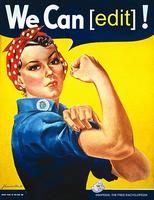
Photo taken by me at Summerhall hacklab. No rights reserved by me.
We are recruiting a Digital Recruitment and Marketing intern. If you are an Edinburgh University student check out our advert on employ.ed.
Information Services Group at University of Edinburgh is one of the largest IT employers in Scotland. We are looking for a digital marketing intern to work with us to enhance our online presence, and specifically our ‘company profile’ on LinkedIn to ensure that we attract the best candidates and showcase our organisation as a great place to work. You will work closely with managers across our organisation to provide advice to us on how best to use online recruitment tools and strategies and to develop content and stories for our LinkedIn profile.
Use your digital marketing expertise and copy-writing skills to design and populate our LinkedIn company profile which will:
Be effective in recruiting the best IT and Library staff for our organisation.
Showcase ISG as a great place to work and a good project partner.
Showcase the career paths and profiles on offer in our organisation.
Promote our family friendly, inclusivity and flexible working policies.
Report on metrics to monitor success.
Be easy for our recruiting managers to continue to use after your internship has finished.
You will gain real life experience of working with a large employer to enhance our business through effective use of digital marketing and recruitment tools.
Essential:
Excellent copy-writing and editorial skills.
A well designed and effective profile on LinkedIn.
Good social media nous and understanding of how the internet works for companies and organisations.
Evidence of being able to identify examples of good practice in digital recruitment and advertising.
An up to date knowledge of good practice in HR and marketing strategies.
A keen eye for detail.
Desirable:
Graphic design or journalism skills.
Experience of writing ‘how to’ guides or workplace training.
Our Wikimedian in Residence (WiR) partnership is a result of a long term engagement and also a credit to the quality of the UK Wikimedians and their ability to support, impress and influence senior managers, who in turn, shape institutional strategies and investment.
I have been repeatedly impressed by the quality of the Wikimedians and the generosity of their host organisations to help at events. It seems to me only fair that University of Edinburgh which has benefitted so much from our local WiRs should now host a WiR to continue a sustained involvement with the scheme and the Wikimedia UK community. Once Edinburgh has shown the way I hope the other Scottish universities will follow suit to ensure that there is always at least one WiR for the nation.
Background
When I was Director of Academic IT at University of Oxford my teams attended the editathon organised by JISC (June 2012) to improve articles on the Great War . Oxford holds an elegant collection of crowd-sourced and expert-curated content in the Great War Archive and we were keen to ensure, in advance of the centenary, that our collection of open educational resources (OER) could support public engagement and school teaching on the topic. Martin Poulter was WiR at JISC at the time.
In 2013 we hosted an editathon at Oxford for Ada Lovelace Day. Martin provided training for the event and brought several other wikimedians to help. Liz McCarthy and Kate Lindsay worked with Martin to make the whole event a great success and I was entirely sold on the idea.
Oxford hosted another editathon for Ada Lovelace Day 2014, but by that time I had moved job to become Director of Learning, Teaching and Web Services at University of Edinburgh. There had not yet been any wikipedia editathons at Edinburgh so I brought my new colleagues to the EduWiki conference to find out more. Ally Crockford spoke at the event and she highlighted the WiR scheme. I met with Gill Hamilton at National Library of Scotland (NLS) to learn about the job descriptions, support and work plans which would be successful for a WiR partnership.
Edinburgh University runs an annual Innovative Learning Week designed to enable staff and students to attend day long, or week long events outside of normal timetabling patterns. The first Edinburgh editathon ran during ILW 2015. Ally and Sara Thomas came to help. Ally was very bold and went for an event spanning the full 4 days.
We certainly couldn’t have done it without Ally and Sara but the striking thing for me was how quickly colleagues within the University took to the idea and began supporting each other in developing their skills and sharing knowledge amongst a multi-professional group. This inspired me to commission Allison Littlejohn and her team to do some academic research to look at the connections and networking amongst the participants and to explore whether editathons were a good investment in developing workplace digital skills.
This is the research I presented at Martin’s Wikipedia Science Conference which underpinned my business case for establishing a WiR at University of Edinburgh with focus on skills development as part of the University’s commitment to open knowledge.
This year University of Edinburgh is hosting an international conference on open educational resources : OER16. I am delighted to see so many papers accepted from wikimedia projects. We will also run an editathon alongside the event and hopefully convert even more OER practitioners to the joys of Wikipedia editing. Three of the keynote speakers at the event are from organisations with WiR: John Scally for NLS, Emma Smith for Oxford and me for Edinburgh. Each of these organisations are making big public commitments to open knowledge, sharing and public engagement. Partnership projects with Wikimedia UK is part of the way we do that.
WiR at University of Edinburgh
Ewan McAndrew has been appointed The University of Edinburgh’s Wikimedian-in-Residence.
His year-long residency will run from January 2016 to January 2017 and involves facilitating a sustainable relationship between the university and Wikimedia UK to the mutual benefit of both communities.
To do this, he will be an advocate of open knowledge and deliver training events and workshops which will further both the quantity and quality of open knowledge and the university’s commitment to digital literacy.
More practically, this will involve arranging and delivering skills-training sessions which will fit in with and, importantly enhance, the learning and teaching within the curriculum. He will also stage events outside the curriculum which will draw on the university’s, and Edinburgh’s, rich history and knowledge.
Wikipedia Edit-a-thons will be a large part of this; however, there are numerous ways staff and students can get involved and directly contribute their knowledge and expertise to develop Wikimedia UK’s diverse range of projects.
Ewan is based in the Learning, Teaching & Web Services Division within the Hugh Robson Link Building. You can keep up to date with the residency through Twitter, the WiR blog and through the Wikipedia Project page.
To contact Ewan McAndrew, to discuss collaborating together or just to find out more, email: Ewan.McAndrew@ed.ac.uk
Dermatome man, early twentieth century. (c) University of Edinburgh https://www.flickr.com/photos/crcedinburgh/23707548313/in/album-72157661120362394/ CC BY-SA 2.0
“There are now some astonishingly interesting additions to Wikipedia which just simply weren’t there before….
Including:
Anne’s article on Norman Dott – the first holder of the Chair of Neurological Surgery at the University of Edinburgh.
Gavin’s one man ‘Citation Hunt’ crusade to plug those pesky ‘citation needed’ labels in articles.
Chris’s work on Robert Battey – an American physician who is known for pioneering a surgical procedure then called Battey’s Operation and now termed radical oophorectomy (or removal of a woman’s ovaries).
Melissa’s noteworthy work doubling (if not trebling) the article on Mary Fairfax Somerville – a Scottish science writer and polymath, at a time when women’s participation in science was discouraged. As well as editing articles on Isabel Thorne, Matilda Chaplin Ayrton and the Scottish Blood Transfusion Service.
Christine’s new ‘Controversy’ section on the intriguing case of James Miranda Barry.
Our historian of medicine, James’s work on The Brunonian system of medicine – a theory of medicine which regards and treats disorders as caused by defective or excessive excitation.
Mary’s first ever article on Leith Hospital – illustrated with pictures she took herself and uploaded to Wikicommons.
Eugenia’s articles on Frances Helen Simson (a Scottish suffragist) and The Edinburgh Royal Maternity and Simpson Maternity Hospital Pavilion. Ably added to by Luise Kocaurek’s work on Lady Tweedale.
Anne-Marie’s work on Emily Bovell’s article and a brand new article on the New Zealand Army Nursing Service page which came into being in early 1915, when the Army Council in London accepted the New Zealand government’s offer of nurses to help in the war effort during the First World War.
Neil’s articles on ‘Fabry disease’ – a rare genetic lysosomal storage disease – and on ‘Alport Syndrome’ – a genetic disorder] affecting around 1 in 5,000 children, characterized by glomerulonephritis, end-stage kidney disease, and hearing loss.
Sara’s sterling work uploading images and flitting about improving articles on Leith Hospital, Edinburgh University’s Women’s Union and many more articles.
Kimberley’s work on Frances Hoggan – the first British woman to receive a doctorate in medicine from a university in Europe, and the first female doctor to be registered in Wales.
And much much more besides…. including LiuLing’s work on The Royal Infirmary of Edinburgh on Chinese Wikipedia!”
By Zahari Zograf (1810–1853) [Public domain], via Wikimedia CommonsFebruary 14th is St Valentine’s day. It is also the day we celebrate the patron saints of metadata.
Commemorated on this day are a pair of Slavonic brothers Saints Cyril and Saint Methodius who are the patron saints of data management. Cyril and Methodius began translating the Bible in the 9th Century but ran up against the problem of the lack of a suitable alphabet.
This is a common research problem: They had access to a substantial body of important information; they wanted to share this with a wider audience, and to ensure that it was transmitted accurately and preserved for posterity in a way that would be easily comprehensible. When they found that no existing encoding system was adequate for the task, they set about developing a new one.
Undeterred, Cyril invented a new coding system. He invented a new alphabet. His work formed the basis for Cyrillic, still widely used today. Methodius ‘s name was actually Michael but he changed it to reflect his key research priorities: persistent pursuit of truth conducted in an orderly and methodical way.
How many among us now are so committed to our research that we would change our name?
Do you want to learn how to write for the world’s largest encyclopeadia? Do you want to make knowledge available for the whole world to share? Do you like eating biscuits, meeting new people and having fun?
Building on the tremendous success of last year’s Innovative Learning Week Wikipedia editing extravaganza, we invite all to once again come along and join in.
The focus of this years’ event will be on the History of Medicine. You don’t need to know anything about the subject to participate. Suggestions of topics to create or edit, along with supporting resources will be available, and training will be provided by a professional Wikimedian. If you have a laptop or tablet, please bring it along.
Picture taken by me at Edinburgh Napier, Craiglockhart. No rights reserved by me.
After a quiet time in the last couple of years Girl Geek Scotland relaunched in considerable style last night with a keynote address by Nicola Sturgeon.
Edinburgh Napier University have offered them a home and the Principal, Andrea Nolan and the Dean of Computing, Sally Smith both spoke about the role women do play and should play in the tech sector in Scotland.
We are only 18% it seems, so even though there are no shortage of well paid, interesting, rewarding, professional jobs out there, the guys are still getting them all.
Booking is now open for #OER16 . More than 100 papers accepted, some fine looking speakers, and some of the funnest people with whom you could ever care to discuss the minutae of copyright law.
In this week we will also be launching our new Edinburgh University OER showcase website Open.ed, and celebrating the ratification of our OER policy by University of Edinburgh Learning and Teaching Committee.
Picture taken by me in my house. No rights reserved by me.
ISG is an organisation with a diverse workforce. As the first in our ‘PlayFair Steps‘ equality initiative seminars we invited Wendy Loretto, Deputy Dean and Professor of Organisational Behaviour at University of Edinburgh Business School to talk to ISG staff about ‘Understanding age in the workplace’. Wendy’s main research field is age and employment, with a particular focus on changes in employees’ and employers’ attitudes and practices in extending working lives. She gave us an overview of the issues, challenges and opportunities and brought critical insight to this topic questioning some of the rhetoric and assumptions that underpin much of the policy and mainstream management discourses. The session prompted group discussions amongst ISG colleagues and suggestions for real changes to move us towards working inclusively.
Picture taken by me in the street. No rights reserved by me.
Do you remember when we used to dream that MOOCs would disrupt traditional higher education? Bringing new ways of thinking, learning and interacting?
Today I sat for hours at a Futurelearn partnership event in a hot room balancing my laptop on my knee while a bunch of men presented from the front and ran over time. The group discussion slots were cut short and when a woman did finally speak from the front, her Q&A was cancelled completely.
I pointed out the notable lack of women on the programme to a couple of people. They looked surprised.