The 7th Open Educational Resources Conference, OER16: Open Culture, will be held on the 19th-20th April 2016 at the University of Edinburgh.
The vision for the conference is to focus on the value proposition of embedding open culture in the context of institutional strategies for learning, teaching and research. The conference will be chaired by Melissa Highton, Director of Learning, Teaching and Web Services at the University of Edinburgh, and Lorna Campbell, OER Liaison at the University of Edinburgh and EDINA Digital Education Manager.
And there will be a strong Wikimedia UK presence at the event.
![By Robin Owain (WMUK) (Own work) [CC BY-SA 4.0 (http://creativecommons.org/licenses/by-sa/4.0)], via Wikimedia Commons](http://thinking.is.ed.ac.uk/wir/wp-content/uploads/sites/14/2016/04/Jason_Evans-300x265.jpg)
Jason Evans by Robin Owain (WMUK) (Own work) [CC BY-SA 4.0 (http://creativecommons.org/licenses/by-sa/4.0)], via Wikimedia Commons
is the current
Wikimedian in Residence at the
National Library of Wales. He is also a professional genealogist with a wealth of experience in researching all aspects of Welsh family and local history. This residency will contribute towards the NLW’s aim of providing ‘
Information for All’ and in turn will draw people back to the services and collections of the Library. Information about previous, ongoing, or future Wikipedia-National Library of Wales collaborations are updated regularly on the
National Library of Wales project page.
Jason has worked closely with the Library to release over 15,000 images into the public domain via Wikimedia Commons and has held dozens of public events at the Library and through out Wales. Working closely with other cultural partners in Wales the aim has been encourage and facilitate increased open access across the sector by affecting policy change. Jason has also set-up and run a number of successful Wikimedia projects with the Library’s dedicated volunteer team. The residency is increasingly focusing on Wikipedia in the education sector and he has made steps towards embedding a Wikipedia based projects into the Welsh curriculum for 16-18 year olds and has proposed a series of talks for sixth form students about using Wikipedia responsibly. He has also helped several universities to use Wikipedia as vehicle for outreach and gender equality projects.
![Martin Poulter By Ziko (Own work) [GFDL (http://www.gnu.org/copyleft/fdl.html) or CC BY-SA 4.0-3.0-2.5-2.0-1.0 (http://creativecommons.org/licenses/by-sa/4.0-3.0-2.5-2.0-1.0)], via Wikimedia Commons](http://thinking.is.ed.ac.uk/wir/wp-content/uploads/sites/14/2016/04/Martin-Poulter-300x200.jpg)
Martin Poulter by Ziko (Own work) [GFDL (http://www.gnu.org/copyleft/fdl.html) or CC BY-SA 4.0-3.0-2.5-2.0-1.0 (http://creativecommons.org/licenses/by-sa/4.0-3.0-2.5-2.0-1.0)], via Wikimedia Commons
From April 2015 to March 2016, Martin Poulter was the Wikimedian In Residence at the Bodleian Libraries, Oxford. The project page is at Wikipedia:GLAM/Bodleian. From June 2013 to April 2014, Martin was the Jisc Wikimedia Ambassador running a project to explore overlaps between Jisc, Wikimedia, and academia in general. A certified Lead Trainer for Wikimedia UK in Membership Development and a trained Campus Ambassador as part of the Wikipedia Education Program, on English Wikipedia Martin has more than eleven thousand edits, mainly in the area of psychology. Martin also has hundreds of edits on Wikibooks, a thousand on Wikisource, and thousands of edits cataloguing scientific images on Commons.
In addition, Martin invented the EduWiki Conference (based on an original drink with Fabian Tompsett) and the Wikipedia Science Conference.
![Sara Thomas By Lirazelf (Own work) [CC BY-SA 4.0 (http://creativecommons.org/licenses/by-sa/4.0)], via Wikimedia Commons](http://thinking.is.ed.ac.uk/wir/wp-content/uploads/sites/14/2016/04/Sara_Thomas_Wikimedian_in_Residence-e1460492467893-300x225.jpg)
Sara Thomas By Lirazelf (Own work) [CC BY-SA 4.0 (http://creativecommons.org/licenses/by-sa/4.0)], via Wikimedia Commons
Sara Thomas is the Wikimedian in Residence for Museums Galleries Scotland, the national development body for the Scottish museums sector. She’s also an event manager and social/digital media trainer with experience in both the private and third sectors. Since January 2015 in this part time role she’s worked with around 80 cultural institutions to provide training, facilitate content upload and generally advocate for the use of open knowledge in a museums context. She’s trained 280 new users of Wikipedia, run 16 editathons, 20 training sessions and spoken at 25 seminars, workshops and conferences, taking in museums, libraries, and universities. A backstage pass event at Glasgow Museums brought some of the lesser-seen elements of Kelvingrove Museum, Kelvin Hall and the Riverside Museum to the Commons; an editathon dedicated to rent strike organiser and activist Mary Barbour contributed to the campaign for greater recognition of her work; and a recent series of editathons with the National Galleries of Scotland created biographies of key Scottish female artists missing from Wikipedia.
In the last two months of the project Sara will be working with Groam House Museum in Rosemarkie, Glasgow School of Art, Glasgow Women’s Library and Govan’s Hidden Histories to bring Scotland’s rich cultural heritage to a wider audience.

Lucy Crompton-Reid
Lucy Crompton-Reid
Lucy Crompton-Reid joined Wikimedia UK as the new Chief Executive in October 2015, and is working with the staff team, board of trustees and wider Wikimedia community to develop a new strategy and business plan for the charity and to help shape the work of the programmes team. She will also be driving forward the organisation’s advocacy, communications and fundraising activities, and engaging new strategic partners. Lucy has worked in the cultural, voluntary and public sectors for nearly two decades, with past experience including senior roles at Arts Council England, British Refugee Council and the House of Lords. Most recently, she was Chief Executive of the national literature charity Apples and Snakes, England’s leading organisation for performance poetry and spoken word. Throughout her career, Lucy has had a particular focus on widening participation, and brings a strong commitment to access, learning and public engagement in her new role at Wikimedia UK.

Me in Mallaig after walking the West Highland Way and riding the Harry Potter train.
Ewan McAndrew (yours truly)
An MA graduate in English & Modern History from the University of Glasgow, Ewan McAndrew went on to study Software Development at Glasgow Caledonian University before moving abroad to teach English. Ewan has taught in Japan, South Korea & Singapore which, in turn, has allowed him to travel throughout Asia, Australia, North America & South America.
A PGDE English & Media teacher for the last few years, Ewan has taught in various parts of Scotland and worked increasingly with heritage institutions, most recently with the Glasgow School of Art’s Archives team on their WW1 ‘Roll of Honour’ project.
Ewan is the current Wikimedian in Residence at the University of Edinburgh. Previous editathons have been on the ‘History of Medicine’ for Innovative Learning Week 2016, ‘Art & Feminism’ (with the National Galleries of Scotland & Sara Thomas), ‘Women in Art & Science’ for International Women’s Day 2016 and ‘Women in Espionage: Fact & Fiction’ for Spy Week 2016 in partnership with the English Literature and History departments at the University of Edinburgh.
Wikimedia at OER16
Sara Thomas, Lucy Crompton-Reid and Martin Poulter will all be presenting sessions at OER16.
The programme for OER16 (with details of these sessions) can be found here: OER16 website.
In addition, the following sessions will also be available to OER delegates.
1) Wikipedia Training 1.20-2pm 19/04/2016
Editing Wikipedia has never been easier with the new WYSIWYG Visual Editor interface which makes editing Wikipedia as easy as blogging or utilising MS Word. A 2014 Yougov survey found that around two thirds of the British public trust Wikipedia more than traditional news outlets including the BBC, ITV, the Guardian and the Times.
One of the most visited websites worldwide, and now one of the most trusted, Wikipedia is a resource used by most university students. Increasingly, many instructors around the world have used Wikipedia as a teaching tool in their university classrooms as well.
Indeed, as the drive for scholarly research to become ever more Open Access gathers pace, Wikipedia will increasingly become the digital gateway to this research.
Full training will be given – just bring a laptop or tablet with you and start editing!
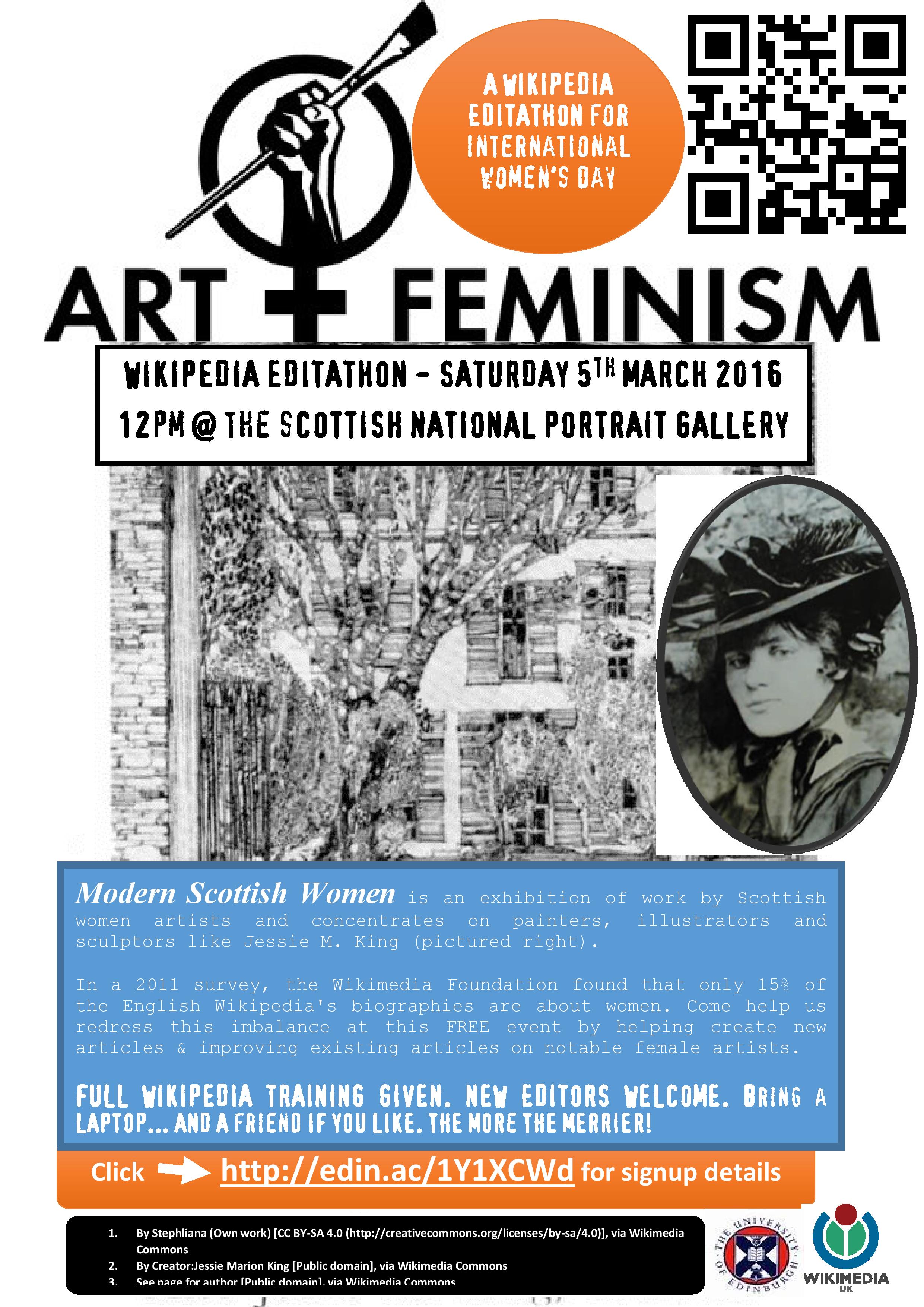
2) Wikipedia Editathon 2-3pm 19/04/2016 – Women in Art, Science & Espionage
Did you know that only 16% of biographies on Wikipedia relate to notable females?
Once training is completed, why not join us for an editathon to improve Wikipedia’s coverage of Women in Art, Science & Espionage to put these skills into practice & help redress the balance?
Contributing to Wikipedia during an editathon can be about creating an entirely new page on Wikipedia (250 words minimum backed up by at least 3 references) or as simple as adding a citation or an image to an existing article or even just fixing a typo. Full training will be given at 1.20-2pm so feel free to join us for the editathon afterwards from 2-3pm or drop in to ask us questions about Wikipedia & its sister projects.
Just bring a laptop or tablet with you and start editing!
3) Ask a Wikimedian: Drop-in clinic 1.20-2pm 20/04/2016
OER16 has a number of Wikimedians attending in Ewan McAndrew (Wikimedian in Residence for University of Edinburgh), Sara Thomas (Wikimedian in Residence for Museums & Galleries Scotland), Martin Poulter (Wikimedian in Residence for the Bodleian Library, Oxford University) and Jason Evans (Wikimedian in Residence for the National Library of Wales).
This lunchtime session will allow you to ask questions about their experiences & seek advice, be it on working with Wikipedia or its sister projects.
4) Wikisource Demonstration: 2pm-2.25pm 20/04/2016
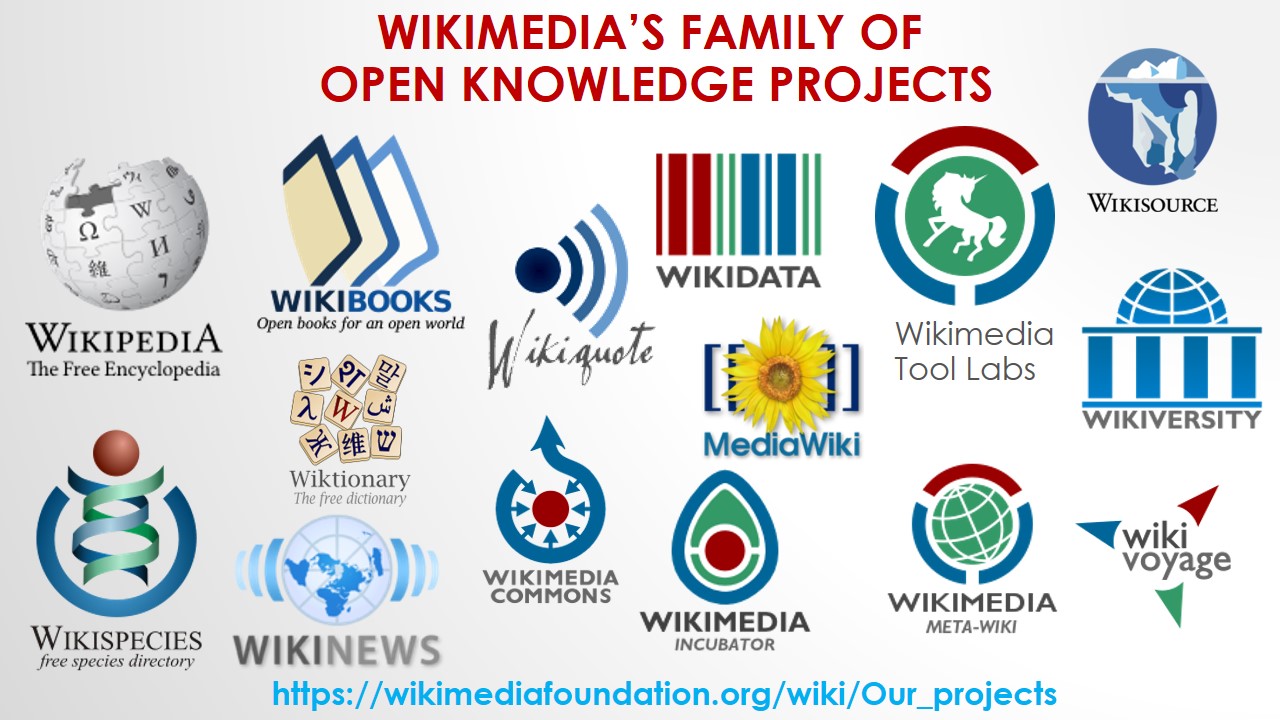
Martin Poulter (Wikimedian in Residence for the Bodleian Library, Oxford University) will demonstrate how to get the best out of Wikisource. Wikisource is a multilingual project, started in November 2003, to archive a collection of free and open content texts. It is not only a superior format for storing classics, laws, and other free works as hypertext, but it also serves as a base for translating these texts. At the beginning, source texts in all languages (except Hebrew) were all on one wiki. However, Wikisource now has several editions in many individual languages.
NB: Please bring a laptop of tablet with you to allow you to navigate around Wikisource.
5) Wikipedia Editing Training: 2.25-2.50pm 20/04/2016
Editing Wikipedia has never been easier with the new WYSIWYG Visual Editor interface which makes editing Wikipedia as easy as blogging or utilising MS Word. A 2014 Yougov survey found that around two thirds of the British public trust Wikipedia more than traditional news outlets including the BBC, ITV, the Guardian and the Times.
One of the most visited websites worldwide, and now one of the most trusted, Wikipedia is a resource used by most university students. Increasingly, many instructors around the world have used Wikipedia as a teaching tool in their university classrooms as well.
Indeed, as the drive for scholarly research to become ever more Open Access gathers pace, Wikipedia will increasingly become the digital gateway to this research.
This will be a truncated training session from the one offered on 19th April but will introduce you to the basics of utilising the new Visual editor interface – just bring a laptop or tablet with you and start editing!
Hopefully see you there and you can meet the gang!



![By Robin Owain (WMUK) (Own work) [CC BY-SA 4.0 (http://creativecommons.org/licenses/by-sa/4.0)], via Wikimedia Commons](http://thinking.is.ed.ac.uk/wir/wp-content/uploads/sites/14/2016/04/Jason_Evans.jpg)
![Martin Poulter By Ziko (Own work) [GFDL (http://www.gnu.org/copyleft/fdl.html) or CC BY-SA 4.0-3.0-2.5-2.0-1.0 (http://creativecommons.org/licenses/by-sa/4.0-3.0-2.5-2.0-1.0)], via Wikimedia Commons](http://thinking.is.ed.ac.uk/wir/wp-content/uploads/sites/14/2016/04/Martin-Poulter.jpg)
![Sara Thomas By Lirazelf (Own work) [CC BY-SA 4.0 (http://creativecommons.org/licenses/by-sa/4.0)], via Wikimedia Commons](http://thinking.is.ed.ac.uk/wir/wp-content/uploads/sites/14/2016/04/Sara_Thomas_Wikimedian_in_Residence-e1460492467893.jpg)







![Jimmy Wales cuts the cake - By Gordon Joly (Own work) [CC BY-SA 4.0 (http://creativecommons.org/licenses/by-sa/4.0)], via Wikimedia Commons](http://thinking.is.ed.ac.uk/wir/wp-content/uploads/sites/14/2016/02/Jimmy_Wales_cuts_the_cake.jpg)