Supporting the University of Edinburgh's commitments to digital skills, information literacy, and sharing knowledge openly

Tag: University of Edinburgh Page 3 of 4

History of Medicine 2017 – Outcomes

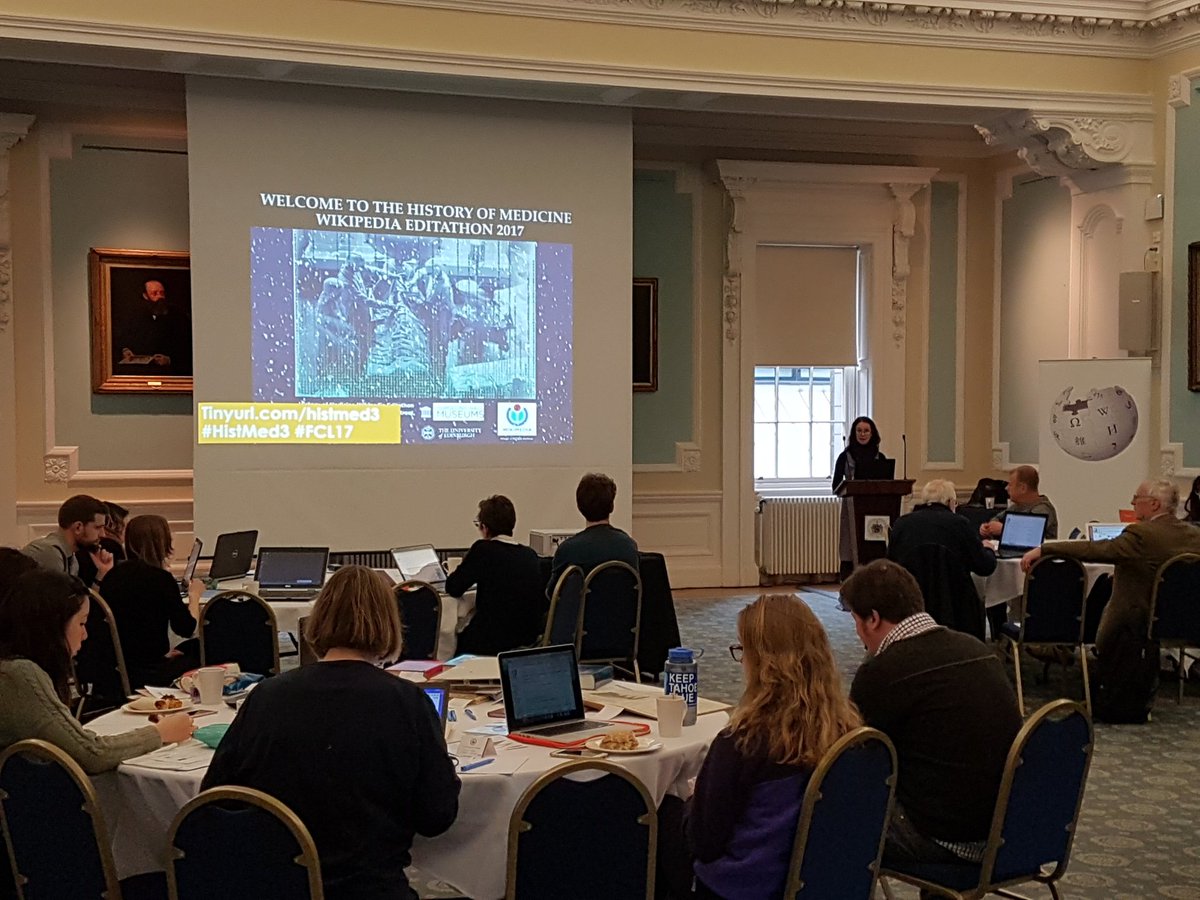
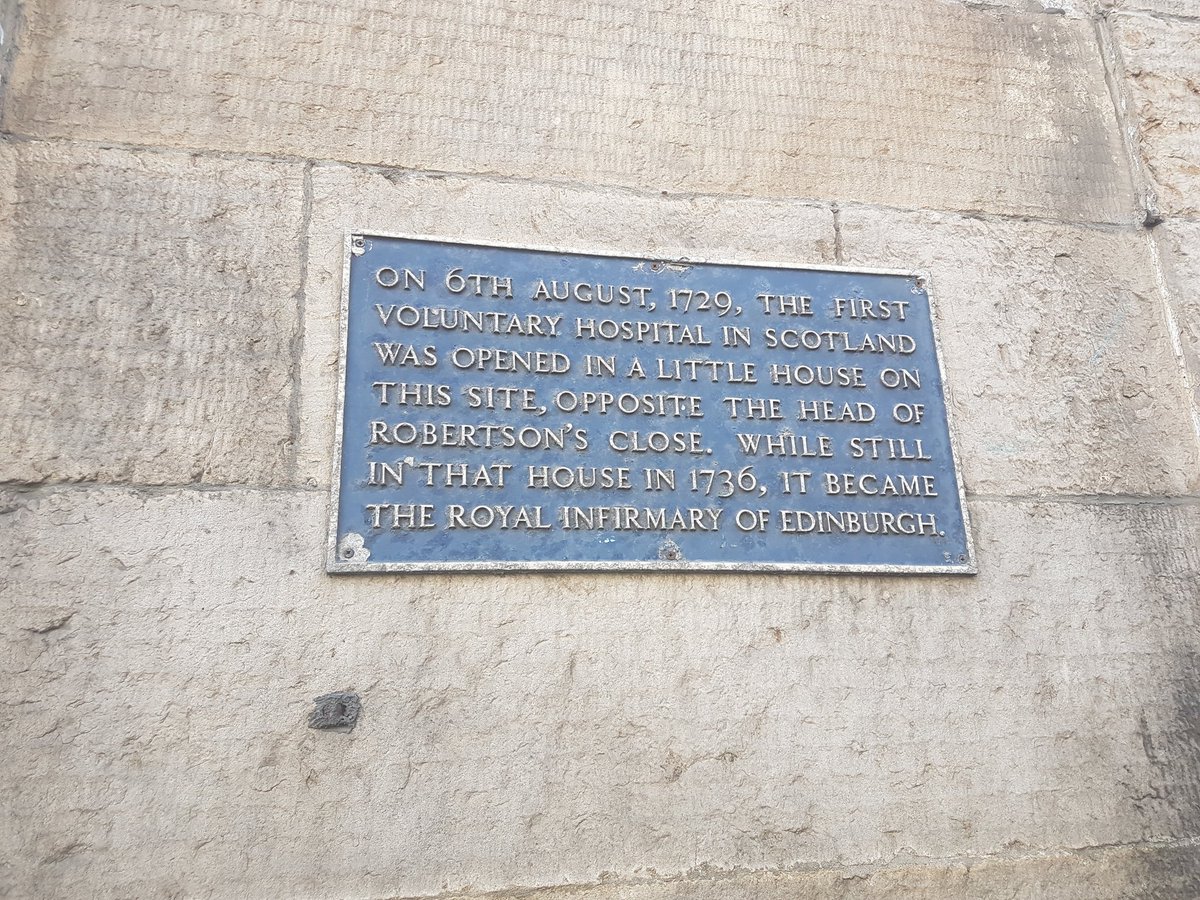
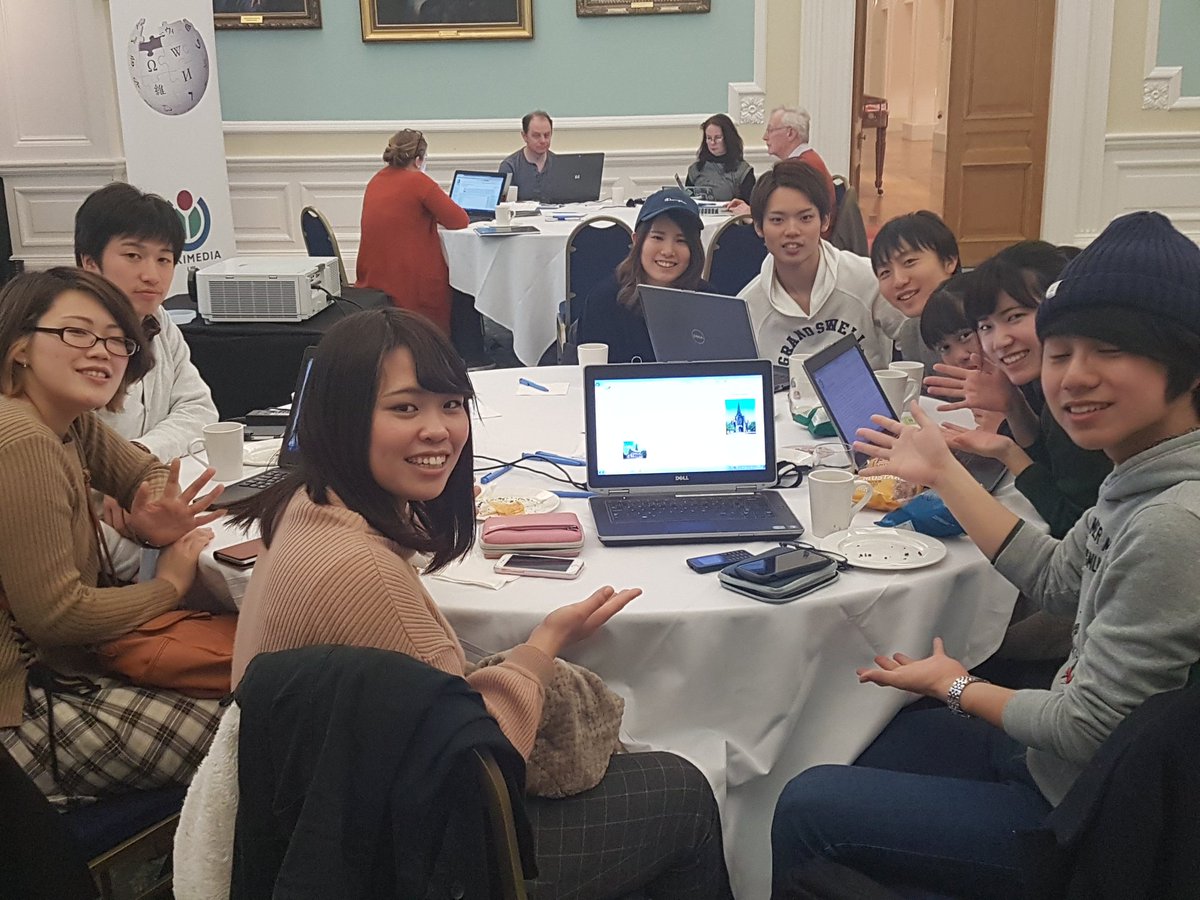
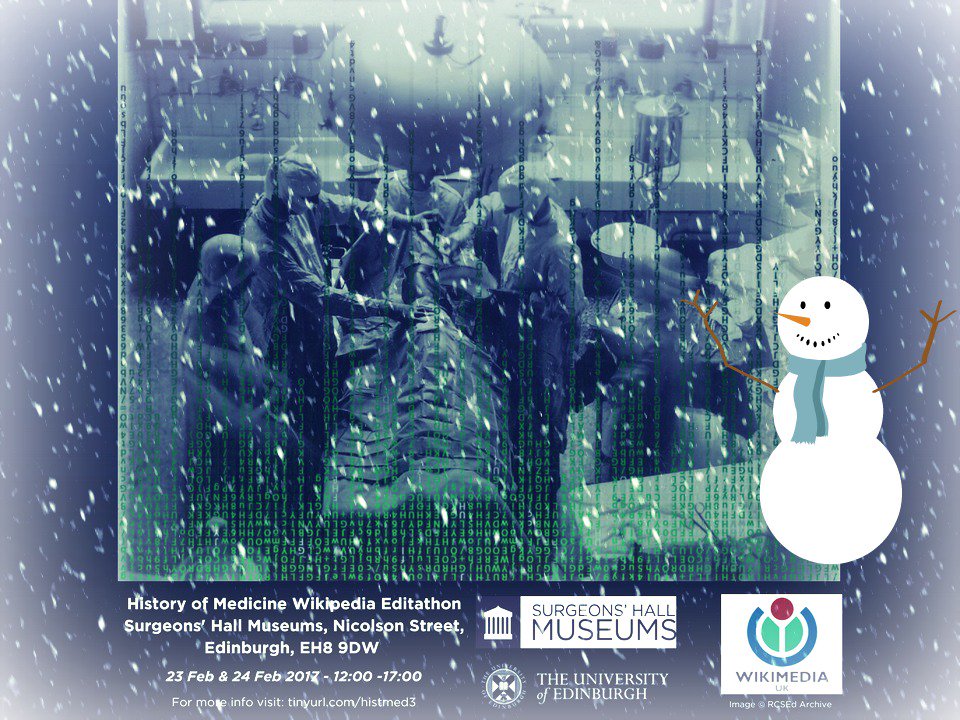
For the third year running, the University of Edinburgh’s Information Services division hosted a ‘History of Medicine’ Wikipedia event; to celebrate the lives & contributions of women in medicine, over sixty years of Nursing Studies & seventy-five years of the Polish School of Medicine. Over the course of two afternoons at the Surgeons’ Hall Museums, we unravelled myths, discovered truths, created new pages & re-wrote existing Wikipedia pages of Scotland’s famous, and infamous, medical figures including gruesome body-snatcher William Burke.

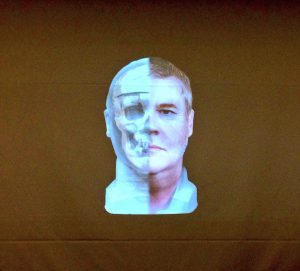
Facial reconstruction of William Burke

Facial reconstruction of William Burke

We were also fortunate to be graced by some excellent guest speakers:

  • Iain MacIntyre – The Scottish and British Societies of the History of Medicine
  • Alice Doyle – The Lothian Health Services Archive
  • Steve Sturdy – The History of Medicine
  • Janet Philp – Uncovering Burke and Hare
  • David Wright – An Illustrated History of Scottish Medicine – the inside story
  • Daisy Cunynghame – The Royal College of Physicians

Articles improved

  • Burke and Hare murders – Image added of facial reconstruction of William Burke. William Burke’s place of birth added as Orrey from his confession. Other corrections made to the article e.g. date of birth and removing the surname Croswhaite from Joseph as no citation and not found in other material.
  • John Barclay (anatomist) – An eminent Scottish comparative anatomist, extramural teacher in anatomy, and director of the Highland Society of Scotland. New paragraph added on Barclay’s candidacy for the chair of comparative anatomy. Further information on Barclay’s Life and organisation.
  • Leith Hospital – 21 paragraphs added.
  • Thomas Keith (doctor) – Added Early life, photographic career, surgical career. A Victorian surgeon and amateur photographer from Scotland. He developed and improved the wax paper process and his photographs are recognised for their composition and use of shade. He was an early practitioner of the operation of ovariotomy (ovarian cystectomy) where his published results were amongst the best in the world.
  • Scottish Women’s Hospitals for Foreign Service – Infobox added and relocated images.
  • Edinburgh Pharmacopoeia – 3 paragraphs added. The Edinburgh Pharmacopoeia was a medical guide consisting of recipes and methods for making medicine. It was first published by the Royal College of Physicians of Edinburgh in 1699 as the Pharmacopoea Collegii Regii Medicorum Edimburgensium. The Edinburgh Pharmacopeia merged with the London and Dublin Pharmacopoeia’s in 1864 creating the British Pharmacopoeia.
  • Royal Hospital for Sick Children, Edinburgh – more information about the future of the hospital added and the various buildings on the current site.
  • Infobox added to Hanna Segal – British psychoanalyst and a follower of Melanie Klein. She was president of the British Psychoanalytical Society, vice-president of the International Psychoanalytical Association, and was appointed to the Freud Memorial Chair at University College, London (UCL) in 1987. James Grotstein considered that “Received wisdom suggests that she is the doyen of “classical” Kleinian thinking and technique.”
  • Information added about the Polish School of Medicine to the article about Francis Albert Eley Crew – English animal geneticist. He was a pioneer in his field leading to Edinburgh’s place as a world leader in the science of animal genetics. He was the first Director of the Institute of Animal Breeding and the first Professor of Animal Genetics. He is said to have laid the foundations of medical genetics.
  • Small amendments and a new Publications section added to Douglas Guthrie – Scottish medical doctor, otolaryngologist and historian of medicine.

Articles created

  • Rebecca Strong – English nurse who pioneered preliminary training for nurses.
  • Kate Hermann – the first female neurology consultant in Scotland. Hermann, who was Jewish, left with her family from Hamburg to London in 1937, fleeing the Nazis. She then moved, in 1938, to Edinburgh to study at the Royal Infirmary under Professor Norman Dott.
  • Anne_Ferguson (physician) – Scottish physician, clinical researcher and expert in inflammatory bowel disease. She was educated at Notre Dame School and The University of Glasgow, graduating with a first class honours degree in Physiology, and winning the Brunton Medal. In 1975 she was appointed as a Senior Lecturer at The University of Edinburgh, also becoming a Consultant at the Gastrointestinal Unit at the Western General Hospital in Edinburgh. In 1987 she was appointed to a personal professorship in gastroenterology, and was honoured by election as a Fellow to the Royal Society of Edinburgh in 1990.
  • Ethel Moir – WW1 nurse with the Scottish Women’s Hospitals for Foreign Service.
  • The Polish School of Medicine – Terrific new illustrated 2200 word article.
  • Henryk Podlewski – Polish doctor who completed his studies at the Polish School of Medicine at the University of Edinburgh during World War II and became the first Psychiatrist to practice in the Bahamas.
  • Nancy Loudon – Scottish gynaecologist. She devoted her professional life to pioneering and ensuring provision of family planning and well woman services. As such she was a fore-runner in what is now the specialty of ‘community gynaecology’. This article is now translated on to the Italian Wikipedia.
  • Krystyna Magdalena Munk – a Polish doctor who completed her studies at the Polish School of Medicine at the University of Edinburgh during World War II.
  • Elizabeth Wilson (doctor) – Family Planning Doctor and Right-to-Die campaigner. She founded the 408 Clinic, and FATE (Friends at the End) in 2000.

Other outcomes and coverage

And this was all despite Storm Doris trying to throw a spanner in the works!

Wikimedia- on the edge of OER17

The 2017 Open Educational Resources Conference (OER17) will be held at Resource for London on the 5th and 6th April. The conference theme is “The Politics of Open” and has never been more timely. Registration closes 16th March so don’t delay.

Once again, there is a strong presence of people associated with Wikimedia UK, as well as other Wikimedians. As Wikipedia edges towards 17 years old and we get ever closer to OER17, here’s a look at the presentations coming up from Wikimedia – on the edge of OER17.

Stevie Nicks. By User:SandyMac [Public domain], via Wikimedia Commons

Stevie Nicks. By User:SandyMac [Public domain], via Wikimedia Commons

(Sadly there will be no Stevie Nicks.)

  • The conference is co-chaired by Wikimedia UK trustee Josie Fraser and Creative Commons Poland co-founder Alek Tarkowski.
  • Wikimedia UK Chief Executive Lucy Crompton-Reid is one of the keynote speakers.

    Lucy Crompton-Reid (CEO Wikimedia UK) – By Simoncromptonreid (Own work) [CC BY-SA 4.0 (http://creativecommons.org/licenses/by-sa/4.0)], via Wikimedia Commons

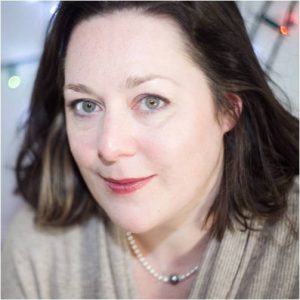
    Lucy Crompton-Reid has a career in the cultural, voluntary and public sectors spanning two decades, with a strong emphasis on leading and developing participatory practice and promoting marginalised voices. As Chief Executive of Wikimedia UK since October 2015, she has led the development of a new strategy focused on eradicating inequality and bias on Wikipedia and the other Wikimedia projects, with an emphasis on the gender gap and geographic bias. In the past year Lucy has given talks on equality and diversity at the Open Data Institute, Open Source Convention and MozFest, and recently spearheaded an international partnership between Wikimedia UK, Wikimedia communities around the world and the BBC, focused on closing the gender gap on Wikipedia. Lucy will be presenting: “Open as inclusive: Equality and Diversity on Wikimedia” at OER17.
  • Sara Mörtsell, Education Manager of WikimediaSE, will present on “How openness in mainstream K-12 education can advance with Wikimedia and GLAMs in Sweden” – This proposal addresses how mainstream K-12 education can transition to use and share open educational resources and play a part in the future direction of the open educational movement (Weller 2014). The presentation is based on practical experience of a one year OER project in 2016 with 230 students in K-12 education from both minority and dominant communities in the city of Stockholm.
    Sara Mörtsell. Pic by Jonatan Svensson Glad [CC0], via Wikimedia Commons

    Sara Mörtsell. Pic by Jonatan Svensson Glad [CC0], via Wikimedia Commons

  • Stefan Lutschinger, an academic and Wikipedia Campus Ambassador at Middlesex University, will present on “Open Pedagogy and Student Wellbeing: Academic Confidence Building with Wikipedia Assignments“. Stefan’s talk talk will introduce the use of Wikipedia assignments in higher education, present a case study, discuss its benefits for students’ academic confidence building and propose a framework for evaluation and critical reflection. The evidence is based on the compulsory course module (level 6) ‘MED3040 Publishing Cultures’ of the BA (Hons) Creative Writing and Journalism degree programme at Middlesex University, Department of Media, developed in cooperation with Wikimedia UK and the Wiki Education Foundation.
  • Me in Mallaig after walking the West Highland Way and riding the Harry Potter train.

    Ewan McAndrew – Wikimedian in Residence at the University of Edinburgh (Own work CC-BY-SA)

    Ewan McAndrew, Wikimedian In Residence at the University of Edinburgh, is delivering a presentation on “Lo and Behold: Reveries of a Connected Campus: Reflections from the Wikimedian in Residence at the University of Edinburgh”.  While there have been previous Wikimedia residencies based in UK cultural institutions focussing on opening up collections, five years have now passed since Grathwohl (2011) acclaimed Wikipedia had ‘come of age’ in formal education settings with Wikipedia still representing the oft-ignored “elephant in the room (Brox, 2012). Hosting a Wikimedian at a Higher Education institution to embed the creation of OER in the curriculum does therefore represent something of a shift in the paradigm. This presentation discusses one such residency and the lessons learnt from the first 15 months.

  • The artwork "Een vertaling van de ene taal naar de andere" / "A Translation from one language to another" by Lawrence Weiner. Placed in 1996 at the Spui (square) in Amsterdam. It consists of three pairs of two stones placed against each other. On each stone there is an inscription "A Translation from one language to another", in another language - Dutch, English, Surinam and Arabic. Author: brbbl (CC-BY-SA)

    The artwork “Een vertaling van de ene taal naar de andere” / “A Translation from one language to another” by Lawrence Weiner. Author: brbbl (CC-BY-SA)

    Ewan will also be giving a lightning talk on “Building bridges not walls – Wikipedia’s new Content Translation tool”. Wikipedia’s new Content Translation tool offers an impactful means of sharing open knowledge globally between languages as it brings up an article on one side of the screen in one language and helps translate it, paragraph by paragraph, to create the article in a different language taking all the formatting across to the new article so a native speaker just has to check to make sure the translation is as good as it can be. This presentation will outline the successful models already employed in a Higher Education context.

  • Martin Poulter By Ziko (Own work) [GFDL (http://www.gnu.org/copyleft/fdl.html) or CC BY-SA 4.0-3.0-2.5-2.0-1.0 (http://creativecommons.org/licenses/by-sa/4.0-3.0-2.5-2.0-1.0)], via Wikimedia Commons

    Martin Poulter By Ziko (Own work) [GFDL (http://www.gnu.org/copyleft/fdl.html) or CC BY-SA 4.0-3.0-2.5-2.0-1.0 (http://creativecommons.org/licenses/by-sa/4.0-3.0-2.5-2.0-1.0)], via Wikimedia Commons

    Martin Poulter, Wikimedian In Residence at the University of Oxford, is giving a presentation on “Putting Wikipedia and Open Practice into the mainstream in a University”. OER Conference attendees are often part of a minority group of Open Education advocates in their institutions, and it is a hard challenge to change wider institutional policy and culture. This presentation will share lessons learned from experience in a UK university, using Wikipedia and the other Wikimedia projects as well as Open Access research publication as levers to encourage an open approach to education. The drive towards open access to the outputs of research, and open access to the collections of cultural institutions, are potentially powerful drivers for the creation of open educational content. This session explores how to push academic culture in that direction.
  • #1Lib1Ref - 1 Librarian adding 1 Reference

    Citation (desperately) needed. #PoliticsOfOpen

    Ewan and Martin are jointly giving a lightning talk on “Citation Needed: Digital Provenance in the era of Post-Truth Politics“.This session covers why the most important frontier of Wikipedia is not its content but its 30 million plus citations (Orlowitz, 2016) and the latest developments behind the WikiCite project after its first year. The WikiCite initiative is to build a repository of all Wikimedia citations and bibliographic metadata in Wikidata to serve all Wikimedia projects. The ultimate goal to make Wikipedia’s citations as “reliable, open, accessible, structured, linked and free as our Knowledge is.”(Orlowitz, 2016)

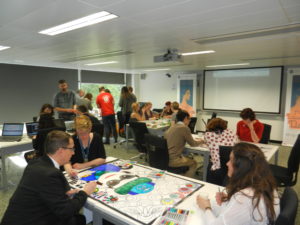
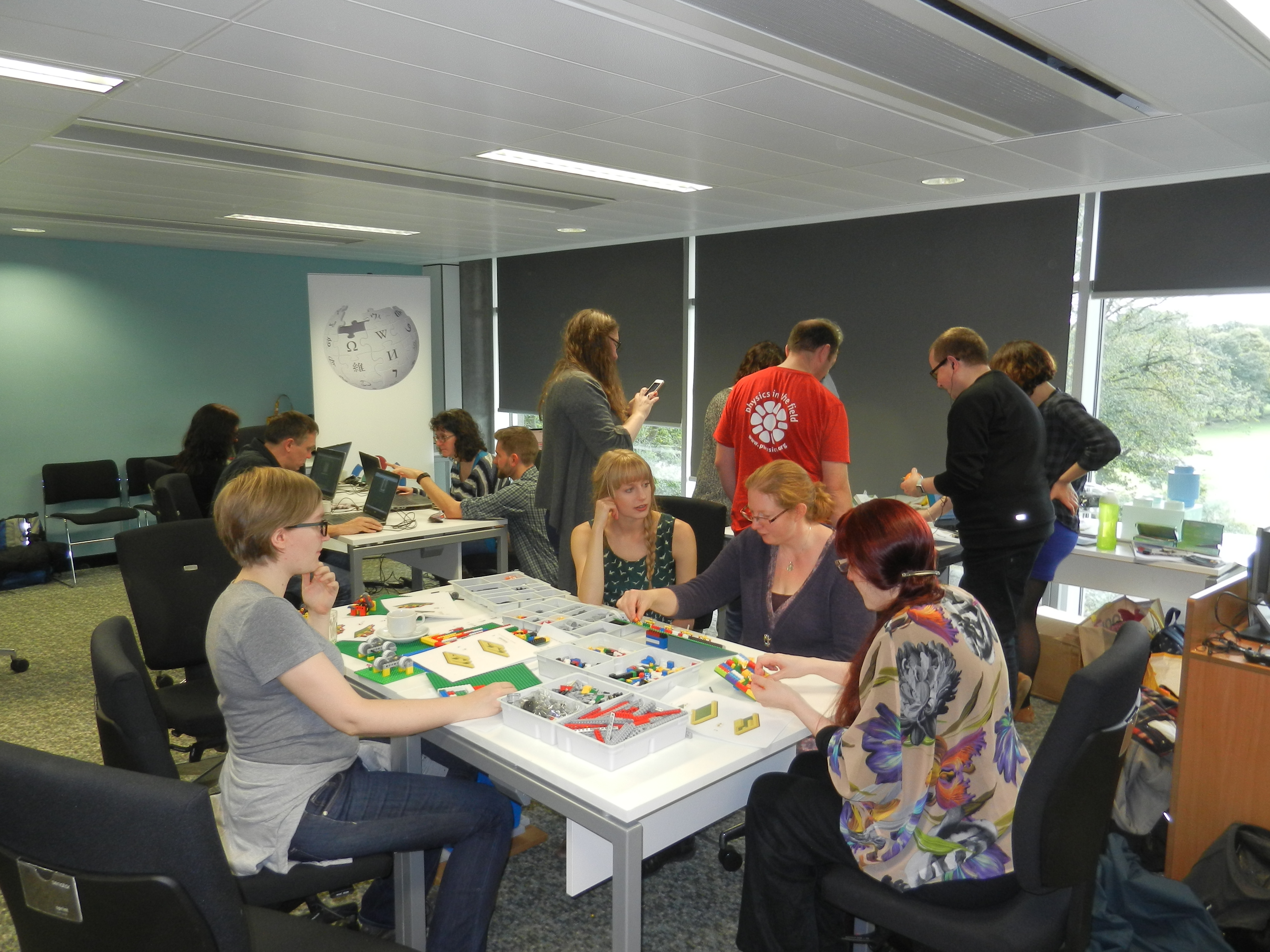
  • Gamifying Wikimedia - Learning through play (Pic from Ada Lovelace Day 2016 at the University of Edinburgh - own work CC-BY-SA).

    Gamifying Wikimedia – Learning through play (Pic from Ada Lovelace Day 2016 at the University of Edinburgh – own work CC-BY-SA).

    Ewan and Martin will also be running a workshop on “Gamifying Wikimedia – Learning through Play (Workshop)“. This workshop will demonstrate that crowd-sourcing contributions to Wikimedia’s family of Open Education projects does not have to involve a heavy time component and that short fun, enjoyable activities can be undertaken which enhance the opportunities for teaching & learning and the dissemination of open knowledge. Participants will be guided through a series of Wikimedia tools; running through the purpose of each tool, how they can be used to support open education alongside practical demos.

  • Wikimedia UK volunteer Navino Evans is giving a workshop on “Histropedia – Building an open interactive history of everything with Wikimedia content“.
    By Wittylama (Own work) [CC BY-SA 4.0 (http://creativecommons.org/licenses/by-sa/4.0)], via Wikimedia Commons

    Navino Evans and Histropedia. Pic by Wittylama (Own work) [CC BY-SA 4.0 (http://creativecommons.org/licenses/by-sa/4.0)], via Wikimedia Commons

    Histropedia is a web application aiming to create free interactive timelines on every topic in history using open data from Wikimedia projects like Wikidata, Wikipedia and Wikimedia Commons.All Histropedia timelines are published under an open licence, which means they can be reused and remixed for any purpose, both within Histropedia and elsewhere on the web. Tools like Histropedia provide an incentive for donating text, data and images to Wikimedia projects, as it can instantly be visualised in exciting ways without incurring any cost.
    Histropedia timeline of University of Edinburgh female alumni; colour-coded by place of birth and with language labels in Japanese, Russian, Arabic and English.

    Histropedia timeline of University of Edinburgh female alumni; colour-coded by place of birth and with language labels in Japanese, Russian, Arabic and English.

    It also shows how data becomes more valuable when it’s open, as it can be combined and compared with other data in a way that is not possible when kept in isolation. It’s our hope that Histropedia can play a role in getting more educational institutions to engage with Wikimedia content and other open resources, as well as inspire others to build innovative applications on top of the wealth of free knowledge that’s available. In this workshop, we will learn how to use Histropedia by completing a sequence of practical exercises to find, combine and improve content.

  • Alice White, Wikimedian in Residence at the Wellcome Library, will also in attendance running a Wikimedia session in the Lewis Suite.
    Alice White- By Zeromonk (Own work) [CC BY-SA 4.0 (http://creativecommons.org/licenses/by-sa/4.0)], via Wikimedia Commons

    Alice White- By Zeromonk (Own work) [CC BY-SA 4.0 (http://creativecommons.org/licenses/by-sa/4.0)], via Wikimedia Commons

    Something for everyone there. Look forward to seeing you there!

Seeing the links at the ‘Celtic Knot’ – Wikipedia Language Conference

By David J. Fred [CC BY-SA 2.5 (http://creativecommons.org/licenses/by-sa/2.5)], via Wikimedia Commons

Tying the Celtic Knot. Pic by David J. Fred [CC BY-SA 2.5 (http://creativecommons.org/licenses/by-sa/2.5)], via Wikimedia Commons

The first ‘Celtic Knot’ – Wikipedia Language Conference will take place Thursday 6 July 2017 at the University of Edinburgh in collaboration with Wikimedia UK. This Wikimedia event will focus on Celtic Languages and Indigenous Languages, showcasing innovative approaches to open education, open knowledge and open data that support and grow language communities.

CC-BY-SA (Own work)

CC-BY-SA (Own work)

To assist with seeing the connections and areas of commonality between your work and the Celtic Knot conference please read the below guide to the Wikimedia projects:

The Celtic Knot conference is jointly supported by the University of Edinburgh and Wikimedia UK.

Wikimedia UK logo

Wikimedia UK logo

Wikimedia UK is the registered charity that supports and promotes Wikipedia and the other Wikimedia projects, and the volunteers who write, edit and curate the content of the projects.

Our mission is to help people and organisations create and preserve open knowledge and to provide easy access for all. We support the widest possible public access to, use of and contribution to open content of an encyclopaedic or educational nature.

  • Culture: We work closely with cultural institutions, including galleries, libraries, archives and museums (GLAMs) to help them realise the potential of openly-licensed content for public benefit.
  • Education: Wikipedia is more than a reference work. All over the world people and institutions are exploring the ways that Wikipedia can be used as a formal education tool. It belongs in education.
  • Volunteers: The Wikimedia projects are written, edited and curated by volunteers who are just like you. There are many ways to get involved – there are activities to suit the interests of everybody. You can also become a member of the charity.
Wikimedia's family of Open Knowledge projects

Wikimedia’s family of Open Knowledge projects


Wikimedia’s family of Open Knowledge projects include:

  • Wikipedia: the free online encyclopaedia exists in each Celtic and Indigenous language and Wikipedia’s new Content Translation tool allows articles to be translated easily between different language Wikipedias.
  • Wikimedia Commons: a media file repository making available public domain and freely-licensed educational media content (images, sound and video clips) to everyone, in their own language.
  • Wikidata is a free and open knowledge base that can be read and edited by both humans and machines. Wikidata acts as central storage for the structured data of its Wikimedia sister projects and many other sites and services beyond. Wikidata can connect other databases and collections of information, allowing computers and software to see connections between hundreds of data sources. GLAM institutions (galleries, libraries, archives and museums) realise that their collections become more useful and reusable when they are deeply interlinked with other collections around the world. Creating open structured data for their collections increases their impact on the public.
  • WikisourceThe Free Library – is a multilingual project to create a growing free content library of OCR-ed source texts, as well as translations of source texts in any language including constitutional documents, court rulings, plays, poems, songs, novels, short stories, letters, travel writing, speeches, obituaries, news articles and more.
  • Wiktionary, a collaborative project to produce a free-content multilingual dictionary.
  • Wikibooks is a multilingual project for collaboratively writing open-content textbooks that anyone can edit including textbooks, annotated texts, instructional guides, and manuals. These materials can be used in a traditional classroom, an accredited or respected institution, a home-school environment or for self-learning.
  • Wikivoyage—a multilingual, web-based project to create a free, complete, up-to-date, and reliable worldwide travel guide.

In addition, the Wiki Education Foundation connects secondary & higher education to the publishing power of Wikipedia. Bridging Wikipedia and academia creates opportunities for any learner to contribute to, and access, open knowledge. We cultivate deeper learning for students as they expand Wikipedia articles for course assignments. We work with libraries to expand the public’s access to their resources. We support academic associations as they expand and improve Wikipedia’s coverage of their field.

If you can see a clear commonality between your work and the projects above then we welcome diverse attendees and presenters working in Celtic and Indigenous languages ranging from Wikimedians, educators, researchers, information professionals, media professionals, linguists, translators, learning technologists and more coming together to share good practice and find fruitful new collaborations to support language communities as a result of the event.

Conference Themes

  • Building language confidence: participation, public engagement & social equality.
  • Putting our language on the map: preserving & opening up our cultural heritage.
  • Languages on the road to open: ongoing or new projects and initiatives in open knowledge, open education and open data.
  • The politics of language: Local, national, and international policy and practice; advocacy for funding, institutional and community support and investment
  • Hacking; making; sharing

The offical call for session proposals has now closed but email ewan.mcandrew@ed.ac.uk if you would like to attend or have a session you would like to showcase.

NB: Abstracts have now been reviewed as of April 2017 and notifications sent out to speakers.

We are not in a post-fact world: Wikipedia vs. claims of fake news

We are not in a post truth world

We are not in a post truth world – Screengrab of Wikimedia’s “We are not in a post-fact world” video by Victor Grigas, CC-BY-SA).

A question on the ‘virtual generation’: “Friends live with their computers rather than their brothers and sisters. All they do all day is use social networks to stay in touch, play online games with people around the world, and download (sometimes illegally) their favourite music and films.  Is this an exaggeration? Should we, as information professionals and custodians of the information society, worry?” (Hyatt, University of Northumbria, 2016)

We are not in a post-fact world: Wikipedia vs. ‘fake’ news

We live in the information age and the aphorism ‘one who possess information possesses the world’ of course reflects the present-day reality.”

(Vladimir Putin in Interfax, 2016).


What are we to make of the ‘post-truth’ landscape we supposedly now inhabit; where traditional mass media appears to be distrusted and waning in its influence over the public sphere (Tufeckzi in Viner, 2016) while the secret algorithms’ of search engines & social media giants dominate instead? The new virtual agora (Silverstone in Weichert, 2016) of the internet creates new opportunities for democratic citizen journalism but also has been shown to create chaotic ‘troll’ culture & maelstroms of information overload. Therefore, the new ‘virtual generation’ inhabiting this post-fact world must attempt to navigate fake content, sponsored content and content filtered to match their evolving digital identity to somehow arrive safely at a common truth. Should we be worried what this all means in ‘the information age’?

Higher Education in the Information Age

Facebook defines who we are, Amazon defines what we want

and Google defines what we think.”

(Broeder, 2016)

The information age is defined as “the shift from traditional industry that the Industrial Revolution brought through industrialization, to an economy based on computerization or digital revolution” (Toffler in Korjus, 2016). There are now 3 billion internet users on our planet, well over a third of humanity (Graham et al, 2015). Global IP traffic is estimated to treble over the next 5 years (Chaudhry, 2016) and a hundredfold for the period 2005 to 2020 overall. This internet age still wrestles with both geographically & demographically uneven coverage while usage in no way equates to users being able to safely navigate, or indeed, to critically evaluate the information they are presented with via its gatekeepers (Facebook, Google, Yahoo, Microsoft et al). Tambini (2016) defines these aforementioned digital intermediaries as “software-based institutions that have the potential to influence the flow of online information between providers (publishers) and consumers”. So exactly how conversant are our students & staff with the nature of their relationship with these intermediaries & the role they play in the networks that shape their everyday lives?

Digital intermediaries

Digital intermediaries such as Google and Facebook are seen as the new powerbrokers in online news, controlling access to consumers and with the potential even to suppress and target messages to individuals.” (Tambini, 2016)


Facebook’s CEO Mark Zuckerberg may downplay Facebook’s role as “arbiters of truth” (Seethaman, 2016) in much the same way that Google downplay their role as controllers of the library “card catalogue” (Walker in Toobin, 2015) but both represent the pre-eminent gatekeepers in the information age. 62% of Americans get their news from social media (Mint, 2016) with 44% getting their news from Facebook. In addition, a not insubstantial two million voters were encouraged to register to vote by Facebook, while Facebook’s own 2012 study concluded that it “directly influenced political self-expression, information seeking and real-world voting behaviour of millions of people.” (Seethaman, 2016)
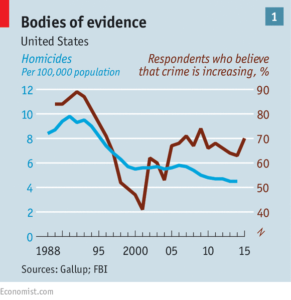
 

image003Figure 1 Bodies of Evidence (The Economist, 2016)

This year has seen assertion after assertion made which bear, upon closer examination by fact-checking organisations such as PolitiFact (see Figure 1 above) absolutely no basis in truth. For the virtual generation, the traditional mass media has come to be treated on a par with new, more egalitarian, social media with little differentiation in how Google lists these results. Clickbait journalism has become the order of the day (Viner, 2016); where outlandish claims can be given a platform as long as they are prefixed with “It is claimed that…”

Now no one even tries proving ‘the truth’. You can just say anything. Create realities.” (Pomerantzev in the Economist, 2016)

The problem of ascertaining truth in the information age can be attributed to three factors:

  1. The controversial line “people in this country have had enough of experts” (Gove in Viner, 2016) during the EU referendum demonstrated there has been a fundamental eroding of trust in, & undermining of, the institutions & ‘expert’ opinions previously looked up to as subject authorities. “We’ve basically eliminated any of the referees, the gatekeepers…There is nobody: you can’t go to anybody and say: ‘Look, here are the facts’” (Sykes in the Economist, 2016)
  2. The proliferation of social media ‘filter bubbles’ which group like-minded users together & filter content to them accordingly to their ‘likes’. In this way, users can become isolated from viewpoints opposite to their own (Duggan, 2016) and fringe stories can survive longer despite being comprehensively debunked elsewhere. In this way, any contrary view tends to be either filtered out or met with disbelief through what has been termed ‘the backfire effect’ (The Economist, 2016).
  3. The New York Times calls this current era an era of data but no facts’ (Clarke, 2016). Data is certainly abundant; 90% of the world’s data was generated in the last two years (Tuffley, 2016). Yet, it has never been more difficult to find ‘truth in the numbers’ (Clarke, 2016) with over 60 trillion pages (Fichter and Wisniewski, 2014) to navigate and terabytes of unstructured data to (mis)interpret.

The way forward

We need to increase the reputational consequences and change the incentives for making false statements… right now, it pays to be outrageous, but not to be truthful.”

(Nyhan in the Economist, 2016)

Since the US election, and President Trump’s continuing assault on the ‘dishonest media’, the need for information to be verified has been articulated as never before with current debates raging on just how large a role Russia, Facebook & fake news played during the US election. Indeed, the inscrutable ‘black boxes’ of Google & Facebook’s algorithms constitute a real dilemma for educators & information professionals.

Reappraising information & media literacy education

The European Commission, the French Conseil d’Etat and the UK Government are all re-examining the role of ‘digital intermediaries’; with OfCom being asked by the UK government to prepare a new framework for assessing the intermediaries’ news distribution & setting regulatory parameters of ‘public expectation’ in place (Tambini, 2016). Yet, Cohen (2016) asserts that there is a need for greater transparency of the algorithms being used in order to provide better oversight of the digital intermediaries. Further, that the current lack of public domain data available in order to assess the editorial control of these digital intermediaries means that until the regulatory environment is strengthened so as to require these ‘behemoths’ (Tambini, 2016) to disclose this data, this pattern of power & influence is likely to remain unchecked.

Somewhere along the line, media literacy does appear to have backfired; our students were told that Google was trustworthy and Wikipedia was not (Boyd, 2016). The question is how clicking on those top five Google results instead of critically engaging with the holistic overview & reliable sources Wikipedia offers is working out?

A lack of privacy combined with a lack of transparency

Further, privacy seems to be the one truly significant casualty of the information age. Broeder (2016) suggests that, as governments focus increasingly on secrecy, at the same time the individual finds it increasingly difficult to retain any notions of privacy. This creates a ‘transparency paradox’ often resulting in a deep suspicion of governments’ having something to hide while the individual is left vulnerable to increasingly invasive legislation such as the UK’s new Investigatory Powers Act – “the most extreme surveillance in the history of Western democracy.” (Snowden in Ashok, 2016). This would be bad enough if their public & private data weren’t already being shared as a “tradeable commodity” (Tuffley, 2016) with companies like Google and Apple, “the feudal overlords of the information society” (Broeder, 2016) and countless other organisations.

The Data Protection Act (1998), Freedom of Information Act (2000) and the Human Rights Act (1998) should give the beleaguered individual succour but FOI requests can be denied if there is a ‘good reason’ to do so, particularly if it conflicts with the Official Secrets Act (1989), and the current government’s stance on the Human Rights Act does not bode well for its long-term survival. The virtual generation will also now all have a digital footprint; a great deal of which can been mined by government & other agencies without our knowing about it or consenting to it. The issue therefore is that a line must be drawn as to our public lives and our private lives. However, this line is increasingly unclear because our use of digital intermediaries blurs this line. In this area, we do have legitimate cause to worry.

The need for a digital code of ethics

  • “Before I do something with this technology, I ask myself, would it be alright if everyone did it?
  • Is this going to harm or dehumanise anyone, even people I don’t know and will never meet?
  • Do I have the informed consent of those who will be affected?” (Tuffley, 2016)

Educating citizens as to the merits of a digital code of ethics like the one above is one thing, and there are success stories in this regard through initiatives such as StaySafeOnline.org but a joined-up approach marrying up librarians, educators and instructional technologists to teach students (& adults) information & digital literacy seems to be reaping rewards according to Wine (2016). While recent initiatives exemplifying the relevance & need for information professionals assisting with political literacy during the Scottish referendum (Smith, 2016) have found further expression in other counterparts (Abram, 2016).

This challenge is not just for school librarians to prepare the next generation to be informed but for all librarians to assist the whole population.” (Abram, 2016)

Trump’s administration may or may not be in ‘chaos’ but recent acts have exposed worrying trends. Trends which reveal an eroding of trust: in the opinions of experts; in the ‘dishonest’ media; in factual evidence; and in the rule of law. Issues at the heart of the information age have been exposed: there exists a glut of information & a sea of data to navigate with little formalised guidance as to how to find our way through it. For the beleaguered individual, this glut makes it near impossible to find ‘truth in the numbers’ while equating one online news source to be just as valid as another, regardless of its credibility, only exacerbates the problem. All this, combined with an increasing lack of privacy and an increasing lack of transparency, makes for a potent combination.

There is a place of refuge you can go, however. A place where facts, not ‘alternate facts’, but actual verifiable facts, are venerated. A place that holds as its central tenets, principles of verifiability, neutral point of view, and transparency above all else. A place where every edit made to a page is recorded, for the life of that page, so you can see what change was made, when & by whom. How many other sites give you that level of transparency where you can check, challenge & correct the information presented if it does hold to the principles of verifiability?
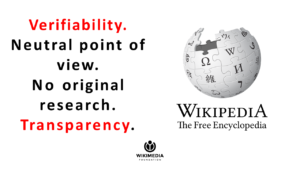
image004

Now consider that this site is the world’s number one information site; visited by 500 million visitors a month and considered, by British people, to be more trustworthy than the BBC, ITV, the Guardian, the Times, the Telegraph according to a 2014 Yougov survey.

image006

While Wikipedia is the fifth most popular website in the world, the other internet giants in the top ten cannot compete with it for transparency; an implicit promise of trust with its users. Some 200+ factors go into constructing how Google’s algorithm determines the top ten results for a search term yet we have no inkling what those factors are or how those all-important top ten search results are arrived at. Contrast this opacity, and Facebook’s for that matter, with Wikimedia’s own (albeit abortive) proposal for a Knowledge Engine (Sentance, 2016); envisaged as the world’s first transparent non-commercial search engine and consider what that transparency might have meant for the virtual generation being able to trust the information they are presented with.

Wikidata (Wikimedia’s digital repository of free, openly-licensed structured data) represents another bright hope. It is already used to power, though not exclusively, many of the answers in Google’s Knowledge Graph without ever being attributed as such.

image009

Wikidata is a free linked database of knowledge that can be read and edited by both humans and machines. It acts as central storage for the structured data of its Wikimedia sister projects including Wikipedia, Wikivoyage, Wikisource, and others. The mission behind Wikidata is clear: if ‘to Google’ has come to stand in for ‘to search’ and “search is the way we now live” (Darnton in Hillis, Petit & Jarrett, 2013, p.5) then ‘to Wikidata’ is ‘to check the digital provenance’. And checking the digital provenance of assertions is pivotal to our suddenly bewildered democracy.

While fact-checking websites exist & more are springing up all the time, Wikipedia is already firmly established as the place where students and staff conduct pre-research on a topic; “to gain context on a topic, to orient themselves, students start with Wikipedia…. In this unique role, it therefore serves as an ideal bridge between the validated and unvalidated Web.” (Grathwohl, 2011)

Therefore, it is vitally important that Wikipedia’s users know how knowledge is constructed & curated and the difference between fact-checked accurate information from reliable sources and information that plainly isn’t.

Knowledge creates understanding – understanding is sorely lacking in today’s world. Behind every article on Wikipedia is a Talk page is a public forum where editors hash it out; from citations, notability to truth.” (Katherine Maher, Executive Director of the Wikimedia Foundation, December 2016)

The advent of fake news means that people need somewhere they can turn to where the information is accurate, reliable and trustworthy. Wikipedia editors have been evaluating the validity and reliability of sources and removing those facts not attributed to a reliable published source for years. Therefore engaging staff and students in Wikipedia assignments embeds source evaluation as a core component of the assignment. Recent research by Harvard Business School has also shown that the process of editing Wikipedia has a profound impact on those that participate in it; whereby editors that become involved in the discourse of an article’s creation with a particular slanted viewpoint or bias actually become more moderate over time. This means editing Wikipedia actually de-radicalises its editors as they seek to work towards a common truth. Would that were true of other much more partisan sectors of the internet.

Further, popular articles and breaking news stories are often covered on Wikipedia extremely thoroughly where the focus of many eyes make light work in the construction of detailed, properly cited, accurate articles. And that might just be the best weapon to combat fake news; while one news source in isolation may give one side of a breaking story, Wikipedia often provides a holistic overview of all the news sources available on a given topic.

Wikipedia already has clear policies on transparency, verifiability, and reliable sources. What it doesn’t have is the knowledge that universities have behind closed doors; often separated into silos or in pay-walled repositories. What it doesn’t have is enough willing contributors to meet the demands of the 1.5 billion unique devices that access it each month in ensuring its coverage of the ever-expanding knowledge is kept as accurate, up-to-date & representative of the sum of all knowledge as possible.

This is where you come in.


Conclusion

It’s up to other people to decide whether they give it any credibility or not,” (Oakeshott in Viner, 2016)

The truth is out there. But it is up to us to challenge claims and to help verify them. This is no easy task in the information age and it is prone to, sometimes very deliberate, obfuscation. Infoglut has become the new censorship; a way of controlling the seemingly uncontrollable. Fact-checking sites have sprung up in greater numbers but they depend on people seeking them out when convenience and cognitive ease have proven time and again to be the drivers for the virtual generation.

We know that Wikipedia is the largest and most popular reference work on the internet. We know that it is transparent and built on verifiability and neutral point of view. We know that it has been combating fake news for years. So if the virtual generation are not armed with the information literacy education to enable them to critically evaluate the sources they encounter and the nature of the algorithms that mediate their interactions with the world, how then are they to make the informed decisions necessary to play their part as responsible online citizens?

It is the response of our governments and our Higher Education institutions to this last question that is the worry.
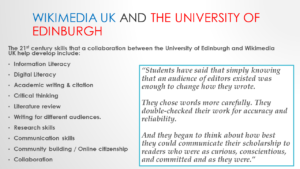
image010

Wikimedia at the University of Edinburgh

As the Wikimedia residency at the University of Edinburgh moves into its second year we are looking to build on the success of the first year and work with other course leaders and students both inside and outside the curriculum. Starting small has proven to be a successful methodology but bold approaches like the University of British Columbia’s WikiProject Murder, Madness & Mayhem can also prove extremely successful. Indeed, bespoke solutions can often be found to individual requirements.


Time and motivation are the two most frequent cited barriers to uptake. These are undoubted challenges to academics, students & support staff but the experience of this year is that the merits of engagement & an understanding of how Wikipedia assignments & edit-a-thons operate overcome any such concerns in practice. Once understood, Wikipedia can be a powerful tool in an educator’s arsenal. Engagement from course leaders, information professionals and support from the institution itself go a long way to realising that the time & motivation is well-placed.

For educators, engaging with Wikipedia:

  • meets the information literacy & digital literacy needs of our students.
  • enhances learning & teaching in the curriculum
  • helps develop & share knowledge in their subject discipline
  • raises the visibility & impact of research in their particular field.

In this way, practitioners can swap out existing components of their practice in favour of Wikimedia learning activities which develop:

  • Critical information literacy skills
  • Digital literacy
  • Academic writing & referencing
  • Critical thinking
  • Literature review
  • Writing for different audiences
  • Research skills
  • Community building
  • Online citizenship
  • Collaboration.

This all begins with engaging in the conversation.

Wikipedia turned 16 on January 15th 2017. It has long been the elephant in the room in education circles but it is time to articulate that Wikipedia does indeed belong in education and that it plays an important role in our understanding & disseminating of the world’s knowledge. With Oxford University now also hosting their own Wikimedian in Residence on a university-wide remit, it is time also to articulate that this conversation is not going away. Far from it, the information & digital literacy needs of our students and staff will only intensify. Higher Education institutions must need formulate a response. The best thing we can do as educators & information professionals is to be vigilant and to be vocal; articulating both our vision for Open Knowledge & the pressing need for engagement in skills development as a core part of the university’s mission and give our senior managers something they can say ‘Yes’ to.

If you would like to find out more then feel free to contact me at ewan.mcandrew@ed.ac.uk

  • Want to become a Wikipedia editor?
  • Want to become a Wikipedia trainer?
  • Want to run a Wikipedia course assignment?
  • Want to contribute images to Wikimedia Commons?
  • Want to contribute your research to Wikipedia?
  • Want to contribute your research data to Wikidata?

References

Abram, S. (2016). Political literacy can be learned! Internet@Schools, 23(4), 8-10. Retrieved from http://search.proquest.com.ezproxy.is.ed.ac.uk/docview/1825888133?accountid=10673

Alcantara, Chris (2016).“Wikipedia editors are essentially writing the election guide millions of voters will read”. Washington Post. Retrieved 2016-12-10.

Ashok, India (2016-11-18). “UK passes Investigatory Powers Bill that gives government sweeping powers to spy”International Business Times UK. Retrieved 2016-12-11.

Bates, ME 2016, ‘Embracing the Filter Bubble’, Online Searcher, 40, 5, p. 72, Computers & Applied Sciences Complete, EBSCOhost, viewed 10 December 2016.

Blumenthal, Helaine (2016).“How Wikipedia is unlocking scientific knowledge”. Wiki Education Foundation. 2016-11-03. Retrieved 2016-12-10.

Bode, Leticia (2016-07-01). “Pruning the news feed: Unfriending and unfollowing political content on social media”. Research & Politics. 3 (3): 2053168016661873. doi:10.1177/2053168016661873ISSN 2053-1680.

Bojesen, Emile (2016-02-22). “Inventing the Educational Subject in the ‘Information Age'”. Studies in Philosophy and Education. 35 (3): 267–278. doi:10.1007/s11217-016-9519-2ISSN 0039-3746.

Boyd, Danah (2017-01-05). “Did Media Literacy Backfire?”. Data & Society: Points. Retrieved 2017-02-01.

Broeders, Dennis (2016-04-14). “The Secret in the Information Society”. Philosophy & Technology. 29 (3): 293–305. doi:10.1007/s13347-016-0217-3ISSN 2210-5433.

Burton, Jim (2008-05-02). “UK Public Libraries and Social Networking Services”. Library Hi Tech News. 25 (4): 5–7. doi:10.1108/07419050810890602ISSN 0741-9058.

Cadwalladr, Carole (2016-12-11). “Google is not ‘just’ a platform. It frames, shapes and distorts how we see the world”The GuardianISSN 0261-3077. Retrieved 2016-12-12.

Carlo, Silkie (2016-11-19). “The Government just passed the most extreme surveillance law in history – say goodbye to your privacy”The Independent. Retrieved 2016-12-11.

Chaudhry, Peggy E. “The looming shadow of illicit trade on the internet”. Business Horizons. doi:10.1016/j.bushor.2016.09.002.

Clarke, C. (2016). Advertising in the post-truth world. Campaign, Retrieved from http://search.proquest.com.ezproxy.is.ed.ac.uk/docview/1830868225?accountid=10673

Cohen, J. E. (2016). The regulatory state in the information age. Theoretical Inquiries in Law, 17(2), 369-414.

Cover, Rob (2016-01-01). Digital Identities. San Diego: Academic Press. pp. 1–27. doi:10.1016/b978-0-12-420083-8.00001-8ISBN 9780124200838.

Davis, Lianna (2016-11-21). “Why Wiki Ed’s work combats fake news — and how you can help”. Wiki Education Foundation. Retrieved 2016-12-10.

Derrick, J. (2016, Sep 26). Google is ‘the only potential acquirer’ of Twitter as social media boom nears end. Benzinga Newswires Retrieved from http://search.proquest.com.ezproxy.is.ed.ac.uk/docview/1823907139?accountid=10673

DeVito, Michael A. (2016-05-12). “From Editors to Algorithms”. Digital Journalism. 0 (0): 1–21. doi:10.1080/21670811.2016.1178592ISSN 2167-0811.

Dewey, Caitlin (2016-05-11). “You probably haven’t even noticed Google’s sketchy quest to control the world’s knowledge”. The Washington Post. ISSN 0190-8286. Retrieved 2016-12-10.

Dewey, Caitlin (2015-03-02). “Google has developed a technology to tell whether ‘facts’ on the Internet are true”. The Washington Post. ISSN 0190-8286. Retrieved 2016-12-10.

Duggan, W. (2016, Jul 29). Where social media fails: ‘echo chambers’ versus open information source. Benzinga Newswires Retrieved from http://search.proquest.com.ezproxy.is.ed.ac.uk/docview/1807612858?accountid=10673

Eilperin, Juliet (11 December 2016). “Trump says ‘nobody really knows’ if climate change is real”. Washington Post. Retrieved 2016-12-12.

Evans, Sandra K. (2016-04-01). “Staying Ahead of the Digital Tsunami: The Contributions of an Organizational Communication Approach to Journalism in the Information Age”. Journal of Communication. 66 (2): 280–298. doi:10.1111/jcom.12217ISSN 1460-2466.

Facts and Facebook. (2016, Nov 14). Mint Retrieved from http://search.proquest.com.ezproxy.is.ed.ac.uk/docview/1838637822?accountid=10673

Flaxman, Seth; Goel, Sharad; Rao, Justin M. (2016-01-01). “Filter Bubbles, Echo Chambers, and Online News Consumption”. Public Opinion Quarterly. 80 (S1): 298–320. doi:10.1093/poq/nfw006ISSN 0033-362X.

Fu, J. Sophia (2016-04-01). “Leveraging Social Network Analysis for Research on Journalism in the Information Age”. Journal of Communication. 66 (2): 299–313. doi:10.1111/jcom.12212ISSN 1460-2466.

Graham, Mark; Straumann, Ralph K.; Hogan, Bernie (2015-11-02). “Digital Divisions of Labor and Informational Magnetism: Mapping Participation in Wikipedia”. Annals of the Association of American Geographers. 105 (6): 1158–1178. doi:10.1080/00045608.2015.1072791ISSN 0004-5608.

Grathwohl, Casper (2011-01-07). “Wikipedia Comes of Age”. The Chronicle of Higher Education. Retrieved 2017-02-20.

Guo, Jeff (2016).“Wikipedia is fixing one of the Internet’s biggest flaws”. Washington Post. Retrieved 2016-12-10.

Hahn, Elisabeth; Reuter, Martin; Spinath, Frank M.; Montag, Christian. “Internet addiction and its facets: The role of genetics and the relation to self-directedness”. Addictive Behaviors. 65: 137–146. doi:10.1016/j.addbeh.2016.10.018.

Heaberlin, Bradi; DeDeo, Simon (2016-04-20). “The Evolution of Wikipedia’s Norm Network”. Future Internet. 8 (2): 14. doi:10.3390/fi8020014.

Helberger, Natali; Kleinen-von Königslöw, Katharina; van der Noll, Rob (2015-08-25). “Regulating the new information intermediaries as gatekeepers of information diversity”info17 (6): 50–71. doi:10.1108/info-05-2015-0034ISSN 1463-6697.

Hillis, Ken; Petit, Michael; Jarrett, Kylie (2012). Google and the Culture of Search. Routledge. ISBN9781136933066.

Hinojo, Alex (2015-11-25). “Wikidata: The New Rosetta Stone | CCCB LAB”CCCB LAB. Retrieved 2016-12-12.

Holone, Harald (2016-12-10). “The filter bubble and its effect on online personal health information”. Croatian Medical Journal. 57 (3): 298–301. doi:10.3325/cmj.2016.57.298ISSN 0353-9504PMC 4937233PMID 27374832.

The information age. (1995). The Futurist, 29(6), 2. Retrieved from http://search.proquest.com.ezproxy.is.ed.ac.uk/docview/218589900?accountid=10673

Jütte, Bernd Justin (2016-03-01). “Coexisting digital exploitation for creative content and the private use exception”. International Journal of Law and Information Technology. 24 (1): 1–21. doi:10.1093/ijlit/eav020ISSN 0967-0769.

Kim, Jinyoung; Gambino, Andrew (2016-12-01). “Do we trust the crowd or information system? Effects of personalization and bandwagon cues on users’ attitudes and behavioral intentions toward a restaurant recommendation website”. Computers in Human Behavior. 65: 369–379. doi:10.1016/j.chb.2016.08.038.

Knowledge, HBS Working. “Wikipedia Or Encyclopædia Britannica: Which Has More Bias?”. Forbes. Retrieved 2016-12-10.

Korjus, Kaspar. “Governments must embrace the Information Age or risk becoming obsolete”. TechCrunch. Retrieved 2016-12-10.

Landauer, Carl (2016-12-01). “From Moore’s Law to More’s Utopia: The Candy Crushing of Internet Law”. Leiden Journal of International Law. 29 (4): 1125–1146. doi:10.1017/S0922156516000546ISSN 0922-1565.

Mathews, Jay (2015-09-24). “Is Hillary Clinton getting taller? Or is the Internet getting dumber?”. The Washington Post. ISSN 0190-8286. Retrieved 2016-12-10.

Mims, C. (2016, May 16). WSJ.D technology: Assessing fears of facebook bias. Wall Street Journal Retrieved from http://search.proquest.com.ezproxy.is.ed.ac.uk/docview/1789005845?accountid=10673

Mittelstadt, Brent Daniel; Floridi, Luciano (2015-05-23). “The Ethics of Big Data: Current and Foreseeable Issues in Biomedical Contexts”. Science and Engineering Ethics. 22 (2): 303–341. doi:10.1007/s11948-015-9652-2ISSN 1353-3452.

Naughton, John (2016-12-11). “Digital natives can handle the truth. Trouble is, they can’t find it”. The Guardian. ISSN 0261-3077. Retrieved 2016-12-12.

Nolin, Jan; Olson, Nasrine (2016-03-24). “The Internet of Things and convenience”. Internet Research. 26 (2): 360–376. doi:10.1108/IntR-03-2014-0082ISSN 1066-2243.

Proserpio, L, & Gioia, D 2007, ‘Teaching the Virtual Generation’, Academy Of Management Learning & Education, 6, 1, pp. 69-80, Business Source Alumni Edition, EBSCOhost, viewed 10 December 2016.

Rader, Emilee (2017-02-01). “Examining user surprise as a symptom of algorithmic filtering”. International Journal of Human-Computer Studies. 98: 72–88. doi:10.1016/j.ijhcs.2016.10.005.

Roach, S 1999, ‘Bubble Net’, Electric Perspectives, 24, 5, p. 82, Business Source Complete, EBSCOhost, viewed 10 December 2016.

Interfax (2016). Putin calls for countering of monopoly of Western media in world. Interfax: Russia & CIS Presidential Bulletin Retrieved from http://search.proquest.com.ezproxy.is.ed.ac.uk/docview/1800735002?accountid=10673

Seetharaman, D. (2016). Mark Zuckerberg continues to defend Facebook against criticism it may have swayed election; CEO says social media site’s role isn’t to be ‘arbiters of truth’. Wall Street Journal (Online) Retrieved from http://search.proquest.com.ezproxy.is.ed.ac.uk/docview/1838714171?accountid=10673

Selinger, Evan C 2016, ‘Why does our privacy really matter?’, Christian Science Monitor, 22 April, Academic Search Premier, EBSCOhost, viewed 10 December 2016.

Sentance, Rebecca (2016). “Everything you need to know about Wikimedia’s ‘Knowledge Engine’ so far | Search Engine Watch”. Retrieved 2016-12-10.

Smith, L.N. (2016). ‘School libraries, political information and information literacy provision: findings from a Scottish study’ Journal of Information Literacy, vol 10, no. 2, pp.3-25.DOI:10.11645/10.2.2097

Sinclair, Stephen; Bramley, Glen (2011-01-01). “Beyond Virtual Inclusion – Communications Inclusion and Digital Divisions”. Social Policy and Society. 10 (1): 1–11. doi:10.1017/S1474746410000345ISSN 1475-3073.

Soma, Katrine; Onwezen, Marleen C; Salverda, Irini E; van Dam, Rosalie I (2016-02-01). “Roles of citizens in environmental governance in the Information Age — four theoretical perspectives”. Current Opinion in Environmental Sustainability. Sustainability governance and transformation 2016: Informational governance and environmental sustainability. 18: 122–130. doi:10.1016/j.cosust.2015.12.009

Stephens, W (2016). ‘Teach Internet Research Skills’, School Library Journal, 62, 6, pp. 15-16, Education Source, EBSCOhost, viewed 10 December 2016.

Tambini, Damian; Labo, Sharif (2016-06-13). “Digital intermediaries in the UK: implications for news plurality”info18 (4): 33–58. doi:10.1108/info-12-2015-0056ISSN 1463-6697.

“A new kind of weather”. The Economist. 2016-03-26. ISSN 0013-0613. Retrieved 2016-12-10.

Toobin, Jeffrey (29 September 2014). “Google and the Right to Be Forgotten”The New Yorker. Retrieved 2016-12-11.

Tuffley, D, & Antonio, A 2016, ‘Ethics in the Information Age’, AQ: Australian Quarterly, 87, 1, pp. 19-40, Political Science Complete, EBSCOhost, viewed 10 December 2016.

Upworthy celebrates power of empathy with event in NYC and release of new research study. (2016, Nov 15). PR Newswire Retrieved from http://search.proquest.com.ezproxy.is.ed.ac.uk/docview/1839078078?accountid=10673

Usher-Layser, N (2016). ‘Newsfeed: Facebook, Filtering and News Consumption. (cover story)’, Phi Kappa Phi Forum, 96, 3, pp. 18-21, Education Source, EBSCOhost, viewed 10 December 2016.

van Dijck, Jose. Culture of ConnectivityA Critical History of Social Media – Oxford Scholarshipdoi:10.1093/acprof:oso/9780199970773.001.0001.

Velocci, A. L. (2000). Extent of internet’s value remains open to debate. Aviation Week & Space Technology, 153(20), 86. Retrieved from http://search.proquest.com/docview/206085681?accountid=10673

Viner, Katherine (2016-07-12). “How technology disrupted the truth”The GuardianISSN 0261-3077. Retrieved 2016-12-11.

Wadhera, Mike. “The Information Age is over; welcome to the Experience Age”TechCrunch. Retrieved 2016-12-12.

Weichert, Stephan (2016-01-01). “From Swarm Intelligence to Swarm Malice: An Appeal”. Social Media + Society. 2 (1): 2056305116640560. doi:10.1177/2056305116640560ISSN 2056-3051.

Winkler, R. (2016). Business news: Big Silicon Valley voice cuts himself off — Marc Andreessen takes ‘Twitter break’ to the bewilderment of other techies.Wall Street Journal Retrieved from http://search.proquest.com.ezproxy.is.ed.ac.uk/docview/1824805569?accountid=10673

White, Andrew (2016-12-01). “Manuel Castells’s trilogy the information age: economy, society, and culture”. Information, Communication & Society. 19 (12): 1673–1678. doi:10.1080/1369118X.2016.1151066ISSN 1369-118X.

Wine, Lois D. (2016-03-28). “School Librarians as Technology Leaders: An Evolution in Practice”. Journal of Education for Library and Information Science. doi:10.12783/issn.2328-2967/57/2/12ISSN 2328-2967.

Yes, I’d lie to you; The post-truth world. 2016. The Economist, 420(9006), pp. 20.

Zekos, G. I. (2016). Intellectual Property Rights: A

Legal and Economic Investigation. IUP Journal Of Knowledge Management, 14(3), 28-71.
Save the date! Celtic Knot conference at Edinburgh University 5 & 6 July

By AnonMoos [Public domain], via Wikimedia Commons

By AnonMoos [Public domain], via Wikimedia Commons

‘Celtic Knot’ conference

A collaboration between Wikimedia UK and the University of Edinburgh

10am to 5pm on 5th and 6th July 2017

University of Edinburgh Business School.

If you want to know what’s important to a culture, learn their language.” Joanne Harris

This Wikimedia UK event will focus on Celtic Languages and Indigenous Languages, showcasing innovative approaches to open education, open knowledge and open data that support and grow language communities.

Identifying ways in which our cultural heritage can be not just preserved but, as living languages, engaged with and expanded on so as to enrich the linguistic map of the British Isles and beyond through a cross-pollination of ideas & knowledge exchange.

Building bridges between communities, this event seeks diverse participants who will share their practice and discover fruitful new collaborations.

Please save the dates. The official call for session proposals has now closed but email ewan.mcandrew@ed.ac.uk if you would like to attend or a session you would like to showcase. Abstracts are being reviewed in April 2017 and notification sent out shortly afterwards.

CC-BY-SA (Own work)

Celtic Knot Conference CC-BY-SA (Own work)

If you are interested in attending the event or can help forward this event to interested colleagues in your network then please let me know by contacting ewan.mcandrew@ed.ac.uk.

At this time we are asking people to save the date, and suggest ideas (no longer than 100-200 words); showcasing the best of your work and linking in with your ideas & suggestions for speakers, keynotes & sessions:

  • Presentations (15 minute talks with 5 mins Q&A).
  • Lightning talks (5-7 mins)
  • Workshops (30 or 60 minute workshops)
  • Discussion spaces.

Conference Themes

  • Building language confidence: participation, public engagement & social equality.
  • Putting our language on the map: preserving & opening up our cultural heritage.
  • Languages on the road to open: ongoing or new projects and initiatives in open knowledge, open education and open data.
  • The politics of language: Local, national, and international policy and practice; advocacy for funding, institutional and community support and investment
  • Hacking; making; sharing

All presentations and discussions are encouraged to be as engaging and interactive as possible and facilitate learning and sharing by the attendees.

Following enquiries, the criteria for submissions is that presentations/workshops should be:

Therefore, any proposals should make it very clear how their presentation will be of interest to this audience.

To assist with seeing links with the Wikimedia projects you can click here.

Language is the road map of a culture. It tells you where its people come from and where they are going.
‒Rita Mae Brown

If you have an idea for a session then email me your proposal indicating the session type, conference theme and how your proposal meets the Wikimedia criteria at ewan.mcandrew@ed.ac.uk no later than Friday 17th March 2017.

Please save the dates. The official call for session proposals has now closed but email ewan.mcandrew@ed.ac.uk if you would like to attend or a session you would like to showcase. Abstracts are being reviewed in April 2017 and notification sent out shortly afterwards.

Edinburgh Gothic – Wikipedia editathon for Robert Louis Stevenson Day 2016

Edinburgh Gothic

Edinburgh Gothic poster. By Stuart Brett, University of Edinburgh Interactive Team. CC-BY-SA.

Edinburgh Gothic poster. By Stuart Brett, University of Edinburgh Interactive Team. CC-BY-SA.

You are cordially invited to come take a walk on the macabre side of Edinburgh this Autumn for a Wikipedia event for Robert Louis Stevenson Day 2016 on Saturday 12th November.


The event is run by the University of Edinburgh’s Information Services team in conjunction with the National Library of Scotland and the University of Sheffield’s Centre for the History of the Gothic.


The focus will be on improving the quality of articles about all things Gothic; be it creating a page for Robert Louis Stevenson’s short story ‘Thrawn Janet’; be it improving content on Angela Carter, Alasdair Gray, Louise Welsh or Ali Smith; or even improving the Wikipedia page on Ken Russell’s movie, ‘Gothic’.


Further event details and booking information can be found at the event page here.


Working together with liaison librarians, archivists & academic colleagues we will provide full training on how to edit and participate in an open knowledge community. Participants will be supported to develop articles covering areas which could stand to be improved.


This free event includes access to the Robert Louis Stevenson exhibition area; Gothic badge-making activities using original collage designs by Tessa Asquith-Lamb; ‘The Strange Case of Dr. Jekyll & Mr. Hyde’ stickers and a talk by National Library of Scotland curator, Andrew Martin, on the illustrations in Robert Louis Stevenson’s works while the editathon itself will take place behind closed doors in the National Library of Scotland’s reading room after it has closed to the public.

Original collage designs by Tessa Asquith-Lamb. CC-BY-SA.

Original collage designs by Tessa Asquith-Lamb. CC-BY-SA.

Come along to learn about how Wikipedia works and contribute a greater understanding & appreciation of Gothic!

Jekyll & Hyde poster from the US Library of Congress. CC-BY-SA

Jekyll & Hyde poster from the US Library of Congress.
CC-BY-SA


*Lunch is provided on the day and new editors are very welcome.  


Hope you can make it along.

Desperately Seeking Ada

Booking for Ada Lovelace Day 2016 is now live – please feel free to pass on details to people you feel maybe interested in coming along.

ada_lovelace_in_1852

Ada Lovelace, “The Enchantress of Numbers”, in 1852.


Who was Ada Lovelace?

Ada Lovelace (1815–1852), the only legitimate child of the poet George, Lord Byron and his wife Anne Isabella Milbanke, was an English mathematician and writer, chiefly known for her work on Charles Babbage‘s early mechanical general-purpose computer, the Analytical Engine. Her notes on the engine include what is recognised as the first algorithm intended to be carried out by a machine. As a result, she is often regarded as the first computer programmer with her work a major influence on Alan Turing & inspiring countless others. There’s now a graphic novel of her short but brilliant life and you can read more about her life here and an ‘interview’ with her in New Scientist here.

On Tuesday 11th October 2016, in Room 1.12 of the University Main Library, we will again be running a Wikipedia edit-a-thon to celebrate Ada Lovelace Day 2016, an international celebration day of the achievements of women in science, technology, engineering and maths (STEM).

Beginning at 10am with a range of guest speakers in the morning, this will be followed by fun technology activities from 11am to 1pm (Metadata games, BBC Microbit, Sonic Pi, Lego calculators/adders).

Full Wikipedia editing training will be given at 1-2pm. Thereafter the afternoon’s editathon from 2-5pm will focus on improving the quality of Wikipedia articles related to Women in STEM!

The event page can be accessed here: http://bit.ly/2cGapkn

For booking purposes, the day is split in two parts: talks & technology activities in the morning and the Women in STEM Wikipedia editathon in the afternoon.

You can attend both morning and afternoon sessions or just one.

Time for lunch? The fun technology activities from 11am to 1pm can be dropped in and out of and there is the Library Cafe downstairs where you can get refreshments and a bite to eat.

Not a student or staff member of the university? You can book tickets through Eventbrite.

Suggestions for notable Women in STEM who could & should be represented on Wikipedia?

Feel free to suggest name of notable women we could include as part of this day of celebration. Email me at ewan.mcandrew@ed.ac.uk

Hope to see you there!

Teaching with Wikipedia – how to get started (an Edinburgh University case study)

Wikipedia is much more straightforward using the new Visual Editor interface which makes editing Wikipedia now as easy as using Microsoft Word. Students can be taught how to edit in approximately 60 minutes and thereafter can research and write, with academic rigour, brand new Wikipedia articles.

The video interview provided by the University of Edinburgh’s Dr. Chris Harlow illustrates  the Wikipedia research session he ran in September 2015.

Dr. Chris Harlow - Reproductive Biology (University of Edinburgh)

Dr. Chris Harlow – Reproductive Biology (University of Edinburgh)

A practical example of engaging with Wikipedia in teaching and learning – watch Dr. Chris Harlow speak about his recent experiences introducing Wikipedia to his 3rd year Honours students to researching & writing a Wikipedia article.

Teaching with Wikipedia – Dr. Chris Harlow (Reproductive Biology research session)

Duration: (7:09)
User: Ewan McAndrew – Added: 03/06/16

YouTube URL: http://www.youtube.com/watch?v=qIHlOWxepoc

Some additional resources & recent examples of approaches to teaching with Wikipedia are detailed here:

1.    Teaching with Wikipedia (University of Edinburgh examples)

2.    How to use Wikipedia as a teaching tool (PDF)

3.    Wikipedia Education Program – Case Studies: How universities are teaching with Wikipedia (PDF)

If you would like to know more about how Wikipedia fits in with academia then these recent articles make very compelling reading:

1.    Wikipedia 15 and education

2.    Wikipedia the digital gateway to academic research

The project page for the residency with details on upcoming events is located here: Wikipedia: University of Edinburgh and the latest Wikipedia training session (30th June 2016) is available to book here: bit.ly/1UdQ4f6

Further video tutorials can be found on the Wikimedian in Residence Youtube channel here.

Further examples of Teaching with Wikipedia include:

Making use of Wikipedia’s new Content Translation tool – University College, London.

  1. The UCL’s Wikipedia ‘Translate-a-thon’ is written up here: https://www.ucl.ac.uk/teaching-learning/case-studies-news/e-learning/teaching-translation-wikipedia
  2. In addition, UCL also ran a Wikipedia session for familiarising Year 1 undergraduates with using sources – making good use of the Wiki Education project dashboard to allow educators to manage & monitor class Wikipedia assignments & communicate with students from a central hub: https://prezi.com/apxnjcabgtdd/when-ucl-students-write-wikipedia.
  3. This one also includes how Wikipedia work complements UCL’s educational strategic aims.

Telling the stories of rural England with Wikipedia – The University of Portsmouth.
Dr Humphrey Southall, Reader in Geography, University of Portsmouth, written with Dr Martin Poulter, describe a Wikipedia-based assignment given to first-year students in Applied Human Geography and also looking at how academics can inform the widest public about their subject, and raise awareness of the reliable sources used in research.


In addition – Wiki Education resources

Wiki Education has a variety of materials which may be helpful. 

A river runs through it – Wikimedia at OER16

Edinburgh Castle on April 19th 2016

Edinburgh Castle on April 19th 2016

Co-chair, Lorna Campbell, welcoming attendees to Edinburgh for OER16. By Stinglehammer (Own work) [CC BY-SA 4.0 (http://creativecommons.org/licenses/by-sa/4.0)], via Wikimedia Commons

Co-chair, Lorna Campbell, welcoming attendees to Edinburgh for OER16.
By Stinglehammer (Own work) [CC BY-SA 4.0 (http://creativecommons.org/licenses/by-sa/4.0)], via Wikimedia Commons

Wikimedia at OER16

Wikimedia at OER16

“A river runs through it” 

Apologies for the naming of this blog article BUT it did seem that there was a common (Wikimedia) thread running through a great many of the sessions at the 7th Open Education Resources Conference this year.

View the Storify of Wikimedia at OER16 in pics & tweets

Hosted by the University of Edinburgh, we were blessed with some surprisingly good weather (not a cloud in the sky) and some stellar keynote speakers; all progressing the case for OER and examining what it means to be ‘open’.

Jim Groom at OER16

Jim Groom at OER16


  • Jim Groom, Reclaim Hosting – an independent web hosting company focused on the higher education community.

Can we imagine tech Infrastructure as an Open Educational Resource? Or, Clouds, Containers, and APIs, Oh My!

Watch Jim Groom’s presentation on Media Hopper.

IMG_5667


  • Catherine Cronin – An educator and researcher at the National University of Ireland, Galway, Catherine has worked as an open educator for many years.

“If ‘open’ is the answer, what is the question?”

Watch Catherine Cronin’s keynote presentation on Media Hopper

Emma Smith at OER16 By Stinglehammer (Own work) [CC BY-SA 4.0 (http://creativecommons.org/licenses/by-sa/4.0)], via Wikimedia Commons

Emma Smith at OER16 By Stinglehammer (Own work) [CC BY-SA 4.0 (http://creativecommons.org/licenses/by-sa/4.0)], via Wikimedia Commons

  • Emma Smith –At the University of Oxford, Dr Emma Smith’s research combines a range of approaches to Shakespeare and early modern drama. She is a fellow of Hertford College and a Professor of Shakespeare studies. She was also one of the first academic colleagues to  champion the use and creation of OER at University of Oxford through her involvement in the Jisc funded Open Spires and Great Writers Inspire projects. Her OER licensed lectures reach an international audience and she continues to produce, publish and share cultural resources online.

Free Willy: Shakespeare and OER”

Watch Emma Smith’s keynote presentation on Media Hopper.

IMG_20160419_170142176_HDR

  • John Scally – National Library for Scotland. John started his library career in 1993 when he was appointed as a curator in the British Antiquarian Division at the National Library. He joined the University of Edinburgh 10 years later as Director of University Collections and Deputy Director of Library, Museums and Galleries.

Postcards from the Open Road

Watch John Scally’s keynote presentation on Media Hopper

Conference co-chair, Melissa Highton, welcomes attendees to Edinburgh at the 7th Open Education Resources conference.

Conference co-chair, Melissa Highton, welcomes attendees to Edinburgh at the 7th Open Education Resources conference.


  • Melissa Highton. University of Edinburgh. Melissa leads the University of Edinburgh’s strategic priorities for open educational resources, digital and distance learning on global platforms, MOOCs, blended learning, virtual learning environments, technology enhanced learning spaces, digital skills  and use of the web for outreach and engagement.

Open with care” – Watch Melissa Highton’s keynote presentation on Media Hopper

IMG_5678

Unexpected outcomes

  • Emma Smith very kindly attended the Wikipedia editing training session I ran at lunchtime that first day of the conference (also my birthday so a double boon) and suggested she may like to collaborate with the Wikimedian at the Bodleian Library, Martin Poulter, upon her return.
  • John Scally referenced the sterling work undertaken by the first Wikimedian in Residence in Scotland, Ally Crockford, during her 17 months at the National Library of Scotland in releasing a considerable amount of the National Library of Scotland’s collections on open licenses to Wikimedia Commons.
  • Melissa Highton both presented a session on the research undertaken following the ‘Women in Science & Scottish History’ Wikipedia edit-a-thon  and then later closed the conference with her ‘Open with Care‘ keynote which eloquently expressed how to give those holding the purse strings at an institutional level something they can say ‘Yes‘ to  when it comes to the move towards openness where ‘not being open is a risk and not being open costs us money‘.
  • Jim Groom summing up Wikipedia as: The single greatest Open Education Resource the world has ever seen“.

My Wikimedia colleague, Martin Poulter, turned to me at this point, conspiratorially, to say that previous OER conferences had not had this level of Wikimedia involvement throughout so there had definitely been a shift in emphasis & in thinking over the years.

Given Wikimedia’s added focus on education this year, it just felt that Wikimedia and Open Education was an idea whose time had come.

Wikimedia at OER16

In addition to our keynote speakers, we ran a number of other Wikimedia sessions for OER delegates to attend.

Wikimedia at OER16

Wikimedia at OER16

Beyond this we had a number of Wikimedia related speakers taking part in OER16.

  • Martin Poulter – Wikimedian in Residence at the Bodleian Library, Oxford University.

IMG_5692

Martin Poulter, Wikimedian in Residence at the Bodleian Library. By Stinglehammer (Own work) [CC BY-SA 4.0 (http://creativecommons.org/licenses/by-sa/4.0)], via Wikimedia Commons

Watch Martin Poulter on Media Hopper (from 21 minutes on)

Martin’s presentation was a critical look inside some of Wikipedia’s sister projects: “Wikibooks as a platform and community for creating open textbooks, Wikidata as a source of open data for educational resources and Wikisource as a way to add educational value to historic texts. All these sites have “Edit” buttons and depend on users to build, evaluate, and repurpose open content.”

  • Lucy Crompton-Reid: CEO Wikimedia UK

Lucy Crompton-Reid, CEO Wikimedia UK. By Stinglehammer (Own work) [CC BY-SA 4.0 (http://creativecommons.org/licenses/by-sa/4.0)], via Wikimedia Commons

Lucy Crompton-Reid, CEO Wikimedia UK. By Stinglehammer (Own work) [CC BY-SA 4.0 (http://creativecommons.org/licenses/by-sa/4.0)], via Wikimedia Commons.

Lucy’s presentation focused on the ways in which Wikimedia UK is working with libraries, archives and museums to ensure greater access to educational content online, with a particular focus on the Wales collaboration but drawing on experience in other settings.

Watch Lucy Crompton-Reid’s presentation on Media Hopper.

  • Sara Thomas – Wikimedian in Residence at Museums & Galleries Scotland.

Sara Thomas at OER16 By Stinglehammer (Own work) [CC BY-SA 4.0 (http://creativecommons.org/licenses/by-sa/4.0)], via Wikimedia Commons

Sara Thomas at OER16
By Stinglehammer (Own work) [CC BY-SA 4.0 (http://creativecommons.org/licenses/by-sa/4.0)], via Wikimedia Commons

In contrast to most residencies, where the resident is embedded with just one institution, Sara was tasked with working with the entire Scottish museums sector, with the aim of increasing open knowledge capacity and beginning to effect culture change with regard to open knowledge in a cultural context. Her presentation reflected on what can (and can’t) be achieved in a year, offers provocations with regard to the challenges faced by the museums sector, and suggestions as to the best direction for future activity.

Watch Sara’s presentation on Media Hopper

  • Subhashish Panigrahi – Cultural Institution aka GLAM for more OER

Subhashish Panigrahi at OER16. By Stinglehammer (Own work) [CC BY-SA 4.0 (http://creativecommons.org/licenses/by-sa/4.0)], via Wikimedia Commons

Subhashish Panigrahi at OER16.
By Stinglehammer (Own work) [CC BY-SA 4.0 (http://creativecommons.org/licenses/by-sa/4.0)], via Wikimedia Commons

GLAM is a global initiative for making cultural data open targeting galleries, libraries, archives and museums in particular. Subhashish’s presentation was around the best practices of several GLAM initiatives and how these projects could lead to create useful OERs.

Watch Subhashish’s presentation on Media Hopper

  • Antoni Meseguer-Artola – Open University of Catalonia

Learning Effectiveness and Perceived Value of Wikipedia as a Primary Course Resource at OER16. By Stinglehammer (Own work) [CC BY-SA 4.0 (http://creativecommons.org/licenses/by-sa/4.0)], via Wikimedia Commons

Learning Effectiveness and Perceived Value of Wikipedia as a Primary Course Resource at OER16.
By Stinglehammer (Own work) [CC BY-SA 4.0 (http://creativecommons.org/licenses/by-sa/4.0)], via Wikimedia Commons

Melissa Highton introducing Antoni Meseguer-Artola at OER16. By Stinglehammer (Own work) [CC BY-SA 4.0 (http://creativecommons.org/licenses/by-sa/4.0)], via Wikimedia Commons

Melissa Highton introducing Antoni Meseguer-Artola at OER16.
By Stinglehammer (Own work) [CC BY-SA 4.0 (http://creativecommons.org/licenses/by-sa/4.0)], via Wikimedia Commons

Antoni’s presentation examines a case study where Wikipedia was used as a primary learning resource, and it was appropriately integrated with the existing learning materials.

Results support the idea that the student’s perceptions about Wikipedia change across knowledge areas, and also depend on the student’s academic profile. Added to this, we have found evidence confirming the hypotheses that Wikipedia has a positive effect on the student’s academic performance, and that the magnitude of this influence ranges from one course to another.”

Watch Antoni Meseguer-Artola’s presentation here.

  • Allison Littlejohn and Melissa Highton – Learning to Develop Open Knowledge
Melissa Highton - Learning to Develop Open Knowledge

Melissa Highton – Learning to Develop Open Knowledge

An editathon is “an event where people develop open knowledge around a specific topic” (Cress & Kimmerle, 2008; Kosonen & Kianto, 2009). Melissa & Allison’s presentation explores learning in an editathon.

All respondents reported that the editathon had a positive influence on their professional role. They were keen to integrate what they learned into their work in some capacity and believed participation had increased their professional capabilities… Overall, the editathon provided opportunity for professional learning, enabling people to learn a range of different types of knowledge useful for work.

Watch Melissa and Allison’s presentation here.

In addition, Martin Poulter ran a successful lunchtime session illustrating how to engage with Wikisource, Wikimedia’s free content library.

Martin Poulter delivering a Wikisource demonstration at OER16. By Stinglehammer (Own work) [CC BY-SA 4.0 (http://creativecommons.org/licenses/by-sa/4.0)], via Wikimedia Commons

Martin Poulter delivering a Wikisource demonstration at OER16.
By Stinglehammer (Own work) [CC BY-SA 4.0 (http://creativecommons.org/licenses/by-sa/4.0)], via Wikimedia Commons

Wikisource demonstration at OER16. By Stinglehammer (Own work) [CC BY-SA 4.0 (http://creativecommons.org/licenses/by-sa/4.0)], via Wikimedia Commons

Wikisource demonstration at OER16.
By Stinglehammer (Own work) [CC BY-SA 4.0 (http://creativecommons.org/licenses/by-sa/4.0)], via Wikimedia Commons

Wikisource demonstration at OER16. By Stinglehammer (Own work) [CC BY-SA 4.0 (http://creativecommons.org/licenses/by-sa/4.0)], via Wikimedia Commons

Wikisource demonstration at OER16.
By Stinglehammer (Own work) [CC BY-SA 4.0 (http://creativecommons.org/licenses/by-sa/4.0)], via Wikimedia Commons

Finally, given that Josie Fraser, Wikimedia trustee and educationalist, has accepted the baton and agreed to co-host OER17 (themed on the ‘Politics of Openness’) next year, the future looks extremely bright.
Who knows which ‘waterbody type‘ Wikimedia might end up being compared to next time….
Wikimedia's Josie Fraser at OER16. By Stinglehammer (Own work) [CC BY-SA 4.0 (http://creativecommons.org/licenses/by-sa/4.0)], via Wikimedia Commons

Wikimedia’s Josie Fraser at OER16.
By Stinglehammer (Own work) [CC BY-SA 4.0 (http://creativecommons.org/licenses/by-sa/4.0)], via Wikimedia Commons


Page 3 of 4

Powered by WordPress & Theme by Anders Norén