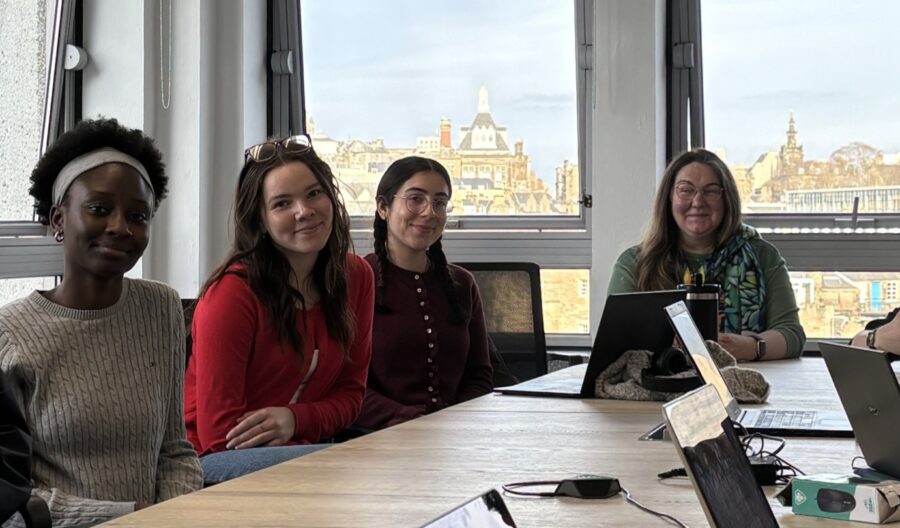
Seven students (and one staff volunteer) completed this extracurricular digital research project amassing both the requisite 55-80 hours of volunteering time AND the significant & demonstrable impact in improving the topic coverage of their chosen project area on the free and open encyclopedia, Wikipedia.
Their projects covered a wide range of topics which often complemented their studies (and at times provided a respite/holiday from their studies) as well as, importantly, enhancing & evidencing their graduate capabilities and digital research skills in such diverse project areas as:
By the award’s completion, our 2025 Edinburgh Award achievers had contributed over 80,000 words and 1200 references to the largest reference work on the internet, and their work had amassed over 1 million pageviews from interested readers all around the world.
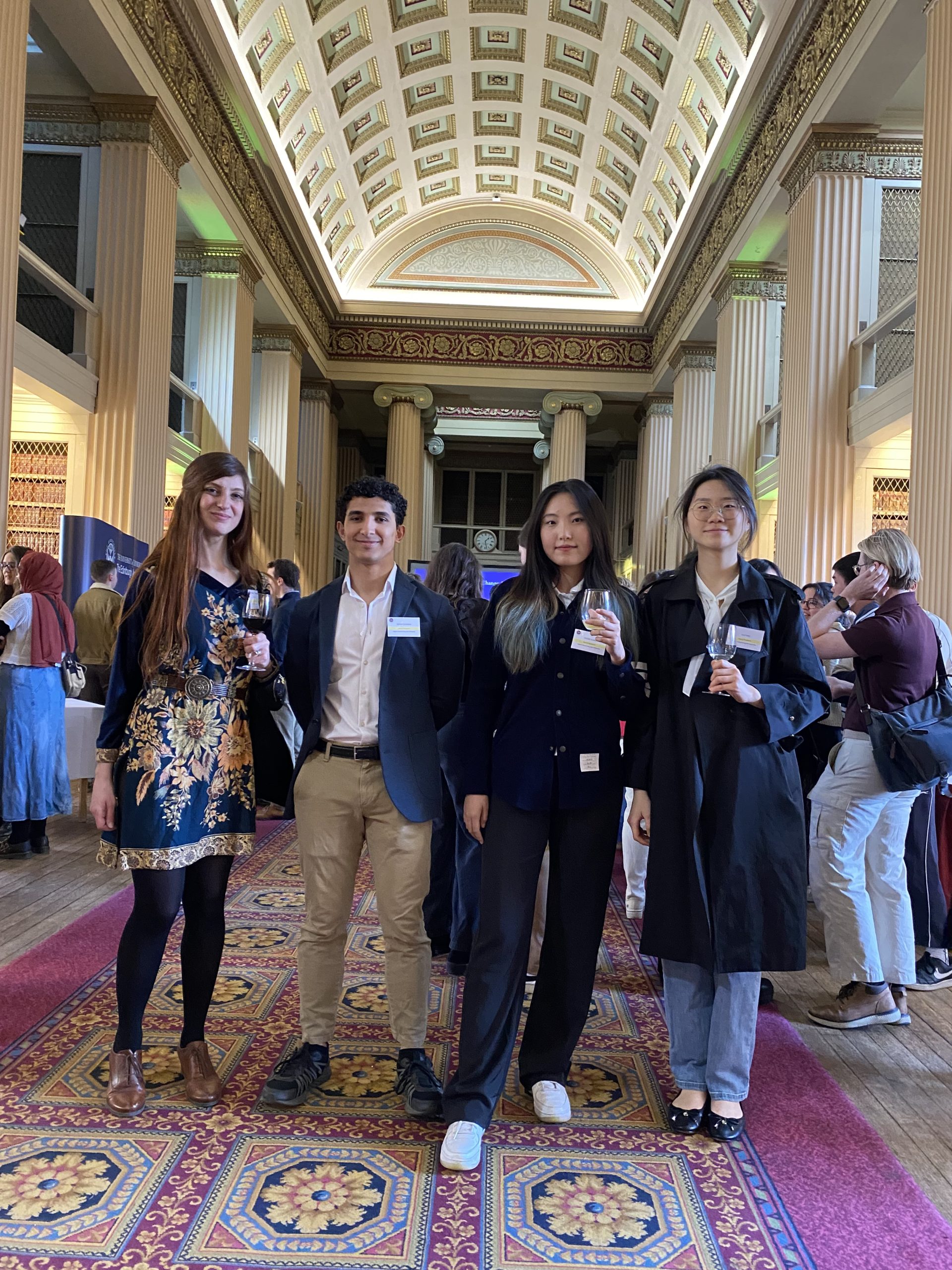
The student achievers were then presented with their certificate of completion, and record of their achievement added on their Higher Education Achievement Report, at a celebration event evening for all Edinburgh Award achievers at the University’s Playfair Library during Reading Week in April.
And we look forward to working with you and toasting your Award success!
Here’s an example ‘end of award’ presentation by one of our 2023 achievers, Ana Aldazabal (pictured above on left), on her project on Latin American literature (suggested by Professor Fiona Mackintosh).
NB: If you are a member of staff at the University then you can also get involved by suggesting topic areas and/or resources (like course reading lists) that would be helpful and of interest to the students for project idea inspiration as to where they could so some good improving topic coverage on Wikipedia.
This adds to the fascinating work of our past award achievers who have helped improve global understanding on other underrepresented topics such as:
This post was written by LLB student Dervla Craig on her first month as Information and Data Literacy intern this Summer.
My name is Dervla and I am going into my second year of the Graduate LLB at the University of Edinburgh. This summer I am doing a 12-week internship with the University’s Information Services Group (ISG) on one of the most fascinating projects I have ever had the opportunity to be a part of: the Accused Witches of Scotland project.
I am one of a long line of interns who has been involved in this project each year since 2019, which aims to commemorate and spread awareness about those who were persecuted as witches in Scotland during the 16th to 18th centuries. While previous interns have primarily been focused on processing and importing data from the University’s landmark The Survey of Scottish Witchcraft database (2003) into Wikidata and created our witches website with new map and timeline visualisations, this year my role looks a bit different.
My remit for the 12 weeks is to prepare a bid to the National Lottery Heritage Fund to secure funding for what we hope can be the next phase of the project. Our goal is to preserve the accused witches’ data in the long-term and ensure that people can connect with and participate in this heritage now and in the future. As it has come to the end of my first month, I wanted to join the tradition of blogging about my internship experience so far.
Getting to know the individual stories of the accused
My first week was spent diving down the rabbit hole to explore all there is to learn about the Scottish witch trials. If you had asked me to describe an accused witch before this week, I would’ve told you they wore a pointy hat and flew around on a broomstick. I couldn’t have been more wrong! Now when I picture these women, they look like my mother, or my grandmother, or me. They were ordinary people who suffered an egregious injustice, and I was extremely moved when learning about their stories.
Josep Garcia-Reyero (2022)
Maggie Lin (2022)
Claire Panella (2023)
Ellie Whitehead (2024)
Prof Julian Goodare and Ruby Imrie (2023-2024)
Geography undergraduate student, Emma Carroll, our first ‘Witchfinder General’ intern in Summer 2019.
Some of the most valuable tools for my research included The Survey of Scottish Witchcraft, created by Julian Goodare, a history professor at the University of Edinburgh, and his team in the late 90’s, and the interactive witches map resource created by Emma Carroll, a geography student and our former Data Visualisation intern, and our late developer colleague Richard Lawson in September 2019. The Survey made use of the historic records of all the accused witches in Scotland between 1563 – 1736 and organised the details into a MS Access 1997 database, and our new 2019 map brings this data to life in a new and engaging way through importing the data into Wikipedia’s sister project, Wikidata, as linked open machine-readable data.
Learning about the great work that has been done previously definitely made me realise I have a lot to live up to but also motivated me to give it my all in the next twelve weeks and hopefully produce an end result that meets the standards of my predecessors.
Writing a National Lottery Heritage Fund bid
The next thing to familiarise myself with before I could dive into my writing was the bid itself. I spent a few days combing through the NLHF website to understand what it is they are looking for and how our project fits those needs. By getting to know my audience, I could ensure that my writing was intriguing, evidence-based and persuasive. I quickly found out that before submitting the 10,000-word application, I must submit a 1000-word ‘Expression of Interest’. This EoI asks questions about the heritage of the project, what our project aims to achieve, and why it is needed now. At this point, I felt I could write a dissertation for each of these questions, so the tight word count was my biggest enemy. I had lots of help from some lovely colleagues who offered their feedback and advice, including the Project Director of the Survey of Scottish Witchcraft, Professor Julian Goodare. After many tweaks and a few redrafts, I am happy to say at the end of week four that the EoI is pretty much ready to go.
Exploring avenues for community engagement
Alongside writing, writing and more writing, I have also been brainstorming ideas for the community engagement side of our project. There have been so many great ideas by the team which have led to interesting and helpful discussions with different people and organisations, including the National Museum of Scotland, Reforesting Scotland, and some really talented artists. Excitingly, most of the responses we have received have been positive and enthusiastic. In the upcoming weeks, I hope to visit some of these places and see firsthand the primary sources from the witch trials.
Workshops and all-staff events
Another educational and fun aspect of my experience so far, outside of my bid writing role, has been the plethora of events hosted by ISG. In the past month I have taken part in ‘intern welcome’ socials, Wikipedia writing workshops and even a workshop on an introduction to blogging! Alongside these, I have also attended two all-staff events, one for all Information Services Group (ISG) staff and one for the Learning, Teaching and Web (LTW) division. Not only have I learned so much about the behind-the-scenes and the people who have made my studies possible for the past five years, but these events have also been an opportunity to get to know more of my colleagues and socialise with other interns. At ISG there is a strong emphasis on having a healthy work-life balance and making sure that you and those around you have what you need to produce your best work.
View of Edinburgh Castle from Floor K, Argyle House. CC-BY-SA by Dervla Craig.
In conclusion, I have had an amazing first month as an intern with the University of Edinburgh. I have learned a lot, met new people, and pushed myself outside of my comfort zone. Plus the amazing view of Edinburgh Castle from Floor K has been a real motivator to work from the office and not from home! I am nothing but hopeful that the next eight weeks will be even more exciting and productive, and that I can blog again soon with positive updates!
We know that many students are involved in activities alongside their studies such as volunteering, part-time work, and getting involved in the University community.
To help these activities to stand out from the crowd, our University has a new Award for “Digital Volunteering with Wikipedia” to sit beside other available Edinburgh Awards– the Edinburgh Award is a programme that allows students to get official recognition for their involvement in extracurricular activities and demonstrate their digital capabilities to employers.
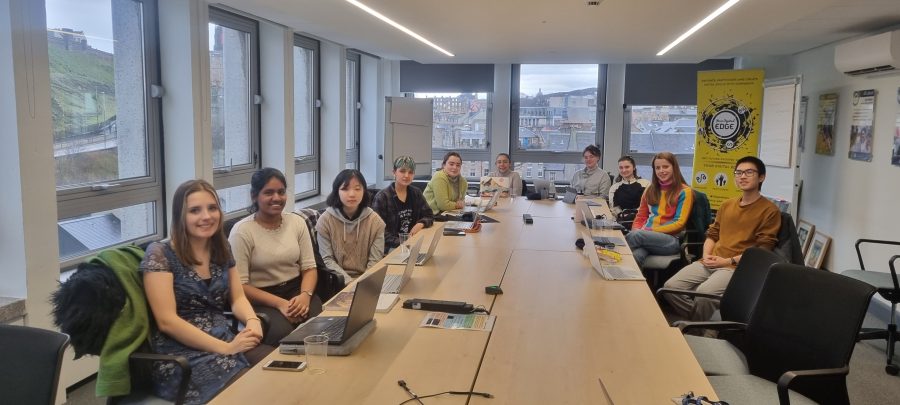
Edinburgh Award participants sat around a boardroom table in the shadow of Edinburgh castle at final showcase event, CC-BY-SA by Ewan McAndrew, University of Edinburgh
There are many different types of Edinburgh Award activity students can undertake but Digital Volunteering with Wikipediafocuses on developing 3 Graduate Attributes (e.g. digital literacy, written communication, assertiveness & confidence etc.) over the course of 55-80 hours of work and providing evidence of demonstrable learning, reflection and impact. These hours are staggered over the October to end of March period punctuated by 3 main mandatory “input” sessions.
In the first, Aspiring, in October the students self -assess themselves against the Graduate Attributes and select three to develop as part of the award. They also select a topic area of Wikipedia they wish to improve and submit a 400 word action plan for how they plan to develop their chosen Graduate Attributes and how they’ll deliver impact.
Once they have had training and researched their topic areas, the 2nd Input Session, Developing, in late December, requires them to re-assess if their Graduate Attribute ranking has changed, and submit a completed Fortnightly Log of Activities designed to evidence their work to date and their reflections on how they are progressing towards their personal project goals. We hold fortnightly group research sessions in the library (because not everything is online) to help their research and allow them to edit in a social and supportive environment where they can ask questions and seek help; both from the Wikimedian in Residence, and from each other.
Example student project on Francophone Literature, CC-BY-SA by Ewan McAndrew, University of Edinburgh
The final Input Session, Owning, is about coming together to share their project outcomes and reflections as well as ensuring the students get the opportunity to tie all this in with their future goals and how they will communicate about their Edinburgh Award experience to their peers, academic advisors or employers. This session takes place at end of March and their final submissions are an 800 word report or 3-6 minute video presentation reflecting on both their impact achieved and the development achieved in their 3 chosen graduate attributes.
Topics suggested by students to improve online
More interestingly, are the topics the students wanted to write about. Climate change, Covid-19, LGBT History, Black History, Women artists, Women in STEM. Marginalised groups, underrepresented topics, some of the biggest and most pressing challenges in the world today. This shows me that students recognise and are intrinsically motivated by the importance of addressing knowledge gaps and improving the world around them.
Here’s a short video of an example project on LGBTQ+ history and women of the MENA region:
The final 10
We started in October with a large cohort off 44 interested students but this reduced to 10 by Input 3 but this was to be expected and is in line with other Edinburgh Award programmes similarly asking students to undergo over 55 hours in extracurricular volunteering.
These ten ‘knowledge activist’ heroes have been put forward to achieving the Award this year.
76,000 words have so far been added to Wikipedia and over 876 references to pages viewed almost 3 million times already!
41 articles created, 157 improved, 35 images uploaded and articles translated in German, Spanish, Greek, Bulgarian and French including the accused Bavarian witch Anna Maria Schwegelin (translated from German Wikipedia) and Crime of Solidarity (translated from French Wikipedia) which is a concept coined in France by human right’s activists in order to fight against organised illegal immigration networks as well as fight against laws that prevent refuge for refugees.
Reflections on the Edinburgh Award. CC-BY-SA by Ewan McAndrew
The Black Penny, also known as the Hume-byres Penny, was a coin with medicinal properties mentioned in the “Remedies for Hydrophobia”, a short folkloric tale included in the Denham Tracts.
Fatat al-Sharq (Arabic: فتاة الشرق; Girl of the East) was an Egyptian women’s periodical first published in 1906 by Labiba Hashim when she was 18 years old.
Here’s a short video of an example project on the history of menstruation:
Here’s a short video of an example project on Witch hunting (past and present):
Quotes from the students
“During the Wikipedia project, Critical Thinking skills were crucial to ensure the information presented was accurate, unbiased, and relevant. As the research progressed, I noticed that my skill improved as I had to analyse and evaluate the information gathered. One of the key improvements in the skills was the ability to identify and evaluate different sources of information. Initially, I relied heavily on a few sources for my research, but as the project progressed, I began considering a wider range of sources. I made an effort to evaluate each source based on its credibility, relevance, and objectivity, which helped me to identify and include the most accurate information.”
“I think that I have helped improve information accessibility on Wikipedia, as one of the most widely used free encyclopaedias I have felt it important to fill gaps in information largely concerning the LGBTQ community and women, as both of these areas are often forgotten about. I think having access to marginalised communities stories, achievements and contributions is a really important value, by contributing to these topics I have hopefully made information available to people around the world.”
“Once, I completed my second article I felt more self-assured and assertive on what was appropriate writing to upload onto Wikipedia. I had created an article on one of Cavafy’s poems, which is one of my favourite poems from his anthology. That could’ve also been a contributor to the overall experience too, since producing something which engages with one of your likes makes the activity a little more bearable. As I overcame this barrier, I was able to expand as well as develop my skills by editing as well as creating a lot more articles on Wikipedia. As it stands right now, I have contributed 10k words on Wikipedia. Although the first half of this process was excruciatingly slow, after overcoming my fears and worries I was keener with contributing on Wikipedia and practically spent most days changing, improving, or producing articles. ”
“Being a part of writing communities like Wikipedia has helped me to improve not only my writing but also my editing and proofreading skills. I have learned to use plain language, avoid jargon and technical terms, and organise information logically and coherently, thanks to Wikipedia’s style guidelines.”
“Doing this award has helped me make significant progress made on improving my independent research skills. For example, I think that over the course of my project, I have become better at picking out relevant information from very long sources and not spending too much time reading and fussing over smaller less significant details. In addition, I am more proficient at finding sources through Google Scholar and DiscoverEd and have also learnt where to look when struggling to find more information about a topic e.g. using good quality sources referenced in the bibliographies of journals and books I had already found to help grow my source lists.”
“Overall, my confidence to make bolder edits and create quality articles on Wikipedia has grown significantly since I started my project and I now feel that I can have a more significant and active presence on the site. Editing and writing articles about witch-hunting has been incredibly enlightening and rewarding and I want to continue to edit about this important topic after I finish the award.”
“My digital literacy skills have greatly improved compared with when I started my Wikipedia research project. Since the project involved extensive online research, it required me to engage with a wide range of digital tools and technologies. Through this process, I have developed proficiency in various areas of digital literacy, such as information literacy, media literacy, and digital communication.”
“My Wikipedia project on the history of menstruation has had a positive impact on others in several ways. Firstly, the project has helped raise awareness and understanding of an often-overlooked aspect of women’s health and history. By providing accurate and accessible information on the history of menstruation, the project has helped to demystify a topic that has long been stigmatized and taboo. I corrected a key part of the history of menstrual cups, which were first patented in the US in 1867, whereas before the article only included that the first patent for a commercial cup was in 1937. My article on Menstruation and humoral medicine has filled a gap in the content on Wikipedia, and highlighted the ambiguities in the ways that people viewed menstruation in the early modern period.”
“I wrote an article on Mary Marjory MacDonald, and significantly edited articles on Edwin Chiloba and the Signares. Mary was nicknamed ‘the Scottish Queen of Thieves’, and I believe it is important to represent more women on Wikipedia, especially figures who do not fit into traditional gender roles. This is also the case for the Signares, who were a group of women who acquired wealth and power in colonial Senegal. In addition, representing African LGBTQ+ activists such as Edwin Chiloba is important, since they are a group often neglected on Wikipedia.”
“I decided to focus on creating new pages to maximise my impact as some very important parts of the history of Francophone literature were missing, such as The Colonial System Unveiled, one of the earliest critiques of colonialism, which is unfortunately not recognised widely enough as a significant historical anticolonial text. I also decided to emphasise the contributions of women to Francophone Caribbean and African writing, as they can be overlooked in this area.”
“I hope that my contributions can help other students like me, such as those studying French or taking the course that inspired me to pursue this project. On a wider level, I also think my project can help increase the awareness of Francophone literature among English speakers. I believe it is very much underappreciated and people do not realise how much influence Francophone African and Caribbean thought have had on literary criticism even in an Anglophone context.”
Here’s a short video of an example project on improving topic coverage of Francophone literature:
Here’s a short video of an example project on improving topic coverage of artworks depicting Edinburgh:
In conclusion
Example student project researching artists,writers and banks related to Edinburgh. CC-BY-SA by Ewan McAndrew, University of Edinburgh
“There are no stars so lovely as Edinburgh street lamps“.
Robert Louis Stevenson’s words (below) are inscribed in Makar’s Court, Edinburgh. In taking this photo and sharing it openly to Wikimedia Commons and inserting it into the Makar’s Court page, the Edinburgh Award student has brought these words to my attention and helped raise my awareness that there are clearly other lovely stars in Edinburgh. Ten student stars in particular. And I have told them that they should all be enormously proud of their achievements this year.
Inscription of Robert Louis Stevenson quote in Makars’ Court, CC-BY-SA by Erisagal via Wikimedia Commons
One final student project!
Here’s a short video of an example project on improving topic coverage of plant pathology on Wikipedia:
Recovering Histories event: 3 student researchers looked at the gaps on Wikipedia and where important histories were not (yet) represented online. CC-BY-SA by Ewan McAndrew
Three students co-authored an application to take part in a Student Experience Grant project over a 14-week time period, learning how to edit Wikipedia and how to fill in diversity gaps on the website:
Eleanor– PhD Student researching LGBTQ+ History.
Sian – PhD student researching Black History.
Kirsty – Undergraduate student researching Gender History.
Each student specialised in a particular aspect of diversity which Wikipedia was lacking coverage on. These were black history, LGBTQ+ history and women’s history. Through these three specialisations each student was able to increase their knowledge in their specialised area, digging through Edinburgh’s history in the matter. For example, Kirsty, one of the students, was able to delve into the University’s rich sporting history and learn about the impressive sportswomen that spent time at Edinburgh University. Kirsty also showed off a poster presentation on the Student Experience Grant project at the University’s GenderEd annual showcase & networking event.
Through the project the students developed knowledge of the gaps on Wikipedia and created worklists of pages in need of creation or updating to improve diversity of representation on Wikipedia. These worklists were utilised in a final end of project event, with 50-60 signups. The hybrid event was held in the Project Room of 50 George Square with students, staff and members of the public taking part in learning new digital and information literacy skills and contributing their scholarship openly to improve coverage of, and understanding about, LGBTQ+ History, Gender History and Black History in Scotland.
This event included many University of Edinburgh students who were introduced to editing Wikipedia, through a led tutorial, and given the aforementioned pre-researched worklists to help contribute to Wikipedia as a whole. The event featured a panel discussion and display of the work of the three primary students involved in the project, educating those in attendance about the disparities within Wikipedia and how they can help improve this as information activists.
Recovering Histories event, CC-BY-SA by Ewan McAndrew, University of Edinburgh
The event also included representatives from University of Edinburgh, University of Dundee, Wikimedia UK, the Devil’s Porridge Museum, Sussex University, University of Cape Town, Swansea University, Birkbeck University London, UCL, University of Leeds, the National Gallery of Ireland, Victoria University of Wellington, Kiel University, ZBW Leibniz, Manchester Metropolitan University, Staffordshire University, National Galleries Scotland, Arts University Bournemouth, University of Kent, Lothian Health Service Archives.
In addition, the structure of the project allowed all three students to specialise in their interests. This allowed each student to delve further into an area of interest/specialisation which was rewarding for all involved. They each created a poster which was printed out to display in the final end of project editing event for all to see.
Gained professional experience using their research skills outside of their main study.
Expanded awareness of information activism as a whole and the role of information in dictating awareness of those often ignored by society.
Had the opportunity to expand their network by making connections with the Scottish Portrait Gallery.
Organised and hosted an edit-a-thon at the University.
Eleanor has subsequently organised her own editathon on LGBTQ+ art on Wikipedia and been in discussions about presenting at the Queering Wikipedia conference 2023.
Scotland, Slavery and Black Histories poster, CC-BY-SA by Sian Davies
Reflections from Sian:
“I have been looking at Black history, specifically focusing on Scotland’s links to transatlantic slavery to try to address the silences on Wikipedia related to this topic. By adding in information to existing pages as well as creating new ones, I hope this work, however marginally, contributes to public understanding of the varied and widespread connections between Caribbean slavery and the making of modern Britain. Examples include adding in details such as William Wright’s, a renowned Scottish Botanist, ownership of enslaved people and how he developed an interest in botany while in the Caribbean, and adding in William Forbes of Callandar’s, a Scottish industrialists, connection to transatlantic slavery through his production of sugar boiling pans sold to planters in the Caribbean. I also developed a new page for Leith Sugar House, to show how some of built environment of Scotland is also connected the Caribbean and the profits made from slavery. “
Gender History poster, by Kirsty Vass-Payne, CC-BY-SA
Reflections from Kirsty:
“Higher Education Institutions, and the student bodies within them, are heavily involved within diversity-based research and movements throughout society. However all too often work fails to extend beyond the reach of the university community. Information activism is an often unappreciated but vital part of diversity and equality movements. Work to increase representation of marginalised communities online helps to make the histories, achievements and movements of communities suppressed in mainstream media available to all. Wikipedia is the perfect website for such work. Further Wikipedia involvement can be vital in transforming this information to a wider community.
Firstly it does not occur to many that they themselves can, and should, contribute their knowledge to Wikipedia. Before entering this project two out of three of the students had not contributed to Wikipedia before. This is often the first, and primary, hurdle to many in being part of the Wikipedia editing community. Herein, raising awareness of the ease at which one can contribute to Wikipedia is vital alongside providing a space in which to edit with support.Through this project Ewan McAndrew assisted the students in entering Wikipedia as editing and taught them the basic understandings and rules necessary to contribute. Although these can be easily learnt online, live teaching can be invaluable in quickly setting up students to edit Wikipedia. Running events on specific topics which include mini tutorials on how to edit are invaluable to adding information on Wikipedia. This is as they target those who are not currently engaged. The more people that are taught to edit Wikipedia, the more who can contribute their wealth of knowledge to Wikipedia.
Wikipedia is a very large website, and as such the breadth of information that can be added to or edited it never ending. This can be a daunting prospect to many. As such it is much simpler, and more manageable to focus particularly on one area. From here you can create a related a worklist of pages to be added/edited, including details of what is missing. Often half the job on Wikipedia is establishing the gap in Wikipedia as there is often the incorrect presumption that everything is already there. If creating a worklist is untenable there are many project pages/worklists already available that you can work through with students. Examples of this include Women in Red which aims to create pages for women of note.”
Researching LGBTQ+ History poster and the rich important stories to tell, CC-BY-SA by Eleanor Capaldi
Reflections from Eleanor:
“The strand I’ve been exploring on this project is diversifying LGBTQ+ records. These could be of individuals, organisations, projects, either historical or contemporary. Filling in the gaps of LGBTQ+ history is necessary to reflect the diversity of society over time, and to readdress inequalities that have seen these identities suppressed or erased in record. Doing so also has a role to play in validating LGBTQ+ communities as being connected to something larger, this history partly acting as defence against suggestions that being LGBTQ+ is new, and therefore temporary, to be changed. It’s a way to say – we’ve always been here. Given that the historical landscape regarding sexuality and gender has evolved over time, from the law to language, it can sometimes prove challenging to attribute LGBTQ+ identities, even when there are indications. It is a catch-22 – to be accessible on a site like Wikipedia where there needs to be evidence, but for LGBTQ+ lives such evidence may have been erased, or alternatively exist, butas a result of primary sources like oral histories, rather than secondary.
That said there are valuable records that have been created and contributed to, and research projects and efforts to establish and expand LGBTQ+ sources that do exist, and they are increasing all the time. Given Wikipedia’s prominence, their inclusion matters. As such, I’ve been exploring the history of the Lothian Gay and Lesbian Switchboard, the first such telephone support service in the whole of the UK, which didn’t have a Wikipedia entry until it was developed as part of this project. Through researching this organisation, in collaboration with Archivist Louise Neilson at the University of Edinburgh (who hold the Switchboard archives and have recently received Welcome Trust funding to catalogue its contents), it has opened up so many avenues of people and events that were connected to a significant and important part of LGBTQ+ history in Scotland. It is a privilege to be able to contribute in even a small way to place this piece of Scottish LGBTQ+ history into the Wikipedia puzzle. “
In terms of challenges, due to the secondary source nature of Wikipedia there were issues encountered with getting archival information on to Wikipedia, which requires a step in between. Had there been a larger project timeframe there would have been more time to do this. However, due to the short nature of the project archival information was simply used less as it would have been too time consuming to use more.
The legacy of the project
The worklist, gaps and resources identified, still exist and the work will have a further legacy as the work will be continued with other student editors contributing to it either through the student Edinburgh Award for ‘Digital Volunteering with Wikipedia’ (Oct-March each year) topics or through the monthly Wikipedia editing workshops run by the University’s Digital Skills team. This project has been a source of inspiration for students taking part in the aforementioned Edinburgh Award for the kind of ‘knowledge activism’ and the agency it demonstrates students can have.
Moreover, the three students involved in the project dictated the strands of their research according to interests found along the way, and lines of success in research. As such there was always interesting work to be done and it allowed the opportunity to have conversations with, meet and work with people inside and outside of the University; to raise awareness and provoke ideas of what more could, and should be, done in future.