
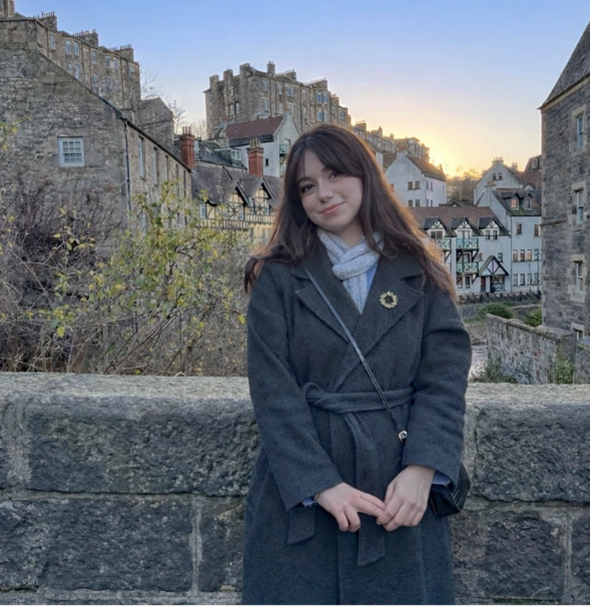
Guest post by Maya Field, Digital Heritage and Open Knowledge intern.
Hello! I am Maya, this year’s Digital Heritage and Open Knowledge Intern at the University’s Information Services Group. My role this summer focuses on exploring the digital outputs that can be created to celebrate the heritage of both Edinburgh Medical School and Nursing Studies as they mark their 300th and 70th anniversaries respectively.
As a History student here at the University of Edinburgh, I am lucky enough to spend much of my time studying in the Old Medical School, the same place where my grandfather, Dr Dileep Godbole, studied for his surgical examinations after moving from Mumbai, India, in the 1970s. This connection, alongside my interest in uncovering the histories of people who have often been overlooked in the historical record, has made me incredibly excited to work on this project and to explore the diverse history of medicine and nursing at the University.
Alongside settling into my role and putting my ability to remember names to the test, my first week involved being trained by my line manager, Ewan McAndrew, in the basics of editing Wikipedia. Armed with this new knowledge, I was soon presented with a collection of Japanese-language sources relating to Agnes Vetch, a Scottish nurse who trained at the Royal Infirmary of Edinburgh and went on to become a pioneer of nursing education in Meiji-era Japan. Despite her remarkable career, her story had previously only been documented on the Japanese-language version of Wikipedia.
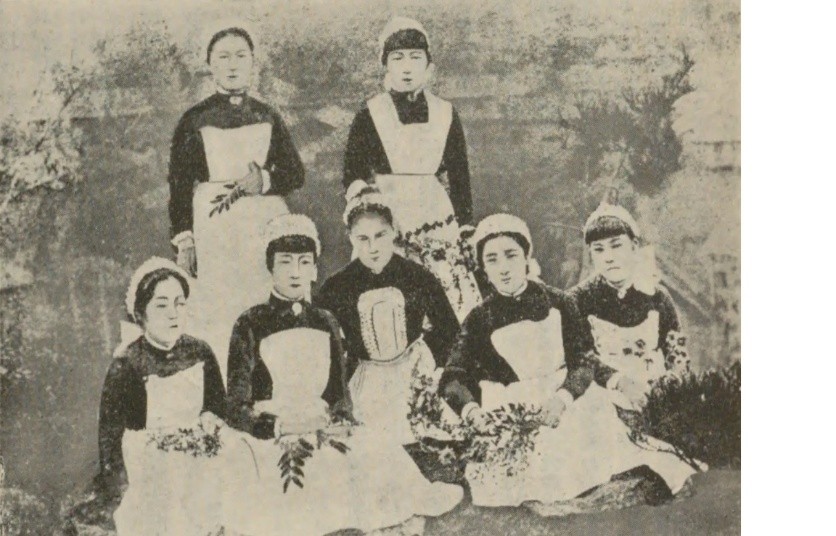
Agnes Vetch, seated in the centre of the front row, with her nursing students from Sakurai Girls School, Tokyo, 1888. Public domain via Wikimedia Commons.
Using these sources, alongside additional research, I created and expanded an English-language article about her life and career. It was a fascinating introduction to the role, not only because it allowed me to learn about an extraordinary woman, but also because it highlighted how many important figures in the history of medicine and nursing remain largely absent from public knowledge resources.
I was also given the opportunity to present this work at the Usher Institute alongside Ewan and fellow intern Anna as part of a session on public health literacy and Wikipedia. It was particularly interesting to hear from both of them about the importance of Wikipedia as a public health resource and the role it can play in making reliable information accessible to a wide audience.
Beyond Wikipedia, much of my work so far has focused on Nursing Studies. With the help of Pam Smith, Professor of Nursing Studies at the School of Health and Social Science, I have been introduced to a wide range of resources relating to its unique history as the first nursing degree programme at a UK university. I’ve spent a lot of time carrying out detective work in the University Centre for Research Collections, looking at stories that have yet to be told, from members of the first cohort to developments in mental health nursing and the programme’s global connections. I am looking forward to continuing this research over the coming weeks and, hopefully, sharing some of these stories by the end of the internship.
Overall, it has been a lovely and varied introduction to the role. I have been welcomed by so many lovely people across ISG, as well as by my fellow interns. A Forrest Hill scavenger hunt with the other interns provided a great introduction to both each other and the maze that is the building itself! I am excited to continue my work with Nursing Studies, get stuck into the Edinburgh Medical School 300 project, and see what the rest of the summer has in store!