
Supporting the University of Edinburgh's commitments to digital skills, information literacy, and sharing knowledge openly

Tag: open collections

Celebrating Edinburgh Medical School and Nursing Studies: Reflections from my first weeks as an intern

Sticky post

Guest post by Maya Field, Digital Heritage and Open Knowledge intern.

Hello! I am Maya, this year’s Digital Heritage and Open Knowledge Intern at the University’s Information Services Group. My role this summer focuses on exploring the digital outputs that can be created to celebrate the heritage of both Edinburgh Medical School and Nursing Studies as they mark their 300th and 70th anniversaries respectively.

As a History student here at the University of Edinburgh, I am lucky enough to spend much of my time studying in the Old Medical School, the same place where my grandfather, Dr Dileep Godbole, studied for his surgical examinations after moving from Mumbai, India, in the 1970s. This connection, alongside my interest in uncovering the histories of people who have often been overlooked in the historical record, has made me incredibly excited to work on this project and to explore the diverse history of medicine and nursing at the University.  

Alongside settling into my role and putting my ability to remember names to the test, my first week involved being trained by my line manager, Ewan McAndrew, in the basics of editing Wikipedia. Armed with this new knowledge, I was soon presented with a collection of Japanese-language sources relating to Agnes Vetch, a Scottish nurse who trained at the Royal Infirmary of Edinburgh and went on to become a pioneer of nursing education in Meiji-era Japan. Despite her remarkable career, her story had previously only been documented on the Japanese-language version of Wikipedia. 
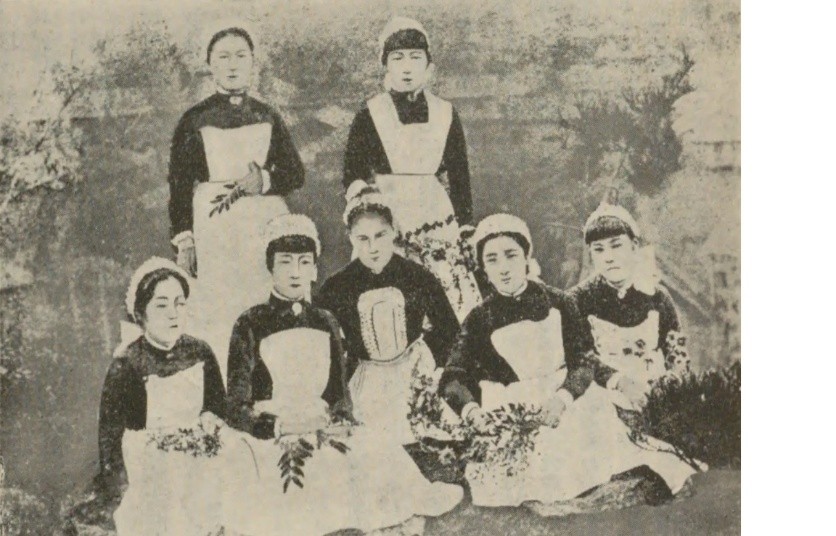
Agnes Vetch, seated in the centre of the front row, with her nursing students from Sakurai Girls School, Tokyo, 1888.

Agnes Vetch, seated in the centre of the front row, with her nursing students from Sakurai Girls School, Tokyo, 1888. Public domain via Wikimedia Commons.

Using these sources, alongside additional research, I created and expanded an English-language article about her life and career. It was a fascinating introduction to the role, not only because it allowed me to learn about an extraordinary woman, but also because it highlighted how many important figures in the history of medicine and nursing remain largely absent from public knowledge resources.

I was also given the opportunity to present this work at the Usher Institute alongside Ewan and fellow intern Anna as part of a session on public health literacy and Wikipedia. It was particularly interesting to hear from both of them about the importance of Wikipedia as a public health resource and the role it can play in making reliable information accessible to a wide audience.  

Beyond Wikipedia, much of my work so far has focused on Nursing Studies. With the help of Pam Smith, Professor of Nursing Studies at the School of Health and Social Science, I have been introduced to a wide range of resources relating to its unique history as the first nursing degree programme at a UK university. I’ve spent a lot of time carrying out detective work in the University Centre for Research Collections, looking at stories that have yet to be told, from members of the first cohort to developments in mental health nursing and the programme’s global connections. I am looking forward to continuing this research over the coming weeks and, hopefully, sharing some of these stories by the end of the internship. 

Overall, it has been a lovely and varied introduction to the role. I have been welcomed by so many lovely people across ISG, as well as by my fellow interns. A Forrest Hill scavenger hunt with the other interns provided a great introduction to both each other and the maze that is the building itself! I am excited to continue my work with Nursing Studies, get stuck into the Edinburgh Medical School 300 project, and see what the rest of the summer has in store! 

Supporting Open Collections – Guest post by Wikisourceror intern, Erin Boyle

Figure 1: ‘Main Library Rainbow’, Stewart Lamb Cromar 2021 CC BY-SA, File:’Main Library Rainbow’ (2 3) (51239066072).jpg – Wikimedia Commons

I am now at the end of week four of my role as a Wikisourceror – Open Collections intern, and the learning process has continued; albeit now I am a bit more familiar with the world of Wiki! I have now created two new articles on Wikipedia (for Hannah Shields and Iona McGregor), and this week I uploaded some of Stewart Lamb Cromar’s (@stubot) Lego Library images to Wikimedia Commons. You can now find one of the Lego Library pictures on the Wikipedia page for the University of Edinburgh Main Library!

I also had the pleasure to attend the Arctic Knot – Wikipedia Language Conference last week, during which I listened to many incredibly interesting and insightful talks. This included several talks about Arctic languages and indigenous languages, digital language activism, and I participated in an Intro to Wikisource workshop led by Nicolas Vigneron; during which we proofread pages from a book in French Breton – it was a bit of a challenge! However, I am getting the hang of Wikisourcing a little more now.

I have also been playing around with the Wikidata query service; especially looking at interesting queries made by others, such as Martin Poulter. Some queries that I found really interesting were those to return items in particular galleries/libraries/museums, organisations founded by people born in Edinburgh, people who invented scientific instruments, and places of education of Members of Parliament of the United Kingdom. I really enjoyed looking at the several different ways of visualising the results of the query, such as plotting geocoordinates associated with the items on a map or making an interactive graph of connections between the items returned.

Over the past week or two I have been turning my attention to drafting content for the University’s Wikimedia website and corresponding resources (PDFs and videos) and laying the foundations for designing the workflows for library staff. This has involved looking at the website as it is currently and deciding where the content gaps are that need filled.

As I am planning content for the website, I am also investigating good examples of GLAM WikiProjects; especially those which involve working with Wikisource. Examples of best practice and advice will both help inform the resources that I am going to create, and demonstrate to people who are thinking about getting involved in Wikimedia (especially those working in Library & University Collections) that their contributions can have a positive impact; and that in the case of the Library they can use Wikimedia to significantly raise awareness and engagement with their collections both within the University, as well as nationally and globally. Institutions that I am investigating involve the Rijksmuseum, Europeana, Wellcome Library, National Library of Wales, The Smithsonian and more.

Knowledge doesn’t belong in silos. The interlinking of the Wikimedia projects exemplified through Robert Louis Stevenson. Media files on Commons, his written works on Wikisource, machine-readable linked open data on Wikidata. All linked to from Wikipedia.

Whilst planning my content and resources, I needed to think a lot about what the needs and prior knowledge of the users would be. Thinking about potential barriers that people face when contributing content to the Wikimedia projects, many difficulties stem from a lack of accessible, easy-to-use documentation, and users not being aware of how to find resources easily or get started with the various platforms. Over the next couple of weeks, I will be having conversations with some members of staff at the university to find out about their previous experiences with the Wikimedia projects, what their feelings towards them are and how they could be better supported to feel able to contribute.

I am creating resources with a Library focus, meaning that for example, my Wikisource resources will focus more on guiding users on how to upload digitised texts to Wikimedia Commons, add structured data for the texts, and then set up the text for proofreading, validating and transcluding on Wikisource. I will also be creating a guide for making an author page on Wikisource and for showing users how they can link content across the Wikimedia projects: such as adding a template to an author’s Wikipedia page that will show an associated works box, so that users who are interested in an author can quickly and easily access their works.

The goal for this week is to begin creating the content that I have planned in my draft last week. This will involve preparing scripts for how-to videos and beginning to carve out some rough drafts for supporting PDF guides.

Updates to come soon!

Erin Boyle – Wikisourceror Open Collections intern

Powered by WordPress & Theme by Anders Norén