Wikimedian in Residence

Supporting the University of Edinburgh's commitments to digital skills, information literacy, and sharing knowledge openly

Screengrab of Histropedia Wikidata Query Viewer (CC-BY-SA).

Histropedia – knowledge from Wikipedia visualised as dynamic timelines

Histropedia Timelines – In the (Saint) Nick of Time.

Can you spot Saint Nick in the below timeline of saints?

Screengrab of Histropedia Wikidata Query Viewer (CC-BY-SA).

Screengrab of Histropedia Wikidata Query Viewer (CC-BY-SA).

For today’s post, the Open Education resource we present to you is Histropedia – the timeline of everything.

Histropedia allows users to create visually dynamic timelines using structured data from Wikidata, articles from Wikipedia and images from Wikimedia Commons. It has in excess of 340,000 timelines listing 1.5 million articles from Wikipedia: including timelines on the Battles of World War One, the Heroic Age of Antarctic Exploration, the Novels by Charles Dickens, Empires, Famous Artists, the filmography of David Bowie and many more.

This 1 minute 22 second video demonstrates how quickly & easily timelines can be put together using Wikipedia articles & categories to dramatically visualise events.

By way of example, I was able to create this Santa Claus in the movies timeline in a matter of minutes going from the 1900 movie, A Christmas Dream, by Georges Méliès right up to modern day with films like Trading Places (1983), Miracle on 34th Street (1994) and Arthur Christmas (2012). The published timeline is now available for others to view and add to as a free open education resource where each timeline event can be clicked on to take you through to the Wikipedia article to find out more.


histropedia-screengrabScreengrab of Histropedia timeline for Santa Claus in the movies. (CC-BY)

Further, now that the Histropedia now has a Wikidata Query Viewer option this means that the structured data can now be queried even further. For example, I was curious to find out more about Saint Nick so I was able to ask Wikidata to show me all the saints it had information about and show them on a timeline according to their year of birth and colour coded by their place of birth. Click here to view the result.

Screengrab from Histropedia Wikidata Query Viewer Tutorial – Timeline of University of Edinburgh female alumni colour-coded by place of birth and labelled in Japanese, Russian, Arabic and English (CC-BY)

Histropedia’s developers, Navino Evans and Sean McBirnie, joined us at Repository Fringe at the University of Edinburgh in August this year where we recorded a short video tutorial in order to demonstrate how to create a Histropedia timeline using their Wikidata Query Viewer – this time on female alumni of the University of Edinburgh; colour-coded by their place of birth and labelled in Japanese, Russian, Arabic & English (depending on whether the query could find an article in these 4 different language Wikipedias).

This OER video tutorial has now been viewed a thousand times and is available to view on the university’s Media Hopper channel on a CC-BY license.

To find out more about Histropedia, you can read this article from the Wikimedia UK blog but why not have a go yourself!

May 2014 – The Right to Be Forgotten & the Mackintosh Building Fire

Two very different events took place in May 2014. As many will recall with great sadness, the Glasgow School of Art’s Mackintosh building, often considered Charles Rennie Mackintosh’s masterpiece, was severely damaged by fire when “a canister of expanding foam” used in close proximity to a hot projector, caused flammable gases to ignite. Since that time, conservation efforts have been ongoing to reopen the Mackintosh building in 2018.
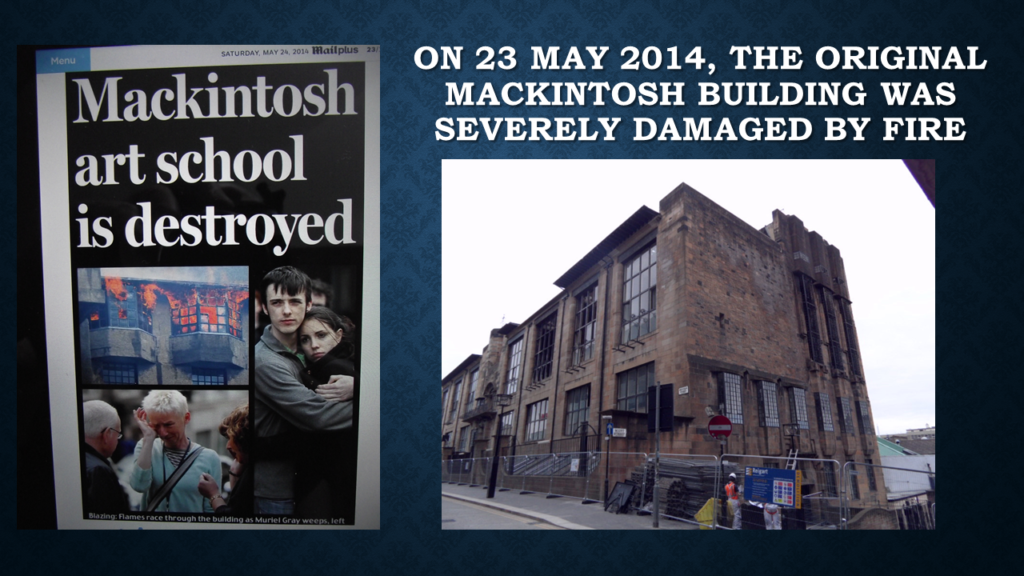
Screengrab of the Mackintosh Building fire

Screengrab of the Mackintosh Building fire

Elsewhere in May 2014, the Google Spain case was being heard at the European Union Court of Justice.

The Right to be Forgotten (GDPR).

Case Summary

The ‘Right to be Forgotten’ (RTBF) was actualised by the Court of Justice of the European Union (CJEU) following its ruling in May 2014 in Google Inc. vs. Agencia Espanola de Proteccion de Datos (aka the Google Spain case). The court ruled that personal information about a Spanish citizen, Mario Costeja Gonzalez, relating to his home being repossessed in 1998 could be removed from search engine results and that any EU citizen could apply to search engines to request that certain links be removed where they are “inadequate, irrelevant, or no longer relevant”. This controversial ruling, has since become the key pillar, Article 17, of the EU’s General Data Protection Regulations (GDPR) set to become law automatically in every EU member state on 25th May 2018 (Ruaraidh, 2016).

The ruling affects not only search engines but any organisation that hosts EU citizens’ information or does business in the EU. (Werfel, 2016). Google’s reaction to the ruling was to de-list search results from the domain extension the delisting request originated from (e.g. Google.de for Germany and Google.fr for France). However, the results could still easily be seen if you utilised a different domain extension; such as Google.com. As a result, France slapped a $112,000 fine on Google for its refusal to remove results outside of France. Consequently, Google now utilises geolocations to determine which country the searcher is searching from and de-lists all affected search results accordingly, regardless of domain extension; thereby “obeying the letter of the law, if not the spirit.”(Tarantola, 2016).


Importance of the Case:

The case has been described as a breakthrough in data protection leading to “a brave new world” (Ruaraidh, 2016) while, at the same time, trampling the ‘right to know’ and marking “the beginning of the end of the global internet, where everyone has access to the same information.” (Granick in Toobin, 2015)

I find the ‘Right to be Forgotten’ as a central pillar of the GDPR a really fascinating subject. The arguments on both sides are really pertinent ones for right now: the ‘right to be respected’ (Ruaraidh, 2016) or ‘right to privacy’ on the one hand versus freedom of information or ‘the right to know’ on the other. Not least because Toobin (2014)’s article in The New Yorker showed both the risks of having a ‘right to be forgotten’ which can be abused (e.g. a Croatian pianist asking for a bad review in the Washington Post to be de-listed) versus the case of the Catsouras family in the USA who were the subject of a chapter in Werner Herzog’s new movie ‘Lo and Behold: Reveries of the Connected world’(2016). The Catsouras case involves a family where their teenage daughter tragically died in a car crash. Mr. & Mrs. Catsouras, along with the daughter’s siblings, had a memory of their daughter that they held on to which was shattered when the police crime scene photographs, taken by the Californian Highway Patrol, somehow came into the public domain and went viral. Suddenly Mr. & Mrs. Catsouras were confronted with graphic images of their daughter’s body decapitated in the fatal accident. So far their attempts to get the pictures de-listed or removed from the internet have been thwarted because the US has no ‘right to be forgotten’ so the fact the GDPR includes it as its central pillar, Article 17, means that the father, Christos Catsouras has said the European Court of Justice ruling represented a “broader victory. “I cried when I read about that decision,” he told me. “What a great thing it would have been for someone in our position. That’s all I wanted. I would do anything to be able to go to Google and have it remove those links.”(Toobin, 2014).

Google processes 90% of searches in Europe (Fioretti, 2014) and has reviewed in excess of 1.5 million webpages, de-listing 40% of them across Europe (Lumsden 2016); effectively creating a library where book titles are removed from the searchable catalogue. The books are still there “but their existence would be unknown and therefore, their access made more difficult.“(Gratton, 2016).

Wikimedia understandably are not a fan of what the Right to be Forgotten means in practice:

Accurate search results are vanishing in Europe with no public explanation, no real proof, no judicial review, and no appeals process… the result is an Internet riddled with memory holes – places where inconvenient information simply disappears.(Tretikov in Fioretti, 2014).

While Google claim the CJEU ruling forces them into a role they are uncomfortable with i.e. deciding what is & is not included in their ‘card catalogue’ (Walker in Toobin, 2015); others maintain that Google’s role has always been more than passive intermediary; therefore “if you’re going to be in the business of search then you need to take on privacy obligations.” (Rutenberg in Toobin, 2015). Forcing private companies to become judge & jury on public searching can hardly be ideal however; especially when Google notifying affected sites can, ironically, increase public scrutiny through what’s been termed ‘the Streisand effect’.

The GDPR will certainly toughen the penalties for non-compliance of these privacy obligations. Previously, £500,000 was the maximum penalty in the UK for breaching privacy rules. Now organisations will be penalised 4% of their turnover, or twenty million Euros, whichever is greater (Davidson, 2016). Organisations, therefore, will need to know & understand the data they hold on individuals in much stricter way. For some, this is a triumph, heralding a new ‘right to be respected’ (Ruaraidh, 2016). Others see it as Balkanizing the internet; resulting in a race to the bottom to see which country’s laws can apply the most pressure on Google (Zittrain in Toobin, 2015).


Implications

The debate over freedom of information vs. the right to privacy will continue to be a source of heated debate. While IM professionals should be very wary of Right To Be Forgotten compromising a record’s integrity & trustworthiness, tighter data protection protocols for UK organisations are likely to become the norm from here on.

Advice from the Information Commisioner’s Office, and independent legal firms, is to start planning your approach to GDPR compliance now (Rustici, 2016). The 2018 deadline is not far away for an institution the size of Edinburgh University to get prepared for with 37,510 students (2015/2016 Student Factsheet) and 13,818 staff (Sept. 2016 HR factsheet). While Brexit creates great uncertainty on the UK’s adherence to EU laws, the likelihood is that, regardless of Brexit, UK Higher Education Institutions will still have to comply with the GDPR. (Rustici, 2016)

Google could, post Brexit, lobby the British court not to adhere to RTBF in the UK however the ICO are advocating the terms of the Data Protection Act (1998) be extended as a way of ensuring UK organisations adopt a stricter data protection strategy more in line with GDPR (Lambe, 2016). While research is currently exempted by the GDPR, Edinburgh University would appear to still be bound to it in that it processes personal data of EU subjects. Therefore, the university will have to ensure it puts a plan in place ensuring a culture of ‘privacy by design’. (McCall, 2016).

This means implementing the ICO’s 12 steps including: designating a Data Protection Office; reviewing rules governing data erasure & portability; getting I.T. to map out & review the data processes throughout the university and how data is shared with 3rd parties; liaising with HR to raise awareness of data protection throughout the university. Reviews of data protection policies and how consent is given & recorded. Data breach protocols will have to be tightened up and any breach must be reported to the ICO within 72 hours. Subject Access Requests will no longer be charged for and must be responded to within a month.

Ultimately, the university may need to ensure it is far more familiar with its data processes & its data protection strategies than it is at present. This may mean that they will better understand the value of the data that it does keep but it is likely that, in seeking to avoid liability, they will err on the side of increased erasure of data rather than less; resulting in ‘premature forgetting’ (Sartor, 2016). The balancing act remains a delicate one but it is something for ‘custodians of the record‘ to prepare for in their increasingly pivotal role.

If the record is to mean anything, now and in the future, it has to have integrity, intactness, trustworthiness, and that can’t be the case if individual people have the opportunity or right or authority to pick and choose and prune and primp the way they are portrayed.” (Joseph Janes, 2016, American Libraries)

Meanwhile…. at the Glasgow School of Art Archives

While organisations around the UK prepare for the GDPR coming in 2018, the Glasgow School of Art archives had to move following the Mackintosh fire to take up residence in their new temporary home of The Whisky Bond site until the Mackintosh building reopens in 2018.

The World War One Roll of Honour Project

Thankfully, the Glasgow School of Art’s WW1 Roll of Honour survived the fire.

GSofA’s First World War Roll of Honour was designed and made by former GSA student Dorothy Doddrell in 1925 to commemorate the efforts of GSA staff, students and governors who served in WW1.

Dorothy Doddrell (All Rights Reserved to Glasgow School of Art)

Dorothy Doddrell (All Rights Reserved to Glasgow School of Art)

With the support of the Centenary Memorials Restoration Fund, it also underwent conservation in 2014.

The memorial is now temporarily on display in GSofA’s Reid Building where it will remain until it can be reinstated in the Mackintosh Building following the completion of restoration work to the building.

WW1 Roll of Honour (All rights reserved to Glasgow School of Art)

WW1 Roll of Honour (All rights reserved to Glasgow School of Art)

The Roll of Honour takes the form of an illuminated parchment in paint and gold leaf set within a substantial copper and wood framed triptych.

Unlike most war memorials, the Roll of Honour records the names and regiments not only of those who died, but also of over 400 GSA staff, students and governors who served in the war.
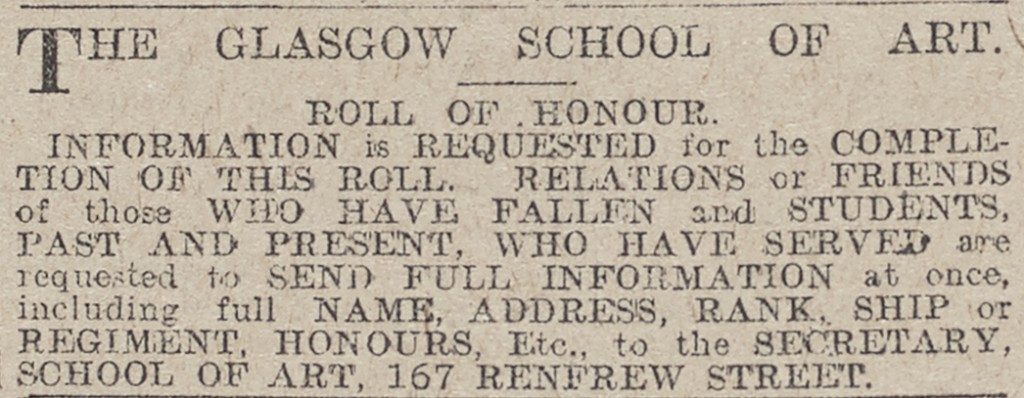
Herald advert (All rights reserved by Glasgow School of Art)

Herald advert (All rights reserved by Glasgow School of Art)

A recently discovered advertisement placed in the Glasgow Herald on 1 November, 1920 shows that the School of Art required the support of the wider public (or at least the readership of the Glasgow Herald) in collating the necessary information in order to deliver a suitable memorial.

Researching the names on the WW1 Roll of Honour

  • In 2015 a research project, supported by a Scottish Council on Archives’ and Heritage Lottery Fund Skills for the Future traineeship, sought to explore and document the stories behind the names recorded on the Roll of Honour.
  • A team of volunteers is now continuing with this research, using original material from GSA’s rich archives and collections to create biographies of those staff and students who feature on the memorial. The resulting biographies have and will continue to be made available on the Archives and Collections online catalogue: www.gsa.ac.uk/archives.

How it worked

  • The investigation process begins with scouring the GSA’s student registers for any recorded instances relating to a listed name which may give an indication of the years they studied at the GSA, the classes they attended, which teachers they had, where they lived, what job they performed and so on.
  • Consulting a number of other sources: census records, birth certificates, death certificates, marriage records, medal cards, regiment histories, photographs as well as any notable artworks or architectural designs bearing their name.

I was a volunteer on the WW1 Roll of Honour project.

Screengrab of William Lindsay Renwick's entry on Glasgow School of Art Archives' website.

Screengrab of William Lindsay Renwick’s entry on Glasgow School of Art Archives’ website.

William Lindsay Renwick was one name on the roll of honour that I researched among many others: a University of Glasgow graduate, he undertook bookbinding classes at the Glasgow School of Art before becoming a professor of English Literature at Durham University and Edinburgh University where he was the founder of the School of Scottish Studies. William Lindsay Renwick fought at the Battle of Loos during World War One where he felt ‘like a ghost, an old ghost, sceptical and disillusioned.’”

Professor William Lindsay Renwick is commemorated on The Glasgow School of Art’s First World War Roll of Honour.

The research I undertook changed the way I viewed war memorials. It shouldn’t have but it did. I realised the name on the Roll of Honour was just one part and there was much more to be said: places lived in; jobs undertaken & where; family members; wives; children; the subjects they studied; their notable artworks; their achievements; the regiments they served in; the battles they fought in; the lives cut short and those lived afterwards; where they married; what they did; how they died. Uncovering the life story behind each name was detective work of the most rewarding kind.

As part of last week’s Samhuinn Wikipedia editathon to honour the dead, we created 16 new articles to remember notable lives & contributions; one of which was on William Lindsay Renwick who founded the School of Scottish Studies. Hence, while the debate about the Right to be Forgotten is an important one, it has to be balanced against the importance of remembering. And that’s where Wikipedia can play a vital role in ensuring digital provenance where the record is trustworthy, reliable and remembered.
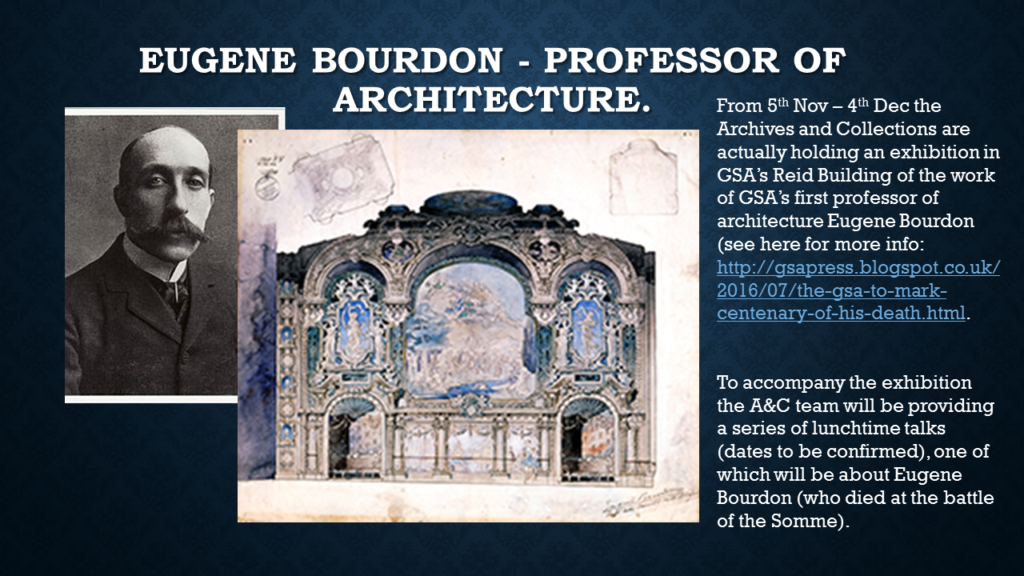
Eugene Bourdon (1st Professor of Architecture at the Glasgow School of Art)

Eugene Bourdon (1st Professor of Architecture at the Glasgow School of Art)

Eugene Bourdon exhibition 5th November to 4th December 2016

From 5th Nov – 4th Dec the Glasgow School of Art Archives and Collections are actually holding an exhibition in GSA’s Reid Building of the work of GSA’s first professor of architecture Eugene Bourdon (see here for more info: http://gsapress.blogspot.co.uk/2016/07/the-gsa-to-mark-centenary-of-his-death.html). To accompany the exhibition the A&C team will be providing a series of lunchtime talks (dates to be confirmed), one of which will be about Eugene Bourdon (who died at the battle of the Somme) which you would be more than welcome to attend.

References

  1. Arthur, Charles (2014-05-14). “Explaining the ‘right to be forgotten’ – the newest cultural shibboleth”. The Guardian. ISSN0261-3077. Retrieved 2016-10-29.
  2. Bartolini, Cesare; Siry, Lawrence (2016-04-01). “The right to be forgotten in the light of the consent of the data subject”. Computer Law & Security Review. 32 (2): 218–237. doi:1016/j.clsr.2016.01.005.
  3. Bygrave, Lee A. (2014-12-01). “A Right to Be Forgotten?”. Commun. ACM. 58 (1): 35–37. doi:1145/2688491. ISSN0001-0782.
  4. “Right to be forgotten”. Wikipedia. 2016-10-27.
  5. Janes, Joseph. “Forget Me Not”. American Libraries Magazine. 2016-05-31. Retrieved 2016-10-29.
  6. Davidson, Colette (2016-04-15). “How Europe’s new privacy rules affect entire digital economy”. Christian Science Monitor. ISSN0882-7729. Retrieved 2016-10-29.
  7. Dent, S. (2016). France fines Google for breaking ‘right to be forgotten’ law. Retrieved 2016-10-29.
  8. Fioretti, Julia (2014).“Wikipedia fights back against Europe’s “right to be forgotten””. Reuters. 2016-08-06. Retrieved 2016-10-29.
  9. Engineering, NYU Tandon School of. “NYU Researchers Find Weak Spots in Europe’s “Right to be Forgotten” Data Privacy Law”. www.prnewswire.com. Retrieved 2016-10-29.
  10. “Forget.me”. Forget.me. Retrieved 2016-10-29.
  11. Gollins, Tim (2016-07-02). “The ethics of memory in a digital age: interrogating the right to be forgotten”. Archives and Records. 37 (2): 255–257. doi:1080/23257962.2016.1220293. ISSN2325-7962.
  12. Gratton, E. (2016, May 10). ‘Right to be forgotten’ wrong for canada. National Post Retrieved from http://search.proquest.com.ezproxy.is.ed.ac.uk/docview/1787892489?accountid=10673
  13. Kerr, J. (2016). What Is Search Engine: The Simple Question the Court of Justice of the European Union Forgot to Ask and What It Means for the Future of the Right to Be Forgotten. Chicago Journal of International Law 17(1), 217-243.
  14. Lambe, John (2016). “Data Protection and Brexit: The implications for UK businesses – Hillyer McKeown”. Hillyer McKeown. 2016-07-05. Retrieved 2016-10-30.
  15. Lambert, Paul (2014). International Handbook of Social Media Laws: Chapter 1 Introduction and Right to Be Forgotten. Practicallaw.com. Retrieved 2016-10-29.
  16. Lardinois, Frederic. “Google now uses geolocation to hide ‘right to be forgotten’ links from its search results”. TechCrunch. Retrieved 2016-10-29.
  17. Lecher, Colin (2016-03-04). “Google will apply the ‘right to be forgotten’ to all EU searches next week”. The Verge. Retrieved 2016-10-29.
  18. org (2016).“The new EU General Data Protection Regulation: why it worries universities & researchers – LERU : League of European Research Universities”. www.leru.org. Retrieved 2016-10-30.
  19. Lloyd, I. G. (2008) Information Technology Law.5th Oxford University Press: Oxford.
  20. Lunden, Ingrid. “Google files appeal in France opposing an order to apply Right to be Forgotten globally”. TechCrunch. Retrieved 2016-10-29.
  21. MacCarthy, M., 2016. Don’t let the rhetoric fool you: The U.S. and the EU share common ground on privacy. com.
  22. McCall, Rebecca (2016). “Will you be ready for the General Data Protection Regulation?”. Association of Heads of University Administration. 2016-05-31. Retrieved 2016-10-30.
  23. McSmith, Andy (2016). “15 EU laws we will miss in post-Brexit Britain”. The Independent. 2016-06-25. Retrieved 2016-10-30.
  24. Myers, Cayce (2016-04-24). “Digital Immortality vs. “The Right to be Forgotten”: A Comparison of U.S. and E.U. Laws Concerning Social Media Privacy”. Romanian Journal of Communication and Public Relations. 16 (3): 47–60. doi:21018/rjcpr.2014.3.175. ISSN2344-5440.
  25. Robertson, Adi (2015-11-25). “Google ‘right to be forgotten’ requests keep piling up”. The Verge. Retrieved 2016-10-29.
  26. Robinson, D. (2016, Feb 12). Google extends ‘right to be forgotten’ EU-wide. Financial Times Retrieved from http://search.proquest.com.ezproxy.is.ed.ac.uk/docview/1772628888?accountid=10673
  27. Ruaraidh, Thomas, (2016). New rules boost data privacy rights. Financial Adviser.
  28. Rustici, Chiara (2016). “Don’t think that Brexit will save you from the EU data protection rules”. ComputerWeekly. Retrieved 2016-10-29.
  29. Rustici, Chiara (2016). “Start getting ready for Europe’s new data protection regulation today”. Help Net Security. 2016-02-26. Retrieved 2016-10-30.
  30. Sartor, Giovanni (2016-03-01). “The right to be forgotten: balancing interests in the flux of time”. International Journal of Law and Information Technology. 24 (1): 72–98. doi:1093/ijlit/eav017. ISSN0967-0769.
  31. Schindler, Ellis (2016). “Will the Right To Be Forgotten be just a memory? | Himsworths Legal Consultancy”. www.himsworthslegal.com. Retrieved 2016-10-30.
  32. Tarantola, Andrew (2016).“Google changes how it scrubs ‘right to be forgotten’ people”. Engadget. Retrieved 2016-10-29.
  33. Information Commissioner’s Office (2016). (“The right to erasure (the right to be forgotten)”. ico.org.uk. 2016-07-07. Retrieved 2016-10-30.
  34. Toobin, Jeffrey (2014). “Google and the Right to Be Forgotten”. The New Yorker. Retrieved 2016-10-29.
  35. Werfel, E (2016). ‘What Organizations Must Know About the ‘Right to be Forgotten’, Information Management Journal, 50, 2, pp. 30-32, Business Source Alumni Edition, EBSCOhost, viewed 29 October 2016.
  36. Williams, Rhiannon (2015). “Telegraph stories affected by EU ‘right to be forgotten'”. Telegraph.co.uk. Retrieved 2016-10-29.
  37. Youm, Kyu Ho; Park, Ahran (2016-06-01). “The “Right to Be Forgotten” in European Union Law Data Protection Balanced With Free Speech?”. Journalism & Mass Communication Quarterly. 93 (2): 273–295. doi:1177/1077699016628824. ISSN1077-6990.
  38. Young, Mary (2016). ‘The risks of deleting history’. Solicitorsjournal.com. Retrieved 2016-10-29.
 

Wikipedia editathon for Samhuinn: Gaelic Fire Festival for the Dead

Samhuinn editathon (CC-BY-SA)

Samhuinn editathon
(CC-BY-SA)

Tomorrow marks Armistice Day commemorated every year on November 11 to mark the armistice signed between the Allies of World War I and Germany at Compiègne, France, for the cessation of hostilities on the Western Front of World War I.

So this post is all about remembering.

Last week, on 31st October & 1st November, the University’s Information Services team held an event to mark Samhuinn: the Gaelic Festival for the Dead.

Samhuinn is a Gaelic festival marking the end of the harvest season and the beginning of winter or the “darker half” of the year. Traditionally, it is celebrated from 31 October to 1 November, as the Celtic day began and ended at sunset. This is about halfway between the autumn equinox and the winter solstice. It is one of the four Gaelic seasonal festivals, along with Imbolc, Beltane and Lughnasadh. Historically, it was widely observed throughout Ireland, Scotland and the Isle of Man. Similar festivals are held at the same time of year in other Celtic lands; for example the Brythonic Calan Gaeaf (in Wales), Kalan Gwav (in Cornwall), and Kalan Goañv (in Brittany)…

It was the time when cattle were brought back down from the summer pastures and when livestock were slaughtered for the winter. As at Beltane, special bonfires were lit. These were deemed to have protective and cleansing powers and there were rituals involving them. Like Beltane, Samhuinn was seen as a liminal time, when the boundary between this world and the Otherworld could more easily be crossed. This meant the Aos Sí, the ‘spirits’ or ‘fairies‘, could more easily come into our world. Most scholars see the Aos Sí as remnants of the pagan gods and nature spirits. At Samhuinn, it was believed that the Aos Sí needed to be propitiated to ensure that the people and their livestock survived the winter. Offerings of food and drink were left outside for them. The souls of the dead were also thought to revisit their homes seeking hospitality. Feasts were had, at which the souls of dead kin were beckoned to attend and a place set at the table for them. Mumming and guising were part of the festival, and involved people going door-to-door in costume (or in disguise), often reciting verses in exchange for food. The costumes may have been a way of imitating, and disguising oneself from, the Aos Sí.” [Source: Wikipedia]

Our Wikipedia event was to remember & honour the dead through setting a place for them on Wikipedia and we were fortunate to secure two great guest speakers in Dr. Emily Lyle, an Honorary Fellow at the School of Scottish Studies, and Dr. Neil Rhind from the Beltane Fire Society.

Neil Rhind and Faerie Porters (courtesy of Eugenia Twomey)

Neil Rhind and Faerie Porters (courtesy of Eugenia Twomey)

More pics and tweets from the day can be found on the Storify here.

Outcomes of the Wikipedia editathon (16 new articles created & 300 openly licensed images uploaded)

  1. Honor Fell, British scientist and zoologist, translated onto Swedish Wikipedia. Her contributions to science included the development of experimental methods in organ culture, tissue culture, and cell biology. Wikipedia’s new Content Translation tool is easy to learn in just 3 minutes and means you can easily translate Wikipedia articles from one language into another.
  2. Brenda Moon – Librarian to the University of Edinburgh from 1980 to 1996. She was the first female chief of a university library in Scotland, and one of the first female librarian chiefs of a major UK research university.

    First female chief librarian at a Scottish university, Brenda Moon. CC-BY-SA

    First female chief librarian at a Scottish university, Brenda Moon. CC-BY-SA

  3. Janet Anne Galloway (1841–1909)
    Janet Anne Galloway. CC-BY-SA

    Janet Anne Galloway.
    CC-BY-SA

    promoted higher education for women in Scotland. As a result of the limited educational opportunities open to women, Janet became an active supporter of the movement for higher education provision for women. In 1877 Janet was appointed as the honorary secretary of the new Glasgow Association for the Higher Education of Women, founded by Jessie Campbell and financed by Isabella Elder. John Caird, principal of Glasgow University at the time, was the first Chairman of its General Committee.

  4. Katherine Clerk Maxwell – a Scottish physical scientist best known for her observations which supported and contributed to the discoveries of her husband, James Clerk Maxwell. She born Katherine Dewar in 1824 In Glasgow and married Clerk Maxwell in 1859. Her contributions are largely recorded in writings on her husband, partly due to a fire at the Maxwell family estate which destroyed many of the family papers.
  5. James MacLagan – a Church of Scotland minister and collector of Scottish Gaelic poetry and song. He was the creator of the McLagan Manuscripts, a collection of some 250 manuscripts containing 630 items of primarily Gaelic song and poetry collected in the second half of the eighteenth century including many of the most well-known 17th- and 18th-century Gaelic poets such as Iain Lom, Màiri nighean Alasdair Ruaidh and Alasdair mac Mhaighstir Alasdair.
  6. Jeffery Collins – prolific electrical engineer who directed and researched experimental physics, robotics, microelectronics, communications technologies and parallel computing.
  7. David Houston (zoologist) – Demonstrated Sex Allocation in lesser black-backed gulls in a practical study with Pat Monaghan in 1999.
  8. Susan Manning (professor) 
    Susan Manning (CC-BY-SA)

    Susan Manning (CC-BY-SA)

    – Scottish academic born in Glasgow, Scotland[1]. She specialized in Scottish studies and English literature. Before her untimely death in 2013 at the age of 59 years, she was the Grierson Professor in English literature in the University of Edinburgh and the Director of the Institute for Advanced Studies in Humanities (IASH) an institute under the University of Edinburgh. Prof. Manning’s work on Scottish enlightenment and transatlantic literature got her international acclaim. Due to her intellectual and academic expertise, Susan was a fellow in the prestigious Royal Society of Edinburgh and the Royal Society of Arts, Manufacturers and Commerce, Edinburgh. Susan Manning after completing her Bachelors of Arts from Newnham College, University of Cambridge in 1976 went to do her doctorate under Prof. David Levin, a literary scholar and the Commonwealth Professor of English in the University of Viriginia, USA.

  9. Joan Brown (potter) – British potter. She setup her pottery workshop in 1967 in Richmond and exhibited widely in Britain. She was born in Aberdeen and was the daughter of Gerda and Walter Bruford. She was married to the landscape architect Michael Brown and worked on several projects for architects, including creating a water sculpture for her husband’s sunken roof garden design for the Royal Northern College of Music in Manchester. She was an associate member of the Craft Potters Association and exhibited several times in the Royal Scottish Academy Christmas Show.
  10. Magdalena Midgley – former Professor of the European Neolithic at the University of Edinburgh (2013-4), dedicated her archaeological career to teaching and researching early farming cultures of Continental Europe. She became renowned for her survey of the TRB culture (Funnel(-neck-)beaker culture), the first farming culture of the North European Plain and southern Scandinavia which was published by Edinburgh University Press.
  11. Ernest Francis Bashford
    Ernest Francis Bashford c/o Cancer Research UK / Wikimedia Commons CC-BY-SA

    Ernest Francis Bashford c/o Cancer Research UK / Wikimedia Commons CC-BY-SA

    – Influential oncologist who pioneered the biological approach to the study of cancer. At Edinburgh he was Vans Dunlop Scholar in anatomy, chemistry, zoology and botany, Mackenzie Bursar in practical anatomy, and won the Whitman prize for clinical medicine, the Patterson prize in clinical surgery, was appointed to the Houldsworth research scholarship in experimental pharmacology and won the Stark scholarship in clinical medicine and pathology. He established the modern practice of experimental investigation of cancer in Britain, asserting that it was a biological problem and not confined to human pathology. From 1915 he served with the Royal Army Medical Corps, initially with the Mediterranean Expeditionary Force and then in France, where he held the post of adviser in pathology in the Army of Occupation. He was appointed OBE in 1919 and died from heart failure in Germany on 23 August 1923.

  12. Christian Kay – Emeritus Professor of English Language and Honorary Professorial Research Fellow in English Language at the University of Glasgow. She was co-editor with scholar Michael Samuels, for the world’s largest and first historical dictionary Historical Thesaurus of the Oxford English Dictionary (HTOED), a project she dedicated 40 years to (1969 – 2009). Kay also founded the Scottish Corpus of Texts and Speech and published work on historical semantics and lexicography, and contributed metaphor and semantic annotation based projects on the Historical Thesaurus of English dataset (HTOED). Kay was educated at The Mary Erskine School in Edinburgh. She completed a MA in English Language and Literature at the University of Edinburgh, before continuing on to Mount Holyoke College, Massachusetts, USA. Retiring in 2005, then Professor of English Language, Kay remained active in the facilitation and research in Thesaurus-derived projects. Kay is credited to have created the first computer laboratory for English studies in the world, developing cutting-edge teaching software, and first of its kind research-led courses in literary and linguistic computing. The result of 44 years of work, the HTOED received critical acclaim and was awarded the Saltire Society Research Book of the Year Award in 2009. The Christian Kay Prize for Outstanding Achievement in Undergraduate Research into Modern English Language and Linguistics was set up in the Professor’s memory.
  13. Anne Strachan Robertson – archeologist, numismatist and writer who was a professor of archeology at the University of Glasgow.
  14. George Robin Henderson (mathematician) – Scots mathematician with a flair for music. Noted as an inspirational character in his field, he taught at Boroughmuir High School, lectured at Napier College, played cornet and tuba, and through the 1980s and 90s as a member of the MacTaggart Scott Works Band he revived the band and pushed them to have a “positive impact on the community”.
  15. William Lindsay Renwick – Professor of English Literature at the University of Durham from 1921 to 1945 and Regis Professor of Rhetoric and English Literature at Edinburgh University from 1945-1959 where he founded the School of Scottish Studies. William was educated at the Woodside School. He then went on to enrol at the University of Glasgow in October 1907. In 1912, he was awarded the George A. Clark Scholarship which allowed him to study French & Italian at the Sorbonne, Toulouse and the British School in Rome. Upon the outbreak of war, William joined the tenth battalion of the Cameronians (The Royal Scottish Rifles) on 27th September 1914. He experienced trench warfare with this regiment & rose quickly in the ranks to become a Captain, serving at home and in France where his battalion took part in the Battle of Loos. After experiencing this particularly devastating attack, according to his entry on Glasgow University’s Roll of Honour, he felt ‘like a ghost, an old ghost, sceptical and disillusioned.’ William returned to civilian life in 1919 and enrolled at Merton College at Oxford University where he completed a thesis on the renaissance poet, Edmund Spenser. William moved to Newcastle-upon-Tyne to become Professor of English Literature at the University of Durham in 1921. He remained in this role for the next twenty-four years. Upon the outbreak of the Second World War, William joined the Home Guard where he was made a commander. Following the end of the war in 1945, William was appointed Regis Professor of Rhetoric and English Literature at Edinburgh University. Moving to a new home in Edinburgh overlooking Arthur’s Seat, he was to remain in this role until he retired in 1959.
  16. Isabella Elder – article improved.
  17. Queen Margaret College (Glasgow) – article improved.
  18. Galoshin section added to Mummers_play#galoshin
  19. 7 openly-licensed images of carved pumpkins and turnips uploaded to Wikimedia Commons.
  20. Evelyn Gillan – Champion of women’s rights, co-founder of the Zero Tolerance campaign and the main proponent in bringing about a minimum alcohol pricing law in Scotland.
  21. Sethu Vijayakumar page created. Sethu Vijayakumar is Professor of Robotics at the University of Edinburgh and a judge on the BBC2 show Robot Wars. He was instrumental in bringing the first Valkyrie humanoid robot out of the United States of America, and to Europe.
  22. 294 openly-licensed images of the #Somme100 ‘We are here’ soldiers commemoration uploaded to WikiCommons.
'We're here because we're here.' Public domain image.

‘We’re here because we’re here.’ Public domain image.


Conflict of Interest

Wikipedia’s Conflict of Interest policy is there to obviously protect against the very real threat of people ‘white-washing’ pages or generally abusing one of the core pillars of Wikipedia; its neutral point of view. It is not however there to get in the way of people genuinely trying to improve Wikipedia’s content.

That being said, I am aware of institutions banned from editing Wikipedia until 2020 because staff were involved in editing the institution’s Wikipedia page.

So if you find you have looked at the Wikipedia page for yourself or the institution you work for and believe it could be improved then what should you do? The question would be who is best placed to do this given Wikipedia’s stance on conflict of interest in order to a) preserve Wikipedia’s intergrity as an objective tertiary source and b) avoid the editor being blocked on account of Conflict of Interest editing.

Ideally, the best person would be a third party; someone clearly independent of the institution/individual being written about so that objectivity can be better demonstrated.

This is not always possible however so in the National Library of Wales example they asked a volunteer to sit for an afternoon with the necessary material to update the NLW Wikipedia page. Thus, there was some degree of distance between the writer and the written about.

The main area of contention is paid editing – where someone has a financial interest in the page being written about but writing about a friend, family member or close work colleague is obviously not advisable either. Asking a volunteer to do the editing gets round this. (Although this can lead into a philosophical debate as to whether anyone can be truly objective… or altruistic for that matter).

Sometimes it is also not possible to find an objective 3rd party volunteer to help in which case it is permissible, though not strictly advisable, to edit the page yourself if, and only if, you fully disclose on your userpage the conflict of interest (e.g. Displaying that you are related to person X or work for company Y).

Full disclosure and transparency of purpose are the key.


Wikipedia:Plain and simple conflict of interest guide

I note with interest the following line from the Plain and Simple guide to COI page.

Practices not regarded as COI

Employees at cultural and academic institutions:

We want experts editing Wikipedia articles. Merely being employed by an institution is not a conflict of interest.”


The main thing is disclosure of your link to the institution hence why an edit to an existing page is probably best suggested on the article’s Talk page disclosing your own connection to the subject being written about and having a disclaimer on your user page.

In terms of the format of how to write this disclosure on your userpage there are a great number of examples linked to from Point 3 in the Advice section of the Plain & Simple Guide to COI.

Although you could just have something as simple as: I work at the University of ____________ and am chair of the __________________.


If you want to completely avoid any perception of COI then you can also request that someone else edit the page from the Wikipedia community using the {{request edit}} template in the Source code of the article’s Talk page although you’d have to wait to see if anyone picked up on the request.


While the advice is that you are strongly discouraged to edit affected articles and a more objective third party is much more agreeable to the community, as long as you disclose your connection and observe Wikipedia’s rules stringently to avoid any possible suggestion of bias so that even a competitor would be happy with the objectivity of the edits then there should not be an issue. Suggesting the edits on the Talk page in the first instance or in a relevant WikiProject may also go some way to assuage any community concerns.

So the advice when you perceive a conflict of interest is:

“You are strongly discouraged from editing affected articles.

You may propose changes by using the {{request edit}} template on talk pages.

The short version:

  1. Learn Wikipedia’s rules.
  2. Be up-front about your associations with the subject.
  3. Avoid creating new articles about yourself or your organization.
  4. Avoid making controversial edits to articles related to your associations.
  5. Don’t push people to change their minds about issues relating to your associations.
  6. Ask for help appropriately.


Edinburgh Gothic – Wikipedia editathon for Robert Louis Stevenson Day 2016

Edinburgh Gothic

Edinburgh Gothic poster. By Stuart Brett, University of Edinburgh Interactive Team. CC-BY-SA.

Edinburgh Gothic poster. By Stuart Brett, University of Edinburgh Interactive Team. CC-BY-SA.

You are cordially invited to come take a walk on the macabre side of Edinburgh this Autumn for a Wikipedia event for Robert Louis Stevenson Day 2016 on Saturday 12th November.


The event is run by the University of Edinburgh’s Information Services team in conjunction with the National Library of Scotland and the University of Sheffield’s Centre for the History of the Gothic.


The focus will be on improving the quality of articles about all things Gothic; be it creating a page for Robert Louis Stevenson’s short story ‘Thrawn Janet’; be it improving content on Angela Carter, Alasdair Gray, Louise Welsh or Ali Smith; or even improving the Wikipedia page on Ken Russell’s movie, ‘Gothic’.


Further event details and booking information can be found at the event page here.


Working together with liaison librarians, archivists & academic colleagues we will provide full training on how to edit and participate in an open knowledge community. Participants will be supported to develop articles covering areas which could stand to be improved.


This free event includes access to the Robert Louis Stevenson exhibition area; Gothic badge-making activities using original collage designs by Tessa Asquith-Lamb; ‘The Strange Case of Dr. Jekyll & Mr. Hyde’ stickers and a talk by National Library of Scotland curator, Andrew Martin, on the illustrations in Robert Louis Stevenson’s works while the editathon itself will take place behind closed doors in the National Library of Scotland’s reading room after it has closed to the public.

Original collage designs by Tessa Asquith-Lamb. CC-BY-SA.

Original collage designs by Tessa Asquith-Lamb. CC-BY-SA.

Come along to learn about how Wikipedia works and contribute a greater understanding & appreciation of Gothic!

Jekyll & Hyde poster from the US Library of Congress. CC-BY-SA

Jekyll & Hyde poster from the US Library of Congress.
CC-BY-SA


*Lunch is provided on the day and new editors are very welcome.  


Hope you can make it along.

Wikipedia editathon for Samhuinn: Gaelic Festival for the Dead 31st Oct-1st Nov.

Pumpkipedia - Wikipedia in carved pumpkin style.

Pumpkipedia – Wikipedia in carved pumpkin style.

Samhuinn: Festival of the dead editathon

Samhuinn: Festival of the dead editathon

Come join us as we set a place for the dead; through helping to create new biography articles and improving existing articles as part of a day of celebration.

Have you ever wondered why the information in Wikipedia is extensive for some topics and scarce for others? On Halloween, Monday 31st October 2016, the University’s Information Services team are running an edit-a-thon to celebrate the lives of those sadly passed on to mark Samhuinn: the Gaelic Festival for the Dead!

Each day will have different guest speakers discussing the traditions of Samhuinn, Celtic history & folklore and the importance of remembering the dead on this day.

Feel free to suggest notable lives & articles we’ve overlooked & should be creating too.

Bring your best spookily carved turnip along and win a prize. We will have tablet skulls to munch on and guest speakers telling us about Celtic customs, beliefs & folklore. Hopefully, we may even be visited by the Faerie Porters too…..

Samhuinn: Festival for the Dead

Samhuinn: Festival for the Dead (Source: Jason Mankey of DeepPaganThoughts.blogspot.co.uk)


Working together with liaison librarians, archivists & academic colleagues we will provide training on how to edit and participate in an open knowledge community. Participants will be supported to develop articles covering areas which could stand to be improved in order to improve Wikipedia’s representation of notable lives; be they connected to the university, to Edinburgh, to Scotland or further afield.

Between the worlds of the living and the dead
A Wikipedia editathon for Samhuinn: The Gaelic Festival for the Dead.

  • Monday 31st October 12pm to 4.30pm – Project Room, 50 George Square.
  • Tuesday 1st November 10am to 4.30pm – The Raeburn Room, Old College.

Book for one day or both!


If you are a student or staff member at the University of Edinburgh:
To book a place for the session on Monday 31st October in the Project Room (room 1.06) of 50 George Square then book through MyEd Event Booking here: Monday 31st October 2016 session.
To book a place for the session on Tuesday 1st November in the Raeburn Room of Old College, University of Edinburgh, then book through MyEd Event Booking here: Tuesday 1st November 2016 session.

If you are from outside the university
To book a place for the session on Monday 31st October in the Project Room (room 1.06) of 50 George Square then book through Eventbrite here: Monday 31st October 2016 session.

To book a place for the session on Tuesday 1st November in the Raeburn Room of Old College, University of Edinburgh, then book through Eventbrite here:  Tuesday 1st November 2016 session.

Samhuinn is a Gaelic festival marking the end of the harvest season and the beginning of winter or the “darker half” of the year. Traditionally, it is celebrated from the very beginning of one Celtic day to its end, or in the modern calendar, from sunset on 31 October to sunset on 1 November.

Samhuinn was seen as a liminal time, when the boundary between this world and the Otherworld could more easily be crossed. This meant the Aos Sí, the ‘spirits’ or ‘fairies’, could more easily come into our world. Offerings of food and drink were left outside for them. The souls of the dead were also thought to revisit their homes seeking hospitality.

New editors very welcome. Full Wikipedia training given.

Bring a laptop (no desktop computers are available) but a few laptops are available if you need to borrow one. Message ewan.mcandrew@ed.ac.uk if you need to borrow a laptop.


Programme – Monday* 31st October 2016 (Project Room, 50 George Square)

  • 12:00pm – 12:15pm: Housekeeping and Welcome.
  • 12:15pm – 12:30pm: Guest speakers
  • 12:30pm – 1:45pm: Wikipedia training
  • 1:45pm – 4:00pm: Research and editing.
  • 4:00pm – 4:30pm: Transferring drafted text to Wikipedia’s live space.

*Lunch is not provided on Monday 31st October but tea, coffee & tablet skulls will all be available and food can be eaten in the room.

Programme – Tuesday 1st November 2016 (The Raeburn Room, Old College)*

  • 10:00am – 10:15am: Housekeeping and Welcome
  • 10:15am – 10:45am: Guest speakers
  • 10:45am – 12:00pm: Wikipedia training.
  • 12:00pm – 1:00pm: Beginning to research and edit.
  • 1:00pm – 1:30pm: Lunch
  • 1:30pm – 4:00pm: EDIT!
  • 4:00pm – 4:30pm: Transferring drafted text to Wikipedia’s live space.

*Lunch will be provided on Tuesday 1st November along with plenty of tea, coffee & tablet skulls!

Desperately Seeking Ada

Booking for Ada Lovelace Day 2016 is now live – please feel free to pass on details to people you feel maybe interested in coming along.

ada_lovelace_in_1852

Ada Lovelace, “The Enchantress of Numbers”, in 1852.


Who was Ada Lovelace?

Ada Lovelace (1815–1852), the only legitimate child of the poet George, Lord Byron and his wife Anne Isabella Milbanke, was an English mathematician and writer, chiefly known for her work on Charles Babbage‘s early mechanical general-purpose computer, the Analytical Engine. Her notes on the engine include what is recognised as the first algorithm intended to be carried out by a machine. As a result, she is often regarded as the first computer programmer with her work a major influence on Alan Turing & inspiring countless others. There’s now a graphic novel of her short but brilliant life and you can read more about her life here and an ‘interview’ with her in New Scientist here.

On Tuesday 11th October 2016, in Room 1.12 of the University Main Library, we will again be running a Wikipedia edit-a-thon to celebrate Ada Lovelace Day 2016, an international celebration day of the achievements of women in science, technology, engineering and maths (STEM).

Beginning at 10am with a range of guest speakers in the morning, this will be followed by fun technology activities from 11am to 1pm (Metadata games, BBC Microbit, Sonic Pi, Lego calculators/adders).

Full Wikipedia editing training will be given at 1-2pm. Thereafter the afternoon’s editathon from 2-5pm will focus on improving the quality of Wikipedia articles related to Women in STEM!

The event page can be accessed here: http://bit.ly/2cGapkn

For booking purposes, the day is split in two parts: talks & technology activities in the morning and the Women in STEM Wikipedia editathon in the afternoon.

You can attend both morning and afternoon sessions or just one.

Time for lunch? The fun technology activities from 11am to 1pm can be dropped in and out of and there is the Library Cafe downstairs where you can get refreshments and a bite to eat.

Not a student or staff member of the university? You can book tickets through Eventbrite.

Suggestions for notable Women in STEM who could & should be represented on Wikipedia?

Feel free to suggest name of notable women we could include as part of this day of celebration. Email me at ewan.mcandrew@ed.ac.uk

Hope to see you there!

Hot Topics and Cool Cats – Wikimania 2016 (22-26 June)


Wikimania

Wikimania

The annual conference celebrating Wikipedia and its sister projects was held in the alpine town of Esino Lario in the province of Lecco, Northern Italy, this year.

It was my first but I am led to believe that this year’s venue, and this year’s conference in general, was quite different from the ones in years gone by; certainly the rural location was quite different from the Hilton Hotel in Mexico City in 2015 and the Barbican in London in 2014.

This time Wikimania really was going outdoors.

IMG_20160626_145606141

Listen to a podcast roundup of Wikimania 2016 in Esino Lario, Italy, recorded on a bus after the Wikimania conference.

There was another gathering going on the day I left for the conference however: the EU referendum vote. Given that I was due to catch a 7.45am flight from Glasgow Airport on the day of the EU referendum, I left my vote in the hands of my girlfriend to vote on my behalf. (The thunder storms that delayed the flight from landing at London Heathrow should have been a portent for the political turmoil to come.)

IMG_20160623_095927957

However, I was in good spirits despite the delay and, even when the consequence of the London storm was that I missed my bus connection from Milan airport to Esino Lario, I was busy contemplating how it might be nice to spend a bit more time travelling by train from Milan Central to Varenna-Esino. Fortunately, I found myself in the same boat as Lucy Crompton-Reid, CEO of Wikimedia UK, who had been on the same flight. A quick chat with a terrifically pleasant Italian gentlemen at the Wikimania greeters’ table at the airport and a taxi was arranged to take us both the rest of the way to Esino Lario.

While we waited, and our charming Italian saviour checked our names off his list of expected delegates, we were told the sad tale of one particular delegate who earlier in the day had been told that his name definitely wasn’t on the list and would he mind checking the FIVE pages of names on the list himself to see that was the case. Perplexed, the man had taken one long look at the list and replied, “But I’m Jimmy Wales.” (Needless to say, I think he probably made it back to Esino Lario okay after that, especially after a few selfies were taken with the volunteers from the local high school.)

IMG_20160624_200214814_HDR

A picturesque drive through Alpine country to Esino Lario in the company of Lucy’s incredibly entertaining, but incredibly dark, sense of humour and I got settled into the family-run hotel I was to spend the next four nights in. Once registered, I was able to wind my way through the narrow cobbled side streets to meet with my fellow Wikimaniacs at the central reception area.

IMG_20160626_132528842

The experience of the first night’s good-humoured chats were typical of the whole conference; here were Wikimaniacs from all over the world ostensibly divided by different backgrounds, languages & cultures but who were all united by their passion for working collaboratively & sharing open knowledge through Wikimedia’s projects.

So it was with some shock that I discovered the next morning that the referendum result had been that the UK had chosen to turn its back on working together as part of the EU. It just ran contrary to everything that Wikimania, and Wikimedia in general, was all about. Consequently, Jimmy Wales in his keynote address at the opening ceremony could not help but address this seismic decision back home in Britain. Clearly emotional, Jimmy Wales referenced the murder of his friend Jo Cox MP, the EU referendum & Donald Trump, when he asserted that Wikipedia was not about the rhetoric of hate or division or of building walls but rather was about building bridges. Wikipedia was instead a “force for knowledge and knowledge is a force for peace and understanding.”

IMG_20160626_202639634_HDR

The focus of the programme for Wikimania 2016, therefore, was on Wikipedia as a ‘driver for change’.

Watch Jimmy Wales’ keynote address here

Of course, I couldn’t get in to see the keynote in person. The venue, the Gym Palace, could only hold around six hundred people and with around 1200 Wikimaniacs, plus curious townspeople attending too, the venue and the wi-fi soon because saturated. Hence, a great many people, myself included, got turned away to watch the keynote opening ceremony via the live stream at a nearby hall. Unfortunately, the one thing that everyone had been worried about prior to the conference occurred; the wi-fi couldn’t cope and we were left with a pixelated image of the opening ceremony that got stuck in buffering limbo. Little wonder then that a massive cheer went up when the young Esino Lario volunteers put on a Youtube clip of Cool cats doing crazy things’ to keep the audience entertained while they desperately tried to fix the live stream.

IMG_20160624_165556099

The town of Esino Lario itself only has a population of around 760 inhabitants so the people of Esino Lario really did invite the 1000+ Wikimaniacs into their homes and I can honestly say that we were treated extremely well by our hosts. The hope is that the experience of hosting Wikimania in such a small town will have an enormous impact on the local economy & a legacy such that their young people, who worked as volunteers to help run the events and made sure we were well looked after in terms of espresso & soft drinks while we walked in the heat of the afternoon sun from venue to venue, may hopefully look to careers in tech and become the next generation of Wikimedians.

The rest of the conference brought no further technical problems and everyone seemed to enjoy the relaxed atmosphere, and stunning views of the surrounding Alpine mountains, to learn & share both in formal presentations and informal discussions in-between times. There was also a preponderance of egalitarian community discussions to determine how each project should move forward which were recorded on Etherpad discussion pages (I made good use of these during the few days I was at the conference to follow real-time discussions at several venues at once.)

IMG_20160625_104730115_HDR

The ticketing system for meal times was a hit too as it meant you were allocated to a certain venue at a certain time so that you couldn’t stay in the same clique & always encountered new people to chat to over a delicious plate of pasta. The evening events – chocolate tasting, cheese & wine, evening hikes, line dancing, a live band, a falcon playing a theremin – all allowed for further discussions and it was a real pleasure to be able to learn through ‘play’ in such relaxed surroundings.

IMG_20160624_174940075

In terms of content, Wikidata proved its growing importance in the Wikimedia movement with a number of sessions threading through the conference and I was also pleased to see Open Street Map and Wikisource, the free content library, garnering greater attention & affection. The additional focus on education, especially higher education, with sessions on Wikipedia’s verifiability, the state of research on Wikipedia and the tidying up of citations was terrific to see. Overall though, it was great to see further focus on translation between Wikipedias and on areas of under-representation: on the gender gap and on the Global South in particular. As one session put it, there is only one international language: translation.

Watch all the talks at Wikimania 2016 on their Youtube channel

IMG_20160630_120448

In a nutshell, the weather was hot, the espresso was hot and the whole town was a hotbed of ideas with people on every street corner discussing the projects they were working on or wanted to find out more about. #Brexit was the hot topic of conversation too but it felt a million miles away; completely unreal & counter-intuitive when the fruits of cross-border collaboration were there for all to see at every turn. People I had encountered only in the online world I was finally able to meet in the flesh and warmly discuss past, present & future collaborations. It was especially pleasing to be able to meet the Wikipedia Library’s Alex Stinson and my Edinburgh Spy Week: Women in Espionage editathon collaborator, Rosie Stephenson-Goodknight from WikiProject Women in Red, who deservingly had just been made Wikipedian of the Year for the work WikiWomeninRed had done in helping to address the gender gap. Warm hugs and warm handshakes about working together was what Wikimania meant to me.

IMG_20160625_173701811

Boarding the bus for the airport home on the Monday morning, I was able to listen in on Andrew Lih’s (author of ‘The Wikipedia Revolution’) roundtable discussion with the Wikimedia Foundation’s James Forrester and Cambridge University’s Wikimedian, Deryck Chan, about their reflections on Wikimania 2016 (as it was recorded as a podcast on the bus at the table of seats nearby).

Listening to their summary of proceedings while I looked out the window at the rolling Alpine foothills & waterfalls proved a nice full-stop to proceedings as it confirmed what UNESCO Wikimedian in Residence, John Cummings, had told me first and many, many others had said since… this was the best Wikimania ever.

COMING SOON: Wikidata & Wikisource Showcase for Repo-Fringe

Wikisource logo

Wikisource logo

Wikidata logo

Wikidata logo

For Repo-Fringe 2016, myself and Histropedia’s Navino Evans will be co-presenting a showcase of two of Wikipedia’s sister projects: Wikisource, the free content library, and Wikidata, the structured data knowledge base. With both projects, it is not about what they hold in their repositories so much as what that knowledge means to the user able to access it; be it the experience of being able to commune with the past through Wikisource for those authentic ‘shiver-inducing’ moments of digital contact with library & archival materials or being able to manipulate & visualise structured data through Wikidata, actually querying & utilising information on Wikipedia, as never before in myriad ways. The possibilities for both projects are endless and highlight the importance of curating & safeguarding repositories of open knowledge such as these.

Hence our showcase event, as part of Repository Fringe 2016 on 2nd August at the John McIntyre Conference Centre in Edinburgh, will focus on this and provide practical demonstrations of how to engage with the past, present & future with these two projects.

Consequently, the English teacher part of me has opted for a title which attempts to sum this up:

“It’s not what you do. It’s what it does to you.”

Wikidata and Wikisource Showcase – 2nd August 2016

Engaging with the past, present & future with Wikipedia’s sister projects.

This is a nod to Simon Armitage’s poem, ‘It ain’t what you do, it’s what it does to you‘, a hymn of praise to the experiential.


It ain’t what you do, it’s what it does to you


I have not bummed across America
with only a dollar to spare, one pair
of busted Levi’s and a bowie knife.
I have lived with thieves in Manchester.

I have not padded through the Taj Mahal,
barefoot, listening to the space between
each footfall picking up and putting down
its print against the marble floor. But I

skimmed flat stones across Black Moss on a day
so still I could hear each set of ripples
as they crossed. I felt each stone’s inertia
spend itself against the water; then sink.

I have not toyed with a parachute cord
while perched on the lip of a light-aircraft;
but I held the wobbly head of a boy
at the day centre, and stroked his fat hands.

And I guess that the tightness in the throat
and the tiny cascading sensation
somewhere inside us are both part of that
sense of something else. That feeling, I mean.

In addition, I am reminded of another poem on the power of the experiential:

The famous aviation poem written in 1941 by 19-year-old Pilot Officer John Gillespie Magee Jr, three months before he was killed.

Oh! I have slipped the surly bonds of earth,
And danced the skies on laughter-silvered wings;
Sunward I’ve climbed, and joined the tumbling mirth
Of sun-split clouds, –and done a hundred things
You have not dreamed of –Wheeled and soared and swung
High in the sunlit silence. Hov’ring there
I’ve chased the shouting wind along, and flung
My eager craft through footless halls of air…
Up, up the long, delirious, burning blue
I’ve topped the wind-swept heights with easy grace
Where never lark or even eagle flew —
And, while with silent lifting mind I’ve trod
The high untrespassed sanctity of space,
Put out my hand, and touched the face of God.

Page 10 of 13

Powered by WordPress & Theme by Anders Norén