Supporting the University of Edinburgh's commitments to digital skills, information literacy, and sharing knowledge openly

Author: Ewan McAndrew Page 12 of 13

Wikimedian in Residence at the University of Edinburgh. English & Media Teacher. Film, Travel & Open Knowledge enthusiast.

Teaching with Wikipedia (some recent homegrown examples)

A little while ago, I came across the reasons to use Wikipedia, (well worth a read) and have been reflecting on how Wikipedia and its sister projects can be best utilised as a teaching tool.

Simply working with Wikipedia as a teaching assignment is much more straightforward using the new Visual Editor WYSIWYG interface (What You See Is What You Get) which makes editing Wikipedia as easy as using Microsoft Word or WordPress blogging. Students can be taught how to edit in as little as 45mins-60mins and thereafter can work individually or collectively to research & write, with academic rigour, brand new Wikipedia articles.

By way of example, Anouk Lang, English Literature Lecturer at the University of Edinburgh, has applied this in getting her students to create a new page on a literary text, Conversations in Bloomsbury, a 1981 memoir that depicts writer Mulk Raj Anand’s life in London during the heyday of the Bloomsbury Group, and his relationships with the group’s members.

The collaborative process engaged her students, and some students in particular who had perhaps been more reticent (or less confident) in participating in more traditional assignments, in researching the topic & in applying the digital literacy skills required to achieve the page’s creation. The net result is not an essay or report that could potentially be filed away & forgotten but instead something that adds to the sum of human knowledge & is discoverable by other readers & editors all over the world so that they, in turn, can add more to it.

Conversations in Bloomsbury

Which all fits in with achieving, quite nicely, with achieving the University’s mission and Wikimedia’s mission.

Areas of convergence between Wikimedia UK and the University of Edinburgh's missions.

Areas of convergence between Wikimedia UK and the University of Edinburgh’s missions.

Similarly, Dr. Chris Harlow at the University of Edinburgh’s Centre for Reproductive Health, has run Wikipedia research sessions with his Reproductive Medicine Honours students where, within the space of an afternoon’s session, they were able to navigate the open access journals to find enough good quality, reliable published sources to create a new article on a term that previously did not exist on Wikipedia: neuroangiogenesis. In doing so, the students created a page that significantly added to the discourse, and the visibility of the discourse, on a number of other related pages: Angiogenesis, Alzheimer’s disease and Endometriosis.

Neuroangiogenesis

The two links below are booklets which have a number of good places to begin teaching with Wikipedia including how to design your assignment as well as alternative assignment ideas such as translating an article into different languages (now even easier with a Wikipedia tool that allows both articles to be onscreen), illustrating an article (with photos, infographics, videos etc.), copy-editing articles to improve critical thinking skills on how good writing is achieved in your particular discipline and so on.

The second booklet explores a number of case studies of approaches taken implementing Wikimedia assignments within a university. However, it is important to note that these are just starting points and that, as this is a new & developing discipline, that newer models can be designed to better suit your purposes.

  1. How to use Wikipedia as a teaching tool
  2. Wikipedia Education Program – Case Studies

If you would like to know more about how our main open knowledge project, Wikipedia, fits in with academia then these recent articles make very compelling reading:

  1. Wikipedia 15 and education
  2. Wikipedia the digital gateway to academic research

Myself and Martin Poulter, former Wikimedia Ambassador at JISC and the current Wikimedian in Residence at the Bodleian Library at Oxford University, will also be attending the OER16 Conference in Edinburgh on 19-20 April if you want to learn more about the education projects he has been involved in.

Indeed, should you wish to discuss teaching with Wikimedia or collaborating on any projects then I would be only too glad to hear from you.

A smorgasbord of Wikimedia projects to choose from: not just Wikipedia!

In visiting a lot of different people of places over the last two months, one question keeps cropping up: what is the difference between Wikimedian and Wikipedian?

Which is a fair question.

Ultimately, Wikimedia UK is the parent or umbrella body, a charitable non-profit foundation (the UK chapter of the global Wikimedia movement which has its HQ in San Francisco) which exists to support & promote Wikimedia’s projects in the UK: one of which happens to be its main open Knowledge project, Wikipedia.

From the Wikimedia Foundation’s FAQs:

“What is Wikipedia?

Wikipedia is the largest collection of free, collaborative knowledge in human history. Millions of people from around the world have written and added to Wikipedia since it was created in 2001: anyone can edit it, at any time. Wikipedia contains more than 35 million volunteer-authored articles in more than 290 languages. Every month, Wikipedia is viewed more than 15 billion times, making it one of the most popular sites in the world. The people who support it are united by the joy of knowledge, their passion and curiosity, and their awareness that we know much more together than any of us does alone.

What is the Wikimedia Foundation?

The Wikimedia Foundation is the non-profit organization that supports and operates Wikipedia and the other free knowledge projects. All of our work is guided by our mission to share the sum of all knowledge with every person in the world. We keep the websites fast, secure, and available. We support the community of volunteers who contribute to the Wikimedia projects. We make free knowledge accessible wherever you are — on your phone or laptop, on a boat in the South Pacific, or in the hills of Nepal. We help bring new knowledge online, lower barriers to access, and make it easier for everyone to share what they know.”

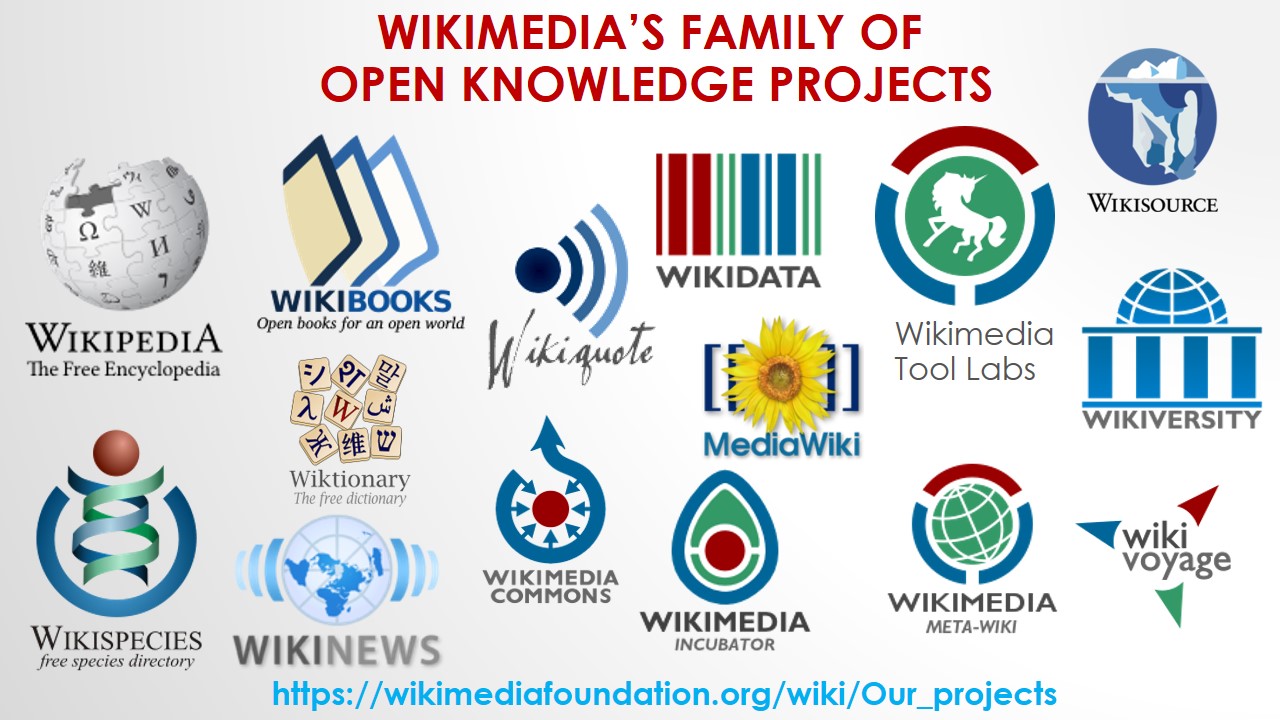
However, while Wikipedia draws the most attention, there are numerous ways where staff & students can get involved & directly contribute their knowledge & expertise to develop Wikimedia UK’s diverse range of projects.

Slide10

Not just Wikipedia: Wikimedia UK’s diverse range projects (above).


Wikisource, for instance, is a ‘free content library of source texts’ with some 300,000+ source texts which anyone can use.

Wikimedia Commons is our media repository with over 30 million freely usable media files to which anyone can contribute to and re-use.

Wikibooks, an open-content textbooks collection that anyone can edit, has been utilised by some academic institutions (notably Greg Singh, lecturer  in Communications, Media & Culture at the University of Stirling) as an assessed part of their courses where students work in research groups to contribute chapters to create a brand new textbook, the Digital Media & Culture Yearbook.

Wikidata, in particular, as Wikipedia’s newest sister project offers up a wealth of possibilities as a structured database of all human knowledge which is readable by humans and machines. For example, the Histropedia website makes good use of the data Wikidata harnesses in order to create visually stimulating & dynamic timelines: be it as straightforward as a timeline of University of Edinburgh alumni or something much more bespoke: such as a timeline of descendants of Robert the Bruce, who are female, and born in Denmark.

Example timeline from Histropedia

Example timeline from Histropedia

As the residency continues, I hope to explore each of these projects a bit further (and others besides) and see if any collaborations can be achieved which mutually benefit the university and Wikimedia in adding open knowledge content to these projects. So watch this space… and if you have any questions about any of the projects then let me know.

Listen to Wikipedia

Screen Shot - Listen to Wikipedia  By Stephen Laporte (http://listen.hatnote.com/) [CC BY-SA 3.0 (http://creativecommons.org/licenses/by-sa/3.0)], via Wikimedia Commons

Screen Shot – Listen to Wikipedia
By Stephen Laporte (http://listen.hatnote.com/) [CC BY-SA 3.0 (http://creativecommons.org/licenses/by-sa/3.0)], via Wikimedia Commons

During the recent History of Medicine editathons, I would often open proceedings by introducing people to a rather wonderful website…

Listen to Wikipedia

The website demonstrates all the real-time edits occurring on Wikipedia taken from Wikipedia’s ‘recent changes feed’ and puts it to music (bells for additions, strings for subtractions).

From the website’s own description:

Bells indicate additions and string plucks indicate subtractions. Pitch changes according to the size of the edit; the larger the edit, the deeper the note.

Green circles show edits from unregistered contributors, and purple circles mark edits performed by automated bots. You may see announcements for new users as they join the site, punctuated by a string swell. You can welcome him or her by clicking the blue banner and adding a note on their talk page.”

Anyway, check it out as it is a lovely way of visualising the Wiki community and all the edits occurring around the world. (NB: And it didn’t hurt that it created a zen-like pagoda garden experience for our editors while they busied themselves adding & subtracting to Wiki articles themselves.)


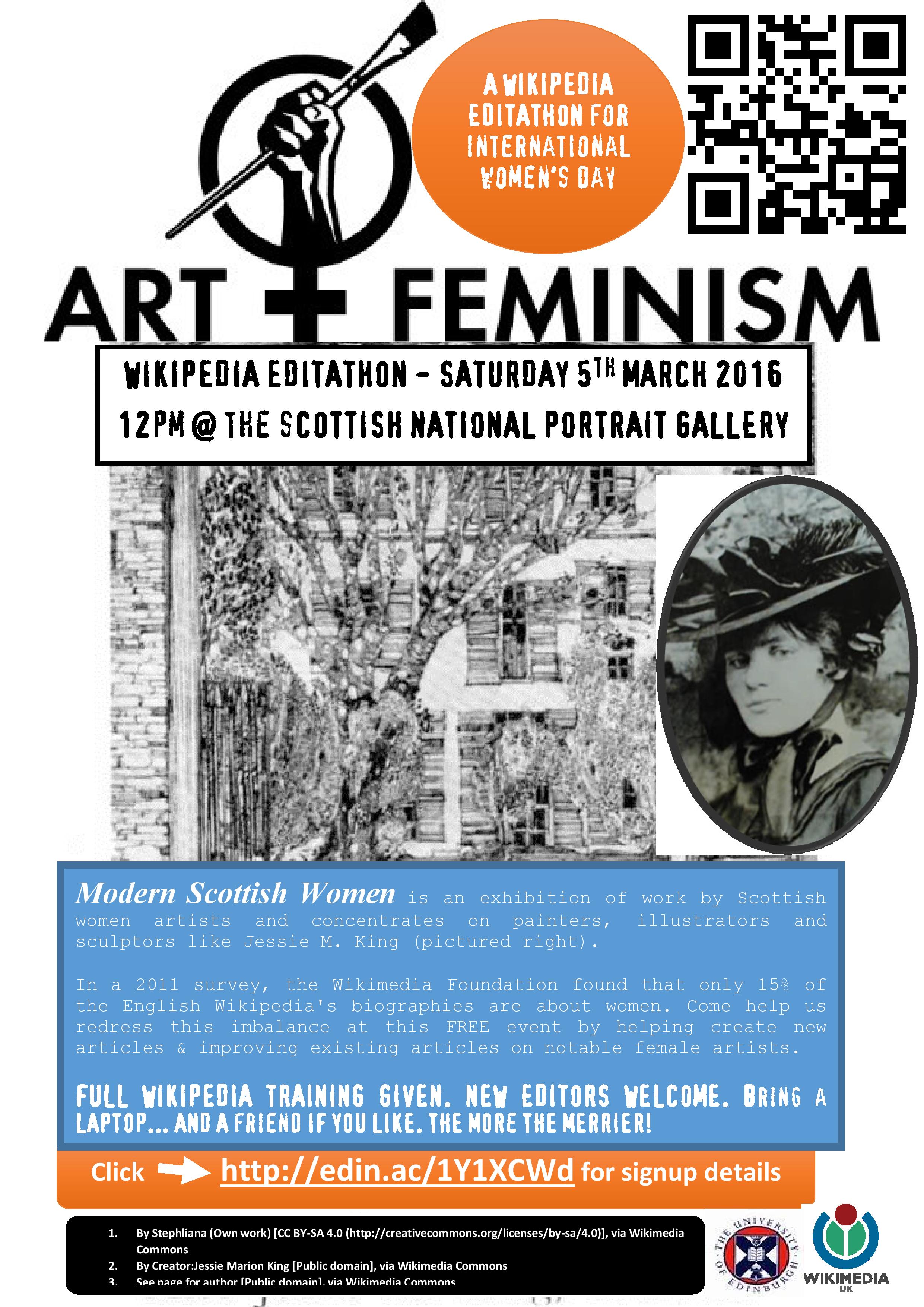
Art+Feminism Wikipedia editathon – Saturday 5th March

In a 2011 survey, the Wikimedia Foundation found that less than 10% of its contributors identify as female while only 15% of the English Wikipedia’s biographies are about women. As a result, content is skewed by the lack of female participation.

About our next event

Following the successful editathon held at Modern One to mark the opening of the exhibition Modern Scottish Women, the Scottish National Gallery of Modern Art is holding a follow-up Wikipedia Edit-a-thon during Women’s History Month as part of the Art+Feminism series. This event will coincide with other International Women’s Day events happening elsewhere in Edinburgh that day and will carry on where the last Modern Scottish Women editathon left off; creating and improving articles relating to those women featured in the exhibition.

Modern Scottish Women is an exhibition of work by Scottish women artists and concentrates on painters and sculptors. It covers the period from 1885, when Fra Newbery became Director of Glasgow School of Art, until 1965, the year of Anne Redpath’s death.

All you need to bring is a laptop as wifi will be provided. But you can also have a look at the notable artists listed below to see if there is someone there you may wish to work on:

Hit list of articles to be created or improved

Articles to be created

Articles to be improved

** The work of those artists marked with a double asterisk has now passed into the public domain.

Come along if you can make it, the more the merrier. New editors are very welcome and full training will be given. With Visual Editor, it really is now as easy as using MS Word or WordPress.

The event signup is here: Art&Feminism Wikipedia editathon

Hopefully see you there!

We Can Edit

We Can Edit

Reflecting on the History of Medicine editathon – The Outcome

After 5 Wikipedia editing sessions over 3 days with some terrific guest speakers, our Wiki editors helped to upload over 500 images, created 12 brand new Wiki pages and improved 63 articles with 249 edits.

Anatomical gingerbread

Anatomical gingerbread

I would encourage everyone to have a look over the work that was created last week (Creating an Open Body of Knowledge editathon) as there are now some astonishingly interesting additions to Wikipedia which just simply weren’t there before….

Including:

  • A new article on Norman Dott – the first holder of the Chair of Neurological Surgery at the University of Edinburgh.
  • Our digital curator’s one man ‘Citation Hunt’ crusade to plug those pesky ‘citation needed’ labels in articles.
  • Improved article on Robert Battey – an American physician who is known for pioneering a surgical procedure then called Battey’s Operation and now termed radical oophorectomy (or removal of a woman’s ovaries)
  • Noteworthy work (because she’s on a banknote) doubling (if not trebling) the article on Mary Fairfax Somerville – a Scottish science writer and polymath, at a time when women’s participation in science was discouraged. As well as editing articles on Isabel Thorne, Matilda Chaplin Ayrton and the Scottish Blood Transfusion Service.
  • A new ‘Controversy’ section added on the intriguing case of James Miranda Barry.
  • A really helpful mapping tool of the buildings to be photographed: https://mapalist.com/map/573668
  • Our historian of medicine worked on The Brunonian system of medicine article – a theory of medicine which regards and treats disorders as caused by defective or excessive excitation.
  • A brand new article on Leith Hospital – illustrated with pictures the new editor took themselves and uploaded to Wikicommons.
  • Articles on Frances Helen Simson (a Scottish suffragist) and The Edinburgh Royal Maternity and Simpson Maternity Hospital Pavilion. Ably added to by work on Lady Tweedale.
  • Work on Emily Bovell’s article and a brand new article on the New Zealand Army Nursing Service page which came into being in early 1915, when the Army Council in London accepted the New Zealand government’s offer of nurses to help in the war effort during the First World War.
  • Improved articles on ‘Fabry disease’ – a rare genetic lysosomal storage disease – and on ‘Alport Syndrome’ – a genetic disorder affecting around 1 in 5,000 children, characterized by glomerulonephritis, end-stage kidney disease, and hearing loss
  • Improvement work on Frances Hoggan – the first British woman to receive a doctorate in medicine from a university in Europe, and the first female doctor to be registered in Wales.
  • And much much more besides…. including work expanding on The Royal Infirmary of Edinburgh’s page on Chinese Wikipedia!
Burke and Hare myths debunked

Burke and Hare myths debunked at the History of Medicine editathon.

The fully illustrated (pics & tweets) story of the History of Medicine editathon can be found on our Storify page so please feel free to take a look: The History of Medicine editathon for ILW 2016

Happily, our editors’ efforts have now been rewarded with a nomination at the Innovative Learning Week 2016 awards. Out of nearly 300 ILW events, the award category we are shortlisted in states:

Best Impact – Innovation doesn’t just happen in a week and these event organisers know it.  They used the festival to support an idea which will have a great deal of impact outside of the classroom and for months – maybe even years! – to come.”

Our next Wikipedia editathon event will be for Women’s History Month and will coincide with a number of other International Women’s Day events in Edinburgh on Saturday 5th March. Feel free to sign up as new editors are very welcome and full training will be given. The event details are here: Art+Feminism Wikipedia Editathon for Women’s History Month

Thanks so much to everyone involved our last one for the History of Medicine for being a part of it.  If you’ve still got something lurking in your sandbox, go on & be bold and publish it!

History of Medicine Wikipedia editathon 16-18th February

Following the successful editathon session on ‘Women, Science and Scottish History‘  that the University of Edinburgh ran with the assistance of the National Library of Scotland’s Wikimedian in Residence, Ally Crockford, during Innovative Learning Week in 2015, the UoE is running a brand new one for Innovative Learning Week 2016 on Tuesday 16th February to Thursday 18th February which Sara Thomas (WiR at Museums & Galleries Scotland) and I are hosting at room LG.07 in the David Hume Tower Building, George Square, Edinburgh, EH8 9JX.

I Want You For Wiki CC-BY-SA

I Want You For Wiki
CC-BY-SA


Feedback from attendees at last year’s editathon event:
“Fantastic week, one of the geeky best. Had a great time at the #ILW2015 #ILWeditathon, researching the #Edinburgh7”
“Shared delight in learning new things about the period & these people”
“Day 3 of #ILWeditathon and I’m getting hooked!”


The topic is on the History of Medicine on this occasion. It covers medical terms not currently covered on Wikipedia as well as historic Edinburgh locations which have played a large role in the history of medicine. It also broadens out to cover notable personages in the history of medicine such as the infamous Burke & Hare grave-robbers as well as the intriguing case of James Miranda Barry and continuing our work on those female pioneers of the medical profession such as ‘the Edinburgh 7’ whose stories continue to be under-represented on Wikipedia.

"A complete delineation of the entire anatomy engraved on copper" - Thomas Geminus

“A complete delineation of the entire anatomy engraved on copper” – Thomas Geminus CC-0

Here’s the event described in brief:

Unravel myths, discover truths and re-write the Wikipedia pages of Edinburgh’s infamous medical figures including gruesome body-snatcher William Burke and intriguing alumni Dr. James Miranda Barry. Come join us for all the fun and gain digital skills, learn how to edit Wikipedia, explore our history and harness the power of the web for public engagement.


There will be refreshments (inc. free lunch if you wish to edit in the morning and afternoon sessions), guest speakers, online materials to work with, physical materials to work with including, hopefully, the letter written in William Burke’s own blood. We’re also looking for some buildings associated with Edinburgh’s role in the history of medicine to be photographed and uploaded to Wikicommons.

You can attend one day or multiple days (or just half a day) if you so desire. Either in person or remotely joining in.

 by the Royal College of Surgeons, Edinburgh. UofE Innovative Learning Week 2015 editathon UofE Innovative Learning Week 2015 editathon CC-BY-SA

University of Edinburgh Innovative Learning Week 2015 editathon CC-BY-SA

It’s open to all: new and experienced editors; UoE staff & students; members of the public. You’d be very welcome. Training will be provided in each session.

Full details on how to register for the event are on the event page here:

https://wikimedia.org.uk/wiki/Creating_an_Open_Body_of_Knowledge_editathon_series

I have also now setup the Wikipedia Project Page for the University of Edinburgh residency with details of what it involves & what I’ll be up to including upcoming & past Wiki editathon events. The link to the Project Page is here:

https://en.wikipedia.org/wiki/Wikipedia:University_of_Edinburgh

If you have any questions regarding the event, the residency or about collaborating on any projects then feel free to get in touch.

Hopefully see you there!

Editing Wikipedia is easy with Visual Editor

I recently found myself chatting with a software engineer friend of mine about the Wikimedian in Residence project at the University of Edinburgh. He proclaimed two things that he felt were ‘acknowledged truths’ which everyone understood about editing Wikipedia.

  1. “You can’t add to Wikipedia. Wikipedia already has EVERYTHING in the entire world within it so there is never any need to add anything more to it.”
Wikipedia's Quality and Ratings scale

Wikipedia’s Quality and Ratings scale – Screengrab from Wikipedia (CC-BY-SA)

As this graphic shows Wikipedia has a ‘Quality and Ratings‘ scale which shows the sheer quantity of English Wikipedia articles (over 5 million) but tellingly only a fraction are deemed of such high quality that they can be the ‘featured article’ (FA) on Wikipedia’s front page. Indeed as the second Pi chart shows (above right), over 50% of the articles on Wikipedia are short ‘stub’ articles (the red ‘stub class’ section).

Hence, while Wikipedia has sought in its first 15 years to achieve the ‘sum of all human knowledge‘ it is not quote there yet. Not quite.

The quantity of articles is there but the quality can certainly be improved. Which is why partnerships between Wikimedia UK and institutions like the University of Edinburgh are so important for both communities. The quantity and quality of Wikipedia’s content is improved by the process of knowledge exchange and the partner institution’s knowledge & expertise is successfully curated & disseminated throughout the world utilising a medium with unparalleled reach and influence.

Screengrab from ‘How to work successfully with Wikipedia’ WMUK GLAM Booklet 2014 (CC-BY-SA)

Screengrab from ‘How to work successfully with Wikipedia’ WMUK GLAM Booklet 2014 (CC-BY-SA)

The second thing my software engineer chum said was:

2. “Editing in Wikipedia using the markup programming language is easy.”

This may well be true. Using the markup language is not that difficult when one considers other programming languages out there but, of course, a software engineer would feel ‘markup’ was easy to use. Other people without the same degree of programming experience may not necessarily feel the same degree of confidence.

This is why Wikipedia’s introduction of the new ‘Visual Editor‘ interface is a HUGE leap forward in allowing would-be editors from all backgrounds to edit with confidence. The new interface has taken years to develop and implement and makes editing so much easier. It is a WYSIWYG interface (What You See Is What You Get) so makes the days of considering the foibles of programming language when creating/editing Wiki articles a thing of the past. Instead, using the Visual Editor makes editing Wikipedia much more like using Microsoft Word or WordPress.

But don’t just take my word for it, here’s a short clip to introduce Visual Editor.

https://www.youtube.com/watch?v=C5iyJSdpvwg


Modern Scottish Women editathon – National Gallery of Modern Art

Modern Scottish Women editathon

Modern Scottish Women editathon

I was invited by Sara Thomas, Wikimedian in Residence at the Museums & Galleries Scotland, to attend an edit-a-thon she was hosting on Saturday 23rd January at the National Gallery of Modern Art to mark their new exhibition entitled ‘Modern Scottish Women’.

Loaded with the cold though I was, I trooped along and was rewarded with a guided tour upon arrival.

Modern Scottish Women

Modern Scottish Women

The exhibition of work by Scottish women artists concentrates on painters and sculptors. It covers the period from 1885, when Fra Newbery became Director of Glasgow School of Art, until 1965, the year of Anne Redpath’s death.

The editathon event page is here: Modern Scottish Women edit-a-thon

After the tour, Sara ran through the steps involved in how to edit Wikipedia and explained that it is a lot easier to work with with Wikipedia now that the ‘Visual Editor’ interface makes editing in Wikipedia as easy as using Microsoft Word or WordPress.

According to Sara’s Edit-a-thon event page:

In a 2011 survey, the Wikimedia Foundation found that less than 10% of its contributors identify as female while only 15% of the English Wikipedia’s biographies are about women. As a result, content is skewed by the lack of female participation.

The event will focus on expanding or improving Wikipedia entries for the artists exhibiting in Modern Scottish Women, and to provide an expanded context for their work and practice.

Following the training, everyone was enthused to correct this lack of female participation on Wikipedia.

Scottish National Gallery of Modern Art

Scottish National Gallery of Modern Art

While I was personally keen to add information to some of my favorite artists’ Wikipedia pages (Joan Eardley, Hannah Frank) it seemed clearly more important to create a new Wiki article on Beatrice Huntingdon whose work was overlooked completely by Wikipedia.

After a couple of hours and a couple of coffees, my careful research, like my fellow Wiki editors at the edit-a-thon, had produced a brand new article on Wikipedia on Beatrice Huntingdon and corrected this sin of omission.

Overall, the National Galleries of Modern Art were terrifically welcoming hosts & were very enthusiastic to make sure the artists in their exhibition received the acknowledgement on Wikipedia that they deserved.

Cold or no cold, it was a successful afternoon and everyone went home feeling ‘mission accomplished’.

Vicks Inhaler

Vicks Inhaler

Open Knowledge meetup at National Library of Scotland

On 19th January 2016, I attended my first ‘Open Knowledge‘ meetup at the National Library of Scotland.

Link here: Open Knowledge meetup at NLS

In an informal friendly setting, with a lovely assortment of sandwiches, nibbles and drinks I was able to observe an equally lovely assortment of Open Knowledge initiatives espoused by the evening’s speakers including:

Jeremy Darot on Edinburgh Open Data Map. Utilising lots of cool data to populate OpenStreetMap. Data like planning projects, schools, GP surgeries, shops, catchment areas, air quality, green belt areas & much more besides. Phew!

Jeremy Darot

Jeremy Darot

Also, the University of Edinburgh’s own Professor Richard Rodger outlined the MESH project (Mapping Edinburgh’s Social History): 60,000+ properties mapped accurately by physically walking past taking a note of every garden, wall and business with the ambition to create the most accurate city map in Edinburgh.

Then there was architect Akiko Kobayashi on fabulous project: open source house designs on Commons  which can be digitally fabricated & assembled easily.

Akiko Kobayashi

Akiko Kobayashi

Lastly, the National Library of Scotland’s own Fred Saunderson enthused about NLS’s Open Data Publication plan to publish 3-star open data (14 datasets in 2016, 8 more in 2017).

Fred Saunderson - NLS

Fred Saunderson – NLS

All in all, a great night of Open Knowledge initiatives. More please!

Wikipedia at 15 – Happy Birthday!

Jimmy Wales cuts the cake - By Gordon Joly (Own work) [CC BY-SA 4.0 (http://creativecommons.org/licenses/by-sa/4.0)], via Wikimedia Commons

Jimmy Wales cuts the cake – By Gordon Joly (Own work) [CC BY-SA 4.0 (http://creativecommons.org/licenses/by-sa/4.0)], via Wikimedia Commons

Last month marked 15 years since Wikipedia first began. A number of excellent articles came out at this time assessing Wikipedia’ impact and its relevance going forward.

I’ve picked two such articles:

The Oxford Internet Institute on Wikipedia’s Ongoing Search for the Sum of All Human Knowledge

The LSE’s Impact Blog on Wikipedia Amplifying Impact Of Open Access

The University of Edinburgh Library also marked the occasion by taking part in Wikipedia’s #1Lib1ref campaign.

There are apparently over 350,000 articles marked with ‘citation needed’ in the English Wikipedia so the library staff spent a little time on Wikipedia’s birthday (15th January) to see if they could help clear some of these tags by using the ‘Citation Hunt’ tool to identify the articles and then added citations using reliable sources such as journals, books and official websites.

The University of Edinburgh’s library blog on #1Lib1Ref

The Wikipedia Library explains the 1Lib1Ref campaign

In all, 32 new citations were added. A fine morning’s work.

By Halibutt (Own work) [CC0], via Wikimedia Commons

Page 12 of 13

Powered by WordPress & Theme by Anders Norén